Showing posts with label Revell. Show all posts

Sunday, 5 January 2025

Republic P-47N Thunderbolt

First build of 2025!

Revell's 1:48 scale Republic P-47N Thunderbolt 44-88835 'Red E Ruth' of 19FS 318FG Le Shima 1945 with Pilot Capt Don Stuck in the cockpit.

This is a Pro Modeler 1997 moulding re-badged and relased by Revell with new Decals in 2012. It was a nice simple build with none of the silly over engineering Airfix have indulged in recently. The figure was brilliant albeit with the canopy closed he's not very visible. Engine detail is likewise very nice, but unlike Andrew's PE2, there's no way to expose this. Overall, a reasonably good kit if you want a P-47 bubble top in your collection.

I actually purchased this for no other reason than it was keenly priced and I thought I could use it as an exhibit for a Nose Art presentation I'm giving to the local u3a Art Appreciation Group later this month.

________

The kit:

Brand: Revell
Number: 04867 (80-4867)
Title: Republic P-47N Thunderbolt
Scale: 1:48
Released: 2012 New decals


Wednesday, 22 May 2024

Marder I

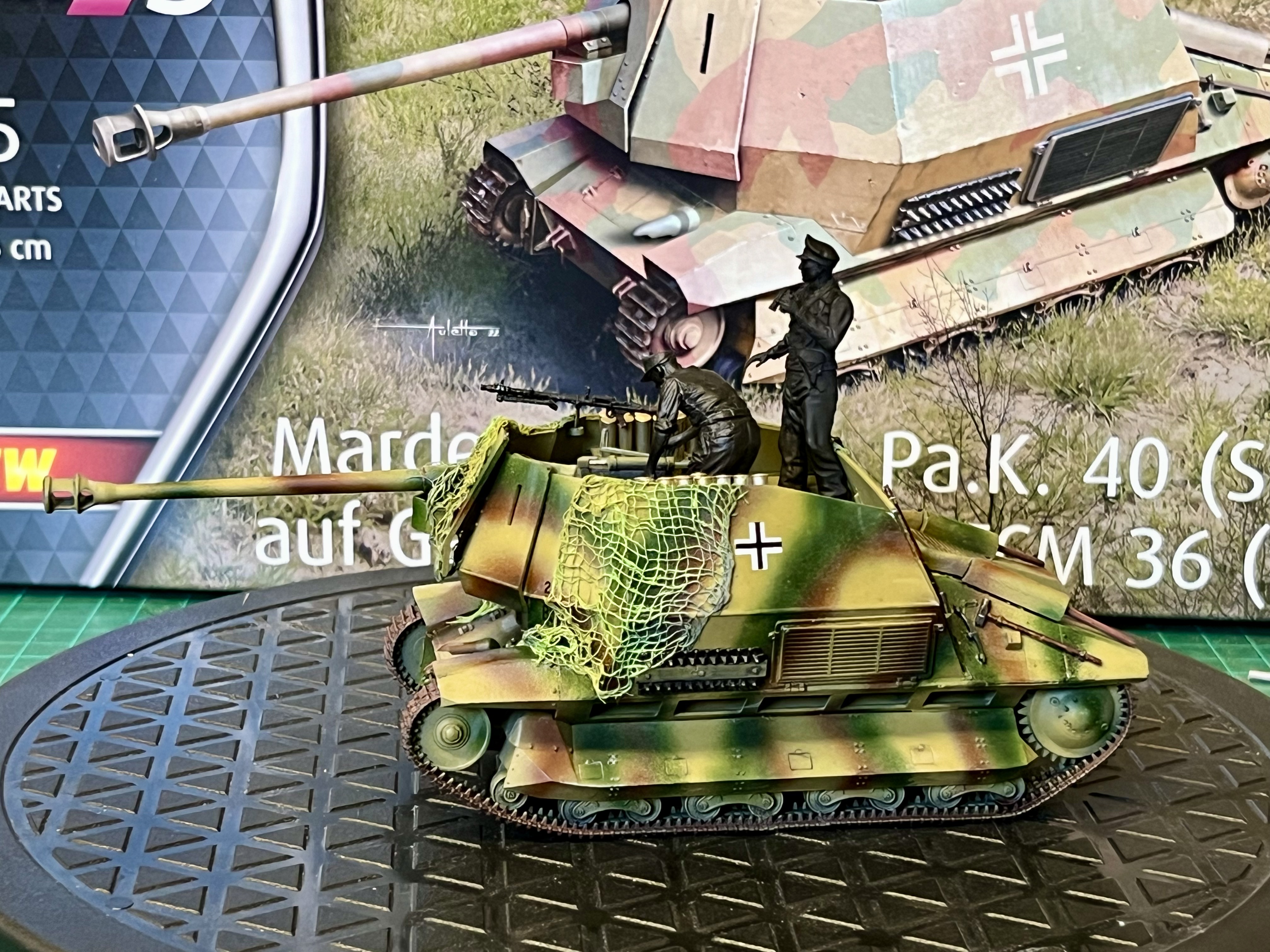
Next on the bench is an AFV I’ve never previously heard of. It’s a 1:35 scale Marder I by Revell, a few of which made an appearance in Normandy following D-Day 1944. 


I picked this up on my recent East of England tour from Trains4U in Peterborough. 


I’ve approached this build totally different from any other of my previous AFV models. I’ve decided to do no pre painting! 

Having completed the construction, I proceeded with my usual black primer. Then I built up the tri-tone camouflage. I always think it looks quite awful at this stage but knowing that the application of oils will harmonise the colours, I can’t wait to move on to this stage.  


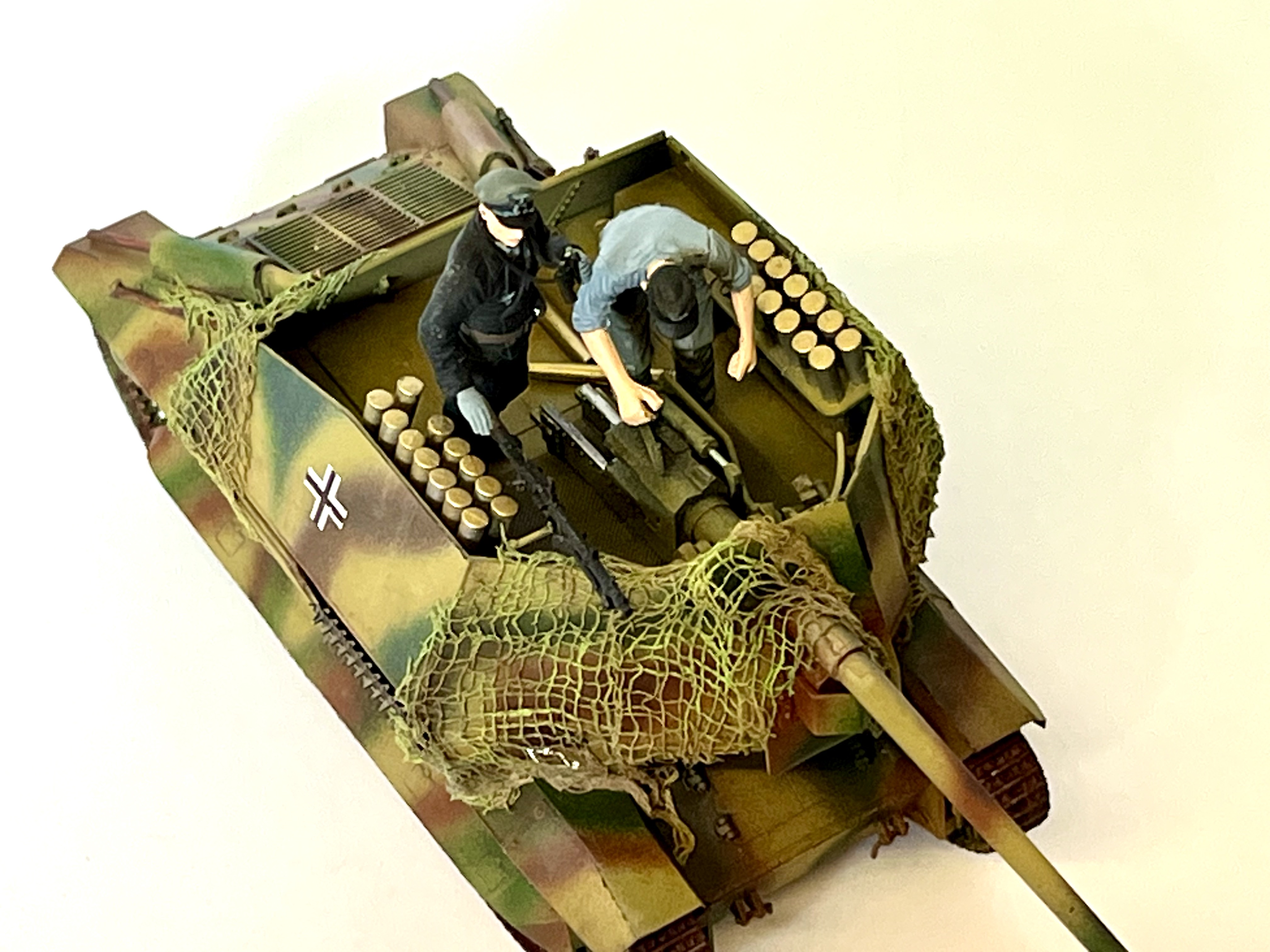
Work in progress on the Marder. I couldn’t resist adding a bit of camouflage netting and have found a couple of figures to bring the scene to life. I’m not sure that officer will last long putting his head that far above the parapet! 

I just need to give the figures some paint and dust weathering to the Marder.

I’ve finished this with Vallejo paints, Abteilung502 oils, AmmoMig Europe Dust and Liquid Pigments Rust Wizard, and added home made camouflage netting with figures depicting a German SPG Crew member from MiniArt and a rather brave officer from 3DGizmo.


This is Revell’s 1/35 scale Marder I, with a 7.5cm Pa.K. 40, of Sturmgeschütz-Abteilung 200 Art.Rgt.Stab z.b.V-931 based in Normandy, France on D-Day, 6th June 1944. One of the most unusual AFVs I’ve come across, not to mention built!


Wednesday, 23 August 2023

Train Busters - Hawker Tempest

This is the 2022 tooled Aifix kit A02109 - Hawker Tempest Mk.V which I’ve finished in the colours of JN751/R-B, the aircraft flown by Wing Commander Roland Prosper ‘Bee’ Beamont, when in command of No.150 Wing, Newchurch, Kent in June 1944 and the 1982 tooled and re-released in 2021 Revell 1:87 scale Schnellzuglokomotive, heavy express locomotive, BR 01 & Tender 2'2' T32.

The inspiration for this “dogfight double” was the picture “Train Busters - Hawker Tempest” painted by Roger H. Middlebrook which I came across while researching the idea of another train v fighter project I still have in plan! Having both the Revell and Airfix kit in my stash, it was just great fun being able to bring the two together. 

A bit of history:

Wing Commander Roland Beamont seems to have been a true British hero. He passed out as a pilot officer on 21st October 1939, flew Hurricanes of No.87 Sqn in France as part of the British Expeditionary Force and earned status of ‘ace’ during the Battle of Britain. He become part of Britain’s fledgling nightfighter force and at the end of his tour of duty took up a position as a production test pilot with the Hawker company. In July 1942, he returned to operational flying with No.56 Sqn and then given command of No.609 Squadron, both units operating the Typhoon. In 1943 he was charged with forming the RAF’s first Tempest Wing (No.150 Wing), used extensively in a home defence role and particularly in combating the V-1 ‘Doodlebug’ threat.


By 12 October 1944 Beamont’s second tour was completed and his replacement had already arrived. Unfortunately, 'Bee' was determined to complete one last sortie. At 1455 hrs he took off from the Wing’s post D-Day base at Volkel in Holland at the head of eight No. 3 Sqn Tempests, and in the Rheine area a stationary train was spotted. With little, if any, flak apparent, ‘Bee’ led them in one and then a second attack, and, totally out of character, and out of ammunition himself, he went on to lead the Tempests back in for a third time. His Tempest EJ710/JF-L (Beamont's own 'RB' aircraft - as I have depicted in my little vignette - was under repair) was hit in the radiator, and 'Bee' was forced to put down well inside enemy territory. Soon captured, he spent the rest of the war as a PoW. 

“Train Busters - Hawker Tempest” painted by Roger H. Middlebrook

Post War, “Bee” retuned to the role of Test Pilot with first flights of the Canberra, lightening, TSR2 and Tornado MRCA to his credit.


The Kits:


Thursday, 16 February 2023

Focke Wulf Ta152

Back after a long day ‘shopping’ at the Bovington model show, one of my purchases,  this Revell Ta 152, rolled off the bench yesterday. 

It’s a very simple kit, formed using Frog’s 1960s moulding, so detailing is minimal to say the least. Decals were beautiful and plentiful, though a little brittle. The red and gold band, for instance, was left on the backing paper, painting being a far better option to laying a mosaic of decal pieces! 


Built out of the box, sticking to the suggested scheme, I finished the kit in what I find to be a most unusual brown and green camouflage. Not sure I like it as much as the greys I normally associate with the Luftwaffe but I guess fighting over Germany, as this aircraft would have been, the colours fit well.

I find the biggest enjoyment in finishing a kit, after I’ve photographed it and flown it around the room a few times, is opening the stash boxes to work out what to make next!

Friday, 6 January 2023

SS-100 Gigant Transporter & V2

Revell’s SS-100 Gigant Transporter & V2 and 1/72 Special Armour’s A-StoManhänger "Liquid Oxygen Tank for V2 Rocket" mounted with a few British and German figures for effect. I acquired this unusual selection of kits from fellow modelling club member, Roy last year and it’s been really rewarding to complete something a little different. 


I’ve built and finished these complementary kits to reflect a moment during October 1945 when a total of 3 V-2 rockets were launched from a test site at Cuxhaven, Germany, by German POWs under the British supervision, into the North Sea as part of ‘Operation Backfire’. The explosive material in the warheads was steamed out and replaced with sand and for tracking purposes, these rebuilt missiles were painted in a black-and-white checkered pattern, similar to the early Peenemünde rocket schemes that were first tested 3 years earlier. 


In June 1945, General Eisenhower approved Operation Backfire, the British initiated Operation put forward by J. C. C. Bernard, A.T.S., Personal Assistant to Major-General Cameron, head of the British Air Defense Division. The objective of the Operation was to provide the knowledge and skills of guided ballistic missiles, to ascertain the German technique of launching long-range rockets and to prove it by performing an actual launch. Following the successful conclusion of the tests, the War Office in London issued a 5-volume report detailing these operations. Operation Backfire resulted in one of the most comprehensive evaluations and documentation of the total V-2 weapons architecture, not only by the Allies, but also the Germans!

If you’re interested in reading more, then check out this amazing article with photos and links to the 5-volume report. http://www.v2rocket.com

Saturday, 11 December 2021

Type II U-Boat

 My Type II U-Boat U20 is now complete. 

U20 was commissioned in February 1936 saw service first in the North Sea prior to being transferred to the Black Sea. In an attempt to avoid an overwhelming British presence around Gibraltar and throughout the Mediterranean U20 was broken into sections to be transported along the Danube to the Romanian port of Galați. She was then re-assembled at the Galați shipyard and sent to her new home in the Black Sea to serve with the 30th U-boat Flotilla against Russian shipping. 

She met her end, scuttled on 10 September 1944, in the Black Sea off the coast of Turkey. 

This 1:144 scale Type II is my second Revell U-Boat, the first being the 1:350 scale Type VII, both of which have been really nice to build, with what I think is some quality moulding and detail. I’m looking to use this in a B-24 Liberator diorama, so I’ve added a bit of poetic licence in applying an Atlantic colour scheme.

Friday, 10 December 2021

Type VII C U-Boat

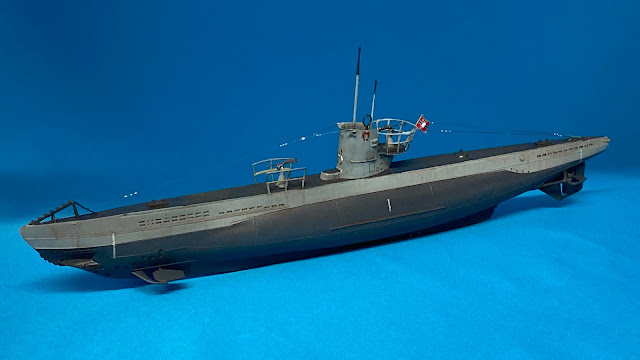
My Type VII C U-Boat is now complete. This is U-96 as it was when it fought in the Atlantic between 1940-43. It met its end when it was sunk on 30 March 1945 at Wilhelmshaven by bombs during US air raid. 

During autumn 1941, war correspondent Lothar-Günther Buchheim joined U-96 for her seventh patrol. This experience was the basis for his 1973 bestselling novel Das Boot, which was adapted into the 1981 Oscar-nominated film.

The kit is Revell’s 1:350 scale which has some lovely detail considering its small size. I now need to decide if to use this or its 1:144 scale cousin in my B-24 Liberator diorama.

Tuesday, 17 August 2021

A Year's Scale Modelling Diorama

It's been a year now since I removed my old Scalextric track in the loft from its baseboard so as to showcase some of my 'lockdown' builds, and having now completed my latest diorama, the RAF Airfield from Autumn 1943, I can't believe I have finally run out of space! 🤦‍♂️


It has been suggested that there may be opportunities to display one or two of these at model shows etc, but how I not only cut them into their respective scenes, let alone bring them down from the loft, is somewhat perplexing me! 🤷‍♂️


I have, however, seen some folk building smaller dioramas, which I understand are called vignettes, using old picture frames, such that I may now have to do a tour of the house to see which pictures I can repurpose!🤭😂

Suggestions welcomed!

Spitfire Squadron - Part 4

Spitfire Squadron … Part 4

It’s finally time to reveal the date of my diorama, a season and year which can be derived from perhaps an unusual source; the RAF vehicle paint scheme and I have to thank Mike Starmer on the Airfix Tribute Forum for this following factoid: 

1937 RAF vehicles were officially RAF Blue Grey BS.33 
1939-40 vehicles in France and Southern England were painted brown and green as used for building camouflage.  
1941 August (AMO 618/41) the RAF fell into line with army’s Khaki Green with Dark Tarmac stripe disrupter. 
1942 December (AMO 1397/42) changed to SCC2 Brown with SCC1A British Brown disrupter in a 'Mickey Mouse' design. 
1943 October changed the disrupter from SCC1A British Brown to SCC14 Black with the same 'Mickey Mouse' design.  
1944 September change to an overall SCC15 Olive Drab paint scheme.
1946 (AMO 306/46), following the end of the war, changed the scheme back to Gloss RAF Blue Grey

As the majority of the RAF vehicles are in the brown and black wavy 'Mickey Mouse' design and none are in Olive Drab it is at least October 1943 and no later than September 1944, and as I opened sating it was between 1941 and 1943 and the trees have autumn leaves, it has to be between October to November 1943!

So, what else is going on this RAF Airfield in Autumn 1943?

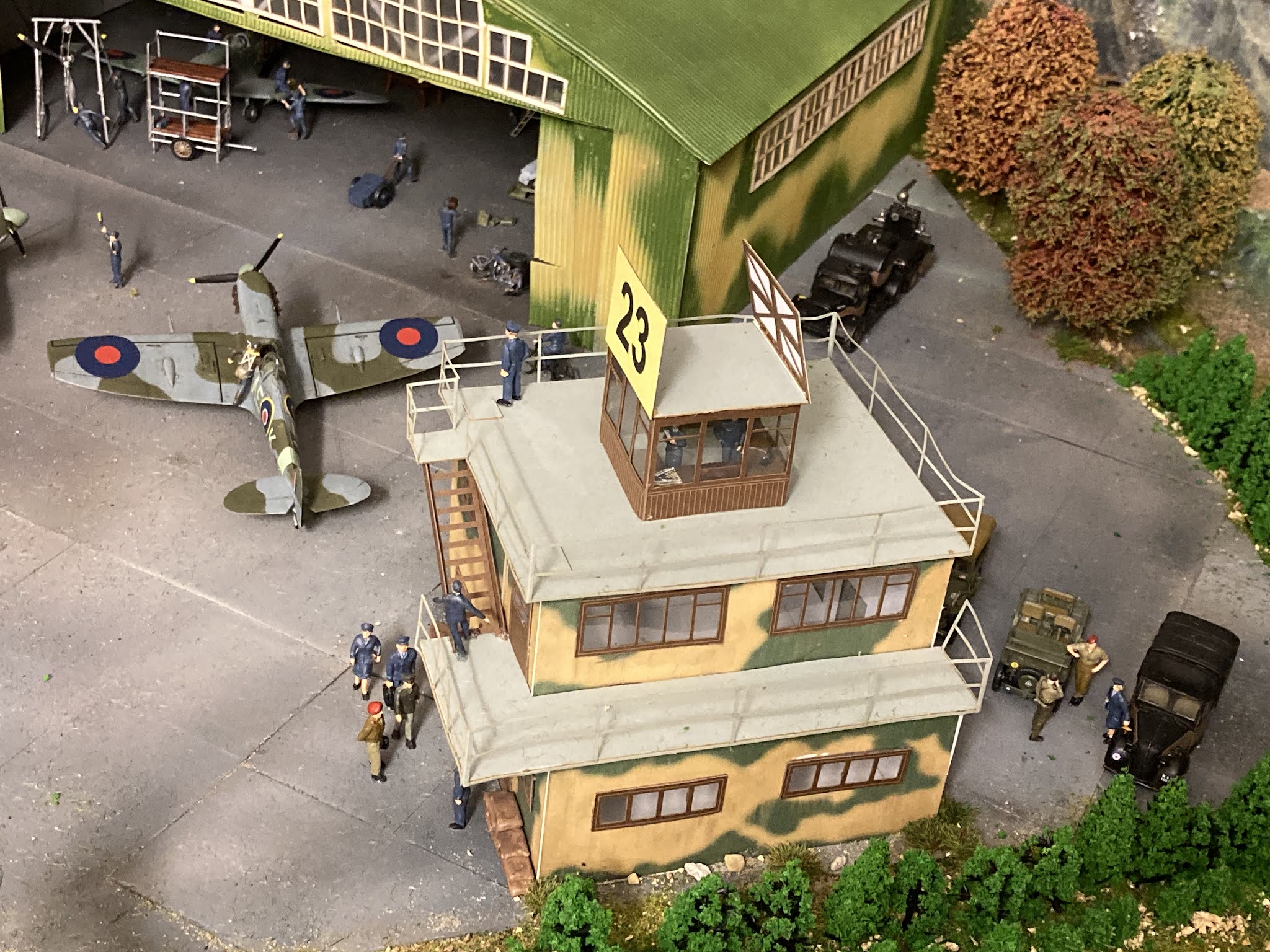
Beyond the control tower, there are parked up 3 vehicles. There is no surprise to see an RAF Standard Tilly, but the presence of the two Jeeps is intriguing. 


One is from the British Army 6th Airborne Division and the other the US Army 4th Divisional HQ. The 3 drivers, now deep in conspiratorial conversation, have just delivered their respective military leaders to the control tower, where they they are now being escorted within, to collaborate in vital D-Day planning! 


Spitfires, like the fighter‐bomber equipped Mk.Vc in front of the hanger, went on to provide essential air support for the D‐Day landings. Around 55 squadrons of Spitfire participated in the invasion of Normandy, between 5 to 7 June 1944, carrying out ground attack missions; perhaps the most famous occurring after the D-Day landings, was on 17 July 1944 when General Rommel himself was wounded in an attack by a Spitfire fighter.


There was much fear during this period of 5th Columnists and Nazi spies. While in reality, and backed up by Ben Macintyre’s excellent book ‘Agent Zigzag’, these fears were mostly unfounded, however, towards the rear of the airfield, you’ll see a spy cornered by 3 RAF Police officers, who, with the high profile visitors on the base, are taking no chances! In Ben Macintyre’s book, the British double agent Eddie Chapman is dropped into England during early 1943 to blow up the Mosquito factory on the outskirts of London; so there was certainly a desire on the part of Germany to use such spies to disrupt the British war effort.


In October 1941, with the Luftwaffe now concentrating on the Russian front and air raids on Britain lessening, so did the need for anti aircraft defences, however, the presence of senior military leaders on the base also has the Bofors 40mm Anti Aircraft gun and crew, repurposed from a my North African campaign collection, scanning the sky for a surprise Luftwaffe attack.


Finally, did you spot the set of camouflaged De Havilland Vampire wings at the back of the hanger? 


I had these left over from a previous build so thought I’d drop them in for fun, as the prototype of this single jet engined DH.100 De Havilland Vampire, Britain’s second jet fighter code named ‘Spider Crab’, conducted its maiden flight from Hatfield Aerodrome on 20 September 1943. 


Although it didn’t actually enter service until a few months after the War, it did go on to be adopted as a replacement for many of the wartime piston-engined fighter aircraft, such as the Spitfire. 


I hope you’ve enjoyed my take on this post Battle of Britain, pre D-Day airfield, and the backstories to the various scenes.


The End


BLOGGER IS DEAD LONG LIVE FACEBOOK & INSTAGRAM

It's been a blast Blogger, but not being able to upload any photos of my builds to this blog really makes you meaningless going forward....