Showing posts with label Malaya. Show all posts

Monday, 25 September 2023

Malayan Emergency Casualty Evacuation (1955)

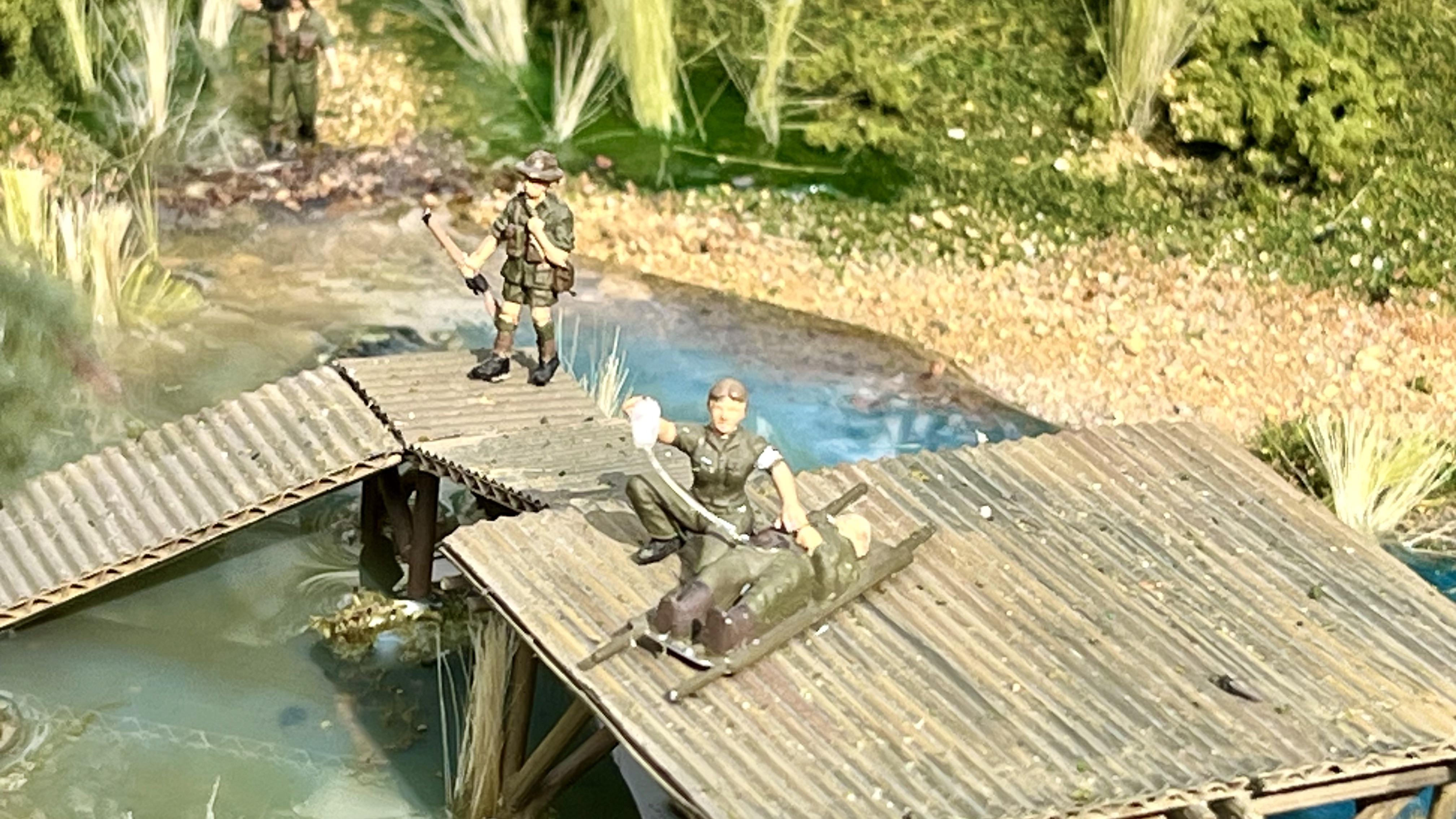
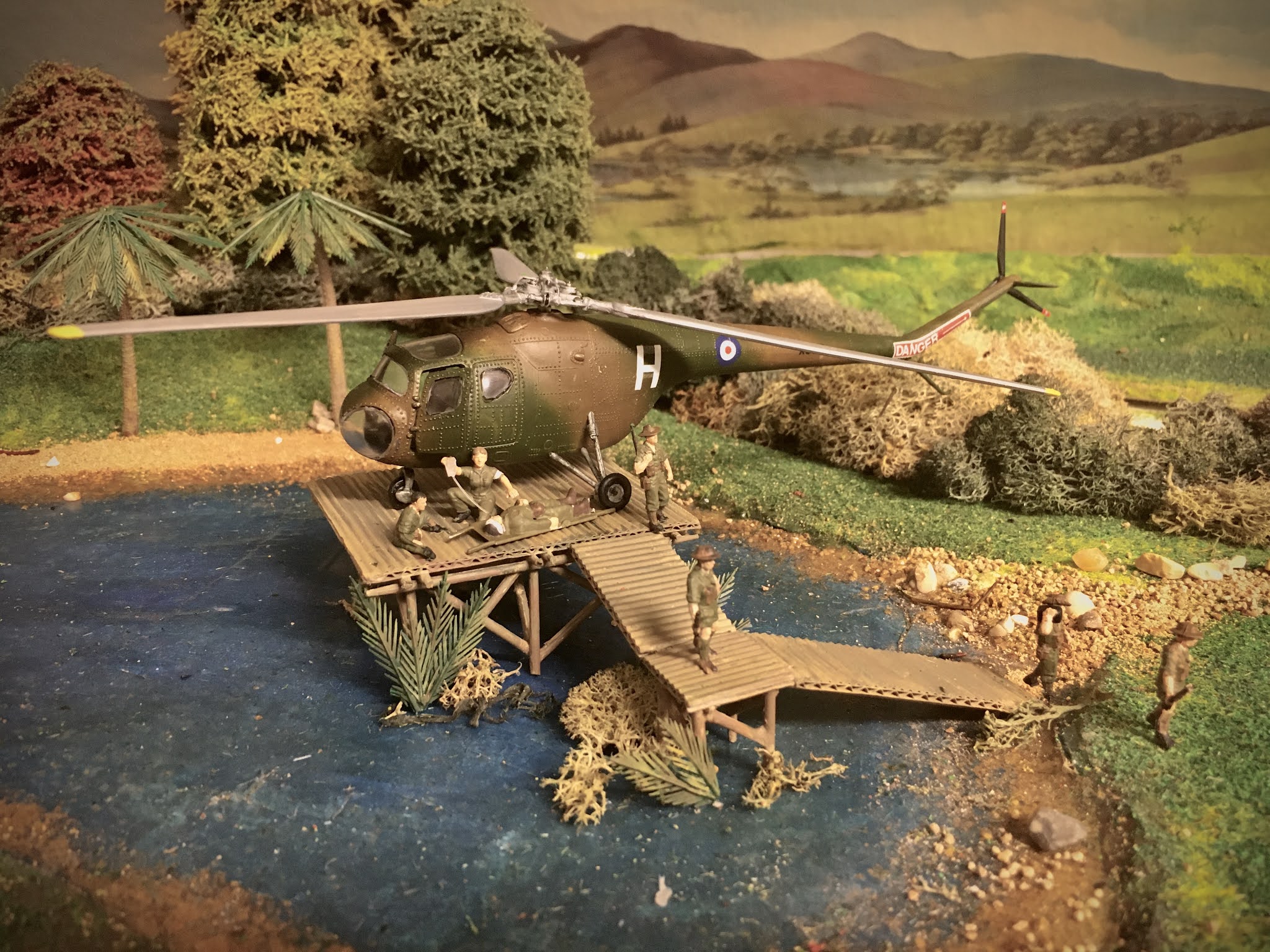
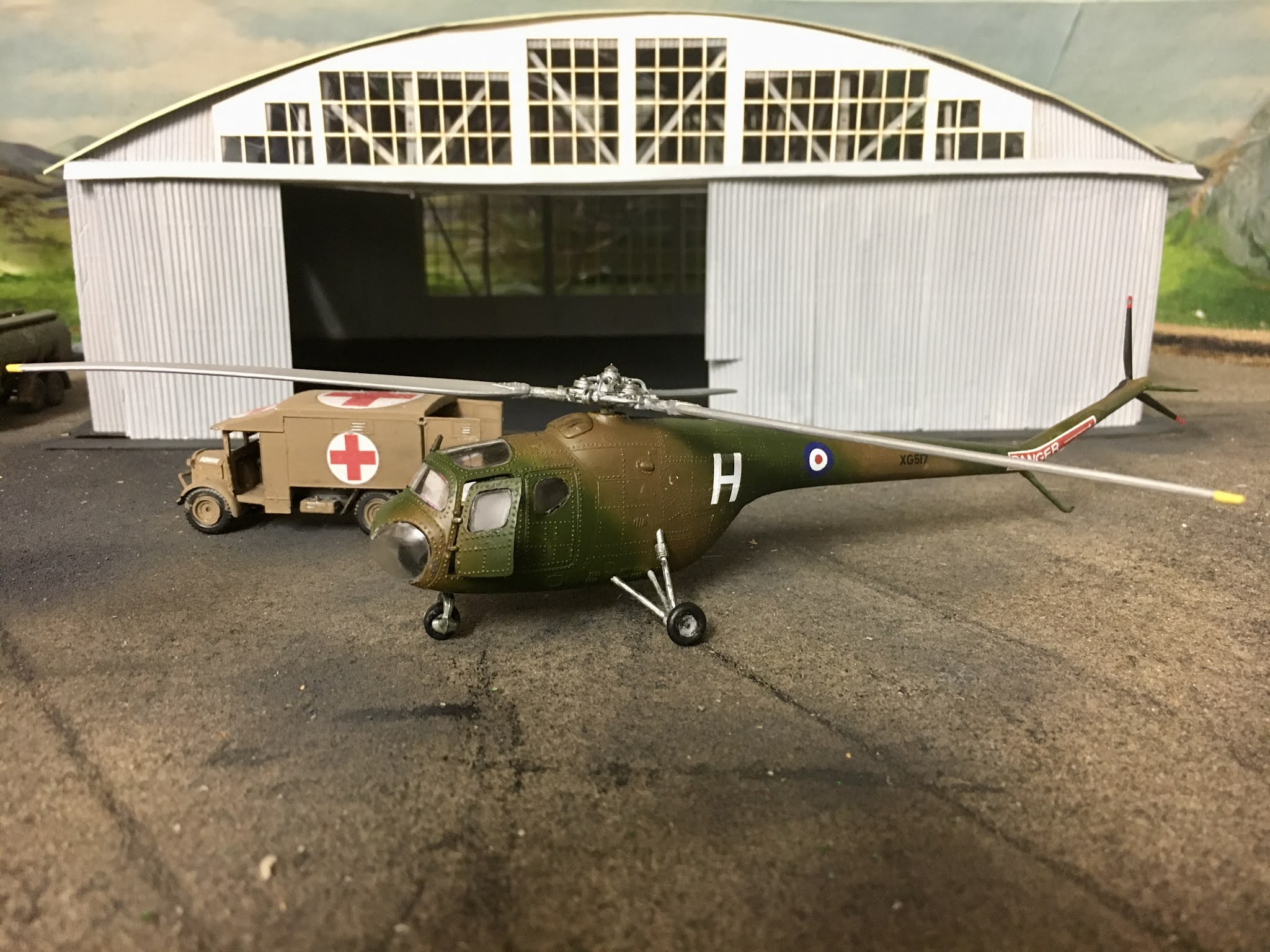
When in 2020, I built Glencoe Model's Bristol Sycamore, I placed it in a jungle casualty evacuation scene set during the 1950s Malayan Emergency. My focus then was on the model and the historical backstory that was more important to me than the diorama I created to display it. After 3 years exposed to modelling fumes and paint spray in the loft, time had taken its tole on both diorama and model. Had it not had such historical and emotional connection, and with a new project in the planning and space being a premium, I would have just 'black bagged' it - a fait already met by my early Vietnam, Korea, and Falklands dioramas! 

Having a plan for a new epic diorama, I thought refreshing this old Malayan scene, keeping true to my original vision but applying skills honed over the past few years - this one having been my first ever proper scale modelling diorama - would give me some much needed practice. 


I dusted down the old diorama clearing all the loose foliage and figures and built my own wooden frame in which to both display it and to give it extra strength, its original base having been just cardboard glued to a larger 'multi diorama' base.


As well as giving the land a new layer of grass and a good covering of undergrowth, I 'borrowed' trees from my Pegasus Bridge diorama - it will be due its own makeover in a year or so - and dug out an old bottle of scenic water. I got a bit carried away with the water, adding a feeder river to my lake, which on reflection probably adds a bit more realism to the scene.


I strategically placed reeds around the new river and dusted off the figures. I didn't think they looked too bad for their years, so left them with their original paint. 


The old Sycamore model was also looking OK to my eye. Yes, if I were building it today, I'll have added a bit of weathering but I was keen to keep it as original to my 3 year old self and so just gave it a clean.


When doing a little more research on the period I came across this picture of a Westland Whirlwind ... 


 .. so as I hast happened to have a Whirlwind in my collection, thought why not!

Finally, here's a little video to complete the project ...


I now feel suitably ready to move on to the next one :) 


Saturday, 9 July 2022

Beaufighter TF.10

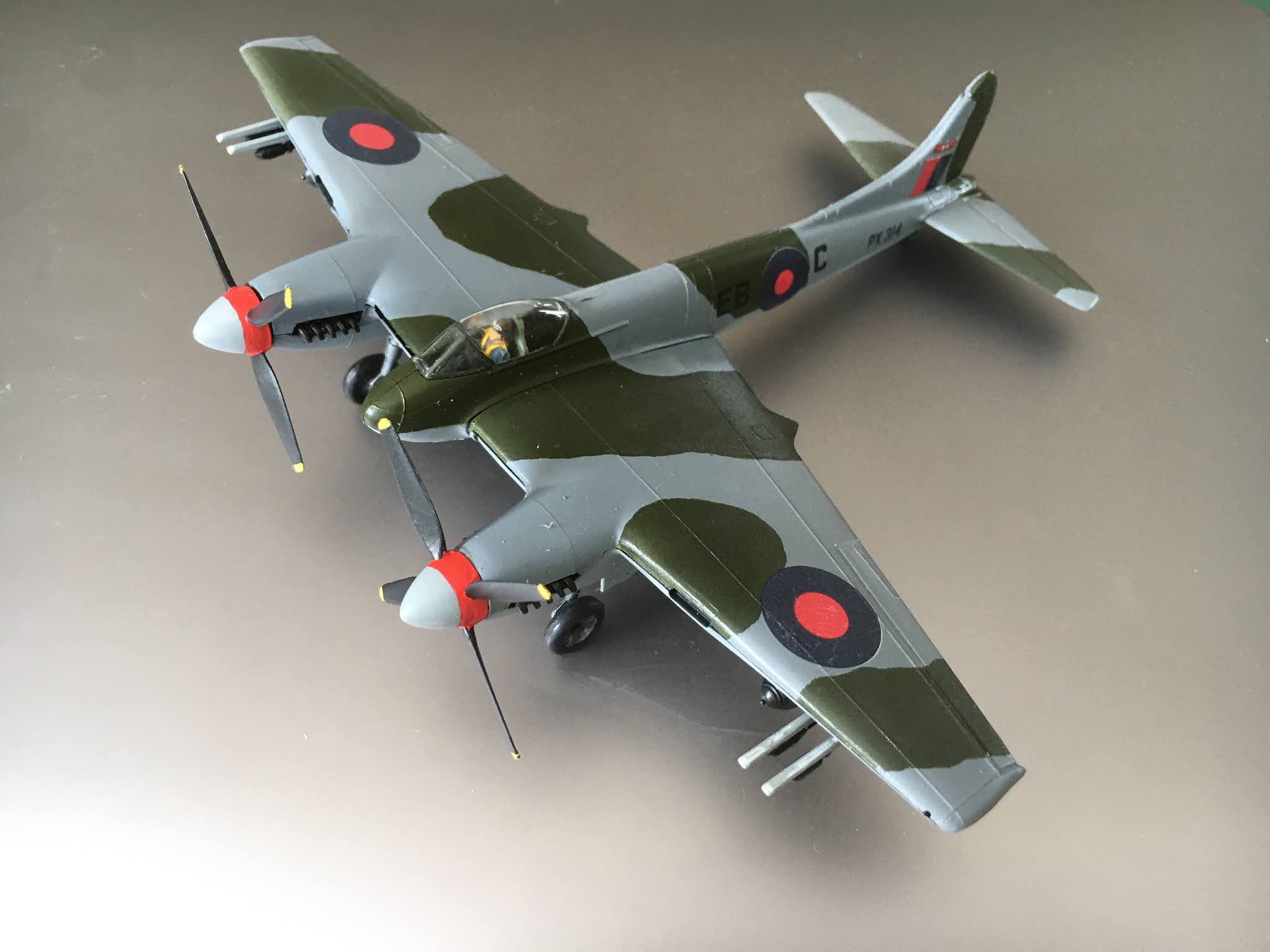
After a couple of whirlwind days modelling, my 1:72 scale Beaufighter TF.10 is just about ready for tomorrow’s Somerset show. 

This is the Beaufighter which flew with No.45 Squadron, RAF Kuala Lumpur, Malaya, during “Operation Firedog”, late May to early December 1949. 

Its role was to provide ground support to the British and Commonwealth forces engaged in a guerrilla war with the communist pro-independence fighters of the Malayan National Liberation Army. 

This Airfix kit is a dream to build, with every part fitting beautifully and being the new moulding, there was only minimal need for filling and sanding. My only complaint would be the tyres, which I should really have taken more time over to fill the rather obvious centre seams and add some tread, but I’m out of time now so may revisit them another time. 

Wednesday, 5 August 2020

Bristol Sycamore HR.14

I was asked when I first started this scale model building project whether I'd ever constructed any helicopters. To my memory, there can only have been one or two, and one would have been James Bond's gyrocopter! ... Does that count? For some reason they have never captured my imagination as much as aeroplanes, that is until now, as my 20th model of lockdown begins with not just one, but a flight of whirly-bird creations and has kindled a new fascination with this most versatile of aircraft.

"Hot Lips" Houlihan delivers aid to a casualty

My first helicopter build is also one of Britain's, the Bristol Sycamore HR.14, the first practical British helicopter to enter production.  It took me quite a while to locate this kit, owing to the fact that, just as with my de Havilland Hornet, no one has produced it for a very long time. I finally purchased a 1991, Glencoe Models kit from a private seller for rather more than was really sensible. Glencoe Models, who I've not come across before, was created by Nick Argento in 1987, with the aim to reissue many classic model kits from earlier years and were the last company to release the Sycamore.

The instructions were sparse but the kit went together relatively cleanly, and the decals provided worked surprisingly well. It did, however, come with a pre-cut hole in its underside for a stand. This must have been a feature of the original moulding that Glencoe acquired, although they themselves chose not to provide the stand! Had I a tube of filler to hand, I would have sealed it up, but as it's hidden beneath and I have no plans to hang it from my ceiling, I left it alone. I also attempted my first ever blended airbrush camouflage which I think turned out OK. 

From my Dad's Photo Album!

The camouflage scheme applied was that used on the Sycamores when first supplied to the RAF during the Malayan Emergency. The above black and white photo of a Sycamore, snapped by my Dad while serving in Malaya with the army was no help with this, but it was behind the passion to secure and build the model. I have read many a publication from the time, stating that finding a sufficient clearing in the jungle to land even a helicopter was close to impossible, so specially built platforms had to be erected over obstacles, and landing strips had to be cleared in forested areas by machete. I, therefore, decided to build a Malayan diorama with a precipitous landing platform over a typical mosquito infested lake to showcase my model. Also, as the primary purpose of the Sycamore was to airlift wounded soldiers from the combat zone, I added a larger than life, MASH inspired "Hot Lips" Houlihan to the scene. If you look closely you'll see her providing plasma to the casualty laid out on the stretcher prior to be evacuated by the helicopter!

Back at base delivering the casualty to the ambulance

-----

My helicopter's backstory ...

Although Leonardo de Vinci had dabbled with the basics of rotary flight in the eighteenth century, the lack of any practical propulsion put a stop to it becoming a reality. That was until the Russians, led by the likes of Igor Sikorsky, finally cracked the problem in the late 1930s. Although Sikorsky later moved to America, Russia has interestingly always been ahead in helicopter technology.

Meanwhile, in Britain, the Royal Navy were well ahead of the RAF in recognising the possible use of the helicopter and even placed an order with Sikorsky for 240 of their R-4Bs, or Hoverfly MK1, during the Second World War, but with the end of hostilities this was cancelled. The RAF then took delivery of a small number of Hoverflys for trials and one was even used to deliver urgent mail to the Queen at Balmoral! With the acute post war shortages they were returned to the US in 1950 when parts became too scarce to keep the Hoverflys in the air. 

Bristol Sycamore  "... taking a casualty to hospital"

It was the challenging terrain found in Malaya during the Malayan Emergency which brought to the fore the necessity for a more versatile aircraft. The Chiefs of Staff were first informed in early March 1949 that operations were being hampered by the length of time it was taking to evacuate casualties. With two thirds of the country consisting of dense, mountainous jungle, almost to the beaches, there were too few accessible landing strips, resulting in missions having to be frustratingly curtailed in the event of a casualty. The helicopter not only had the ability to land in tight spaces, its presence also brought a major boost to the moral of soldiers, who knew they would have a quick way out of the jungle should anything untoward happen to them.

Artist impression of the Sycamore evacuating a casualty

The first RAF helicopters to arrive were Dragonfly, one of which was used to undertake their first Casualty Evacuation Flight on 14th June 1950, some weeks ahead of the first American sortie in Korea using their H-13 Sioux helicopters. The Sycamore entered service in 1953 and in just 3 years had replaced the Hoverfly as the RAF's primary casualty evacuation helicopter. The Sycamore was a much improved design with side by side seating for the crew and space for 2 stretchers in the rear.

In October 1964, RAF Squadron were re-equipped with Whirlwinds, resulting in the withdrawal of the Sycamore from front-line service.

Finally, you couldn't make this up, but similar to my last model, the Hornet, Biggles again enters the scene! In two derivative Biggles action comics, the Sycamore makes an appearance ... first, in the Pyrenean Manhunt, an international gang of diamond thieves kept a Sycamore helicopter which they intended to use as their getaway vehicle and then in the Rescue Mission, a Sycamore comes to pick up Biggles and Ginger after they've rescued General Sir Robert Hordern.

Biggles in the Rescue Mission


---

The model

Make: Glencoe Model
Model: Bristol Sycamore HR.14
Scale:1/65 Marketed as 1/72
Item Code: 04001
Year of Release: 1992

Sunday, 26 July 2020

de Havilland D.H.103 Hornet

With the last of my photo reconnaissance Spitfires having unexpectedly flown us out to the Far East and into the opening years of the 1948-1960 Malayan Emergency, I've had the opportunity to uncover a number of very interesting aircraft and factoids from this period which I am now dying to share with you. We will, therefore, be hanging around in Malaya for a few more weeks yet, as I unveil new builds with hopefully interesting backstories of firsts, lasts and intriguing random factoids.

For build 19 of my Lockdown Scale Modelling Project, I’ve selected a kit almost as vintage as the aircraft itself. This is Frog’s 1971 model of the de Havilland D.H.103 Hornet. Frog was a well-known British brand producing model kits between the 1930s to 1970s. Launched in 1932, they created the world’s first kits made from cellulose acetate. Polystyrene models were then introduced in 1955 and by the 1970s, Frog's catalogue included a large number of lesser-known aircraft types only to be manufactured by the company; such as this Hornet. The last Frog-branded kits were produced in 1976, whereupon many of the Frog moulds were sold to the Soviet Union to be marketed under the Novo name. 

It was a real experience constructing this model. The instructions were considerably less detailed than today’s kit modellers would expect to find and in a musty condition that would not have been there when new! The decals also required quite some tempting to remove from their backing paper and liberal quantities of Decalfix fluid to soften and affix them to the finished model. 

In finishing the build, I've tried a new painting technique, replacing my brushes with an airbrush and marking out the camouflage pattern with masking fluid. It was a challenging and lengthy process and only time will tell if I attempt it again! 

My Frog 1:72 scale de Havilland D.H.103 Hornet

The de Havilland D.H.103 Hornet, the forgotten successor of the very successful de Havilland Mosquito. While the Mosquito took multiple leading roles in World War Two and then went on to star in its own book and blockbuster film, 633 Squadron, the Hornet arrived too late to take up its intended role and was then quickly withdrawn from service on the arrival of the jet era. 

The de Havilland Hornet represents in many ways the peak of piston engine fighter design. With its slim fuselage, clean lines and tightly cowled engines, great attention was paid from the outset on maximising performance.

The original de Havilland D.H.103 Hornet

The Hornet prototype (RR915) flew for the first time on 28th July 1944. Powered by a pair of 2,070 hp Merlin engines driving opposite-handed propellers for increased stability and handling, it could reach an astonishing maximum speed of 485 mph at 22,000 ft, making it the RAF's fastest ever propeller aircraft.

Two main marks saw service with RAF Fighter Command: The F Mk 1 and the F Mk 3 with the latter (my model) having an increased fuel capacity and a large dorsal fin. For its standard armament it had four 20mm cannon in the nose and then an option of rockets, bombs or 200 gallon drop tanks carried under the wings.
 
It was conceived for operations in the Pacific Theatre against the Japanese, however, the conflict had ended before the aircraft reached operational status. It first saw combat in 1951, when Hornets were redeployed from Fighter Command to the 33, 45, 64 and 80 squadrons of the Far East Air Force (FEAF) to support ground security forces in operations against Communist guerrillas during the Malayan Emergency. The Hornets replaced the Bristol Beaufighters and Supermarine Spitfires that had been operating in Malaya since the outbreak of hostilities in 1948. With their long range and good endurance, they were able to spend hours loitering over a given target area, a key attribute when target identification was often very challenging and time consuming. 

de Havilland Hornet refuelling at RAF Seletar, Singapore

The Hornet proved to be very reliable; 45 Sqn Hornets, based in Singapore, achieved a total of 4,500 operational sorties over their five year tour of duty, more than any other squadron in the FEAF. However, with the evolution of longer-range jet-powered fighters such as the de Havilland Vampire, de Havilland Venom and Gloster Meteor, the Hornet became obsolete fairly quickly and on 21st May 1955, just as with the Spitfire a year earlier, the Hornet flew its last RAF operational sortie; another last flight of an RAF aircraft during this Malayan Emergency.

Sadly, the Hornet also had an Achilles heal. The glue which de Havilland used to bond its plywood skins proved susceptible to breaking down in the high heat and humidity of the tropics. The resulting de-lamination problems, coupled with termite issues have resulted in there being no complete examples of the Hornet remaining in existence today. However, remains of a de Havilland Sea Hornet, the aircraft carrier version as used by the Navy's Fleet Air Arm, was discovered in 2016 dumped on the edge of a Canadian airfield, and is now in the process of restoration in New Zealand. If it gets to fly, this will be one very rare aircraft.

While its predecessor, the Mosquito, appeared in that book made famous by the big screen, it is possible that the Hornet may have its own literary claim to fame by being flown by none other than Biggles!


Le Cygne Jaune

In Le Cygne Jaune, a 1946 Biggles graphic novel by W. E. Johne, illustrated by Francis Bergèse, the Second World War is over and Air Commodore Raymond urgently persuades Biggles, Algy, Ginger and Bertie to join a special unit at Scotland Yard specialising in crimes committed with aircraft. 

Spur prototype?

To intercept airborne criminals, Biggles takes delivery of a Spur prototype which is still undergoing tests. The aircraft was a twin engined, advanced high performance, long-range fighter which was only prevented from making history by the termination of the war. Sound familiar? 

While the Spur is, of course, a fictional aircraft, as Johns needed an advanced, late war design, it is not surprising that Francis Bergèse's Spur looks so much like that of a real Hornet!

Bergèse's remarkable attention to detail

This scene at Croydon Airport shows Bergèse's remarkable attention to detail. With Croydon's apparently famous control tower, a Mosquito on the left and the Spur ... or may be a Hornet ... on the right!

---

The model:

Make: Frog 
Model: DH Hornet F.Mk.3 Long Range Fighter
Scale: 1:72
Item code: F239
Year of Release: 1971


BLOGGER IS DEAD LONG LIVE FACEBOOK & INSTAGRAM

It's been a blast Blogger, but not being able to upload any photos of my builds to this blog really makes you meaningless going forward....