Showing posts with label Italeri. Show all posts

Friday, 11 April 2025

LVT-4 Water Buffalo

Next in the bench is that Water Buffalo I picked up from Crewkerne Models a couple of weeks ago.

Such an unusual vehicle!

It is however another Italeri. Same soft plastic as the ‘Fury’ Sherman, equally erratic instructions and this one needs some SERIOUS tape to mould it into shape! 


Making progress with the LVT-4 Water Buffalo!

The kit itself is is a bit hit and miss for a 2000 tooled mould but I think the main issue for me is Italeri’s softer plastic which seems to suffer from warping, the need to drill out some of the holes and a less accurate fit. Italeri have unusually for them, added large pieces of PE for the machine gun pods. Although these add a bit of crispness, I’m not sure they are really necessary considering the lack of detail elsewhere. 
So, you’ll note that I’ve progressed to that favoured position of having it black primed ready for the Olive Drab and detailing. 


Oh yes, one final observation. This comes with no crew nor even hatch openings for the driver, so having seen archive pictures of them carrying SAS Jeeps across the Elbe in April 1945, I’m going to lay my hands on one of those nice Tamiya Jeeps to add to the finished build 

All now ready for some weathering and that SAS Jeep, which I’m looking forward to picking up from Crewkerne Models on Friday! 
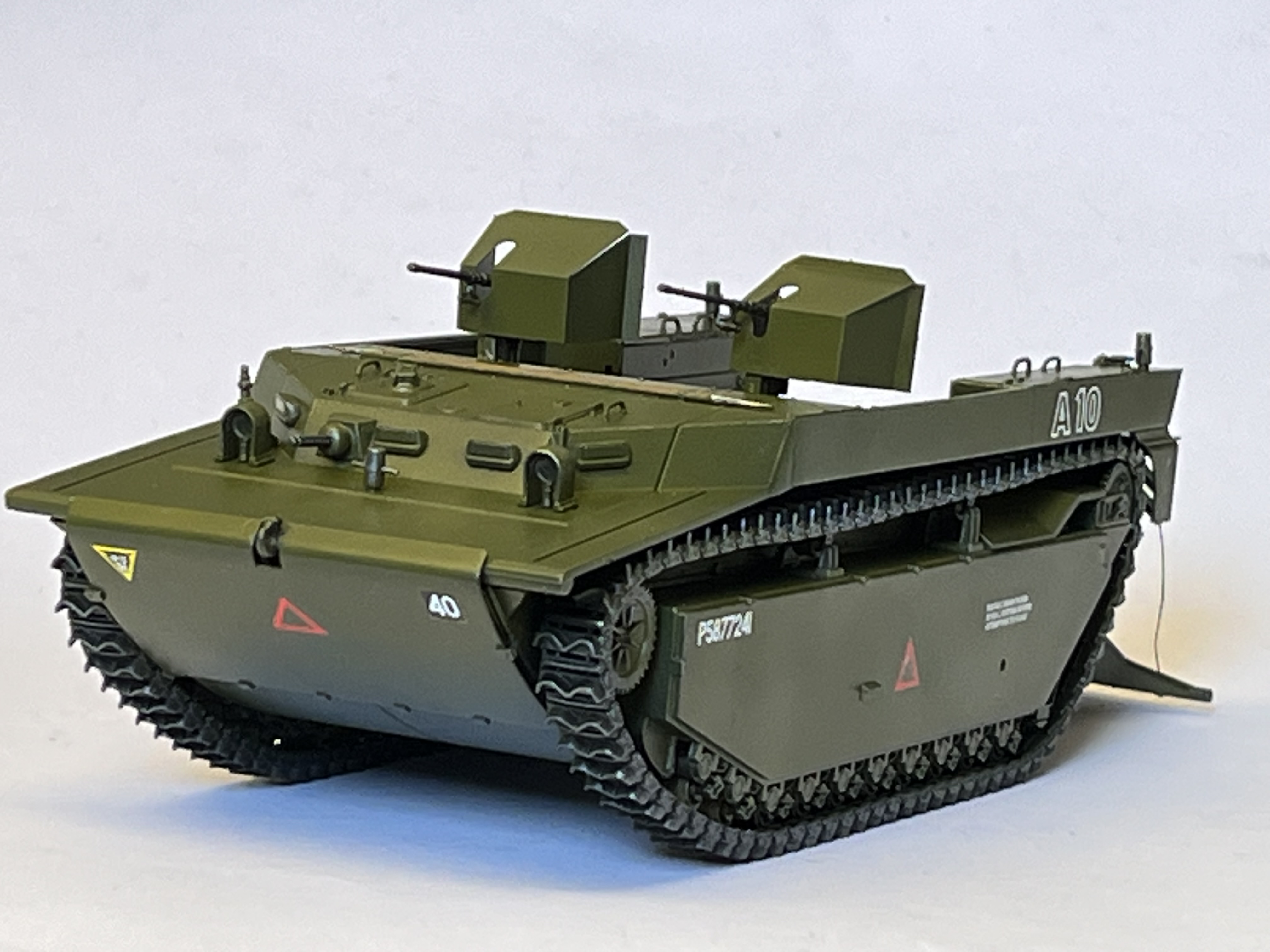
I first primed this in SMS Surfacer Black followed by SMS Premium US Olive Drab. These paints are fantastic to airbrush, if not a bit smelly! Detailing has been completed with my go to Vallejo acrylics.

Tamiya’s SAS Jeep and Gecko Models British drivers (soon to join the SAS) for my Water Buffalo crossing of the Elbe, now acquired from Crewkerne Models and construction under way!


Water Buffalo, SAS Jeep and troops united. Now finally time for that weathering! 


Italeri’s LTV-4 Water Buffalo, Tamiya’s SAS Jeep and a couple of Gecko Models British Army drivers now complete this 1:35 scale ensemble. 

This finished look was inspired by a photograph of an SAS jeep sitting inside a Buffalo amphibious landing craft before the crossing of the Elbe on 29 April 1945.


It’s a shame the Jeep is now hidden in the Buffalo as there’s so much additional detail on it  that we’ll never now see … BUT … I know it’s there.

SMS paints were sprayed for the large areas, including the final mat varnish, Vallejo paints were used for brush painting the figures and detailing and Abteilung 502 oils for the weathering.


Tuesday, 25 June 2024

P-38J Lightning

The Italeri P-38J Lightning finished to depict “BAMBI” of 55th FG 338th Fighter Squadron in its D-Day ground attack role.


I’ve painted a set of July 1944 invasion stripes and had to quite a bit of cutting and filing to rework the undercarriage flaps to go for the wheels up config as one of my scale modelling buddies, mr.airfox asked for.

The undercarriage and wheels are actually very nicely moulded but in order to avoid the inevitable tail sitter issues this will be mounted on a stand. 

As I’ve messed with Italeri’s plans to have their kit  finished with undercarriage lowered, I’m not now going to be able to display their lovely detailed cockpit interior with open canopy as many others have done.  An aircraft in flight, after all, has to have a pilot so I’ve had to raid my spares box! 


It looks good and sleek in the painted plastic but difficult to really see its beauty on its stand. I fitted drop tanks as just after D-Day Allied planes were still flying the channel as airfields were built and just check out those rocket launchers!

Tuesday, 24 October 2023

M113 APC

Italeri’s 1:72 scale M113 finished as one of the Australian Army APCs involved in the battle of Long Tan, 18 August, 1966. 

These M113s were in far from the best condition and so I’ve painted a layer of rust over the standard green paintwork. I think it looks better in the metal than in these photos. 

I’ve also added 3 Modelu figures depicting a moment of reflection post battle. 


Saturday, 22 July 2023

Vespa 125 Primavera

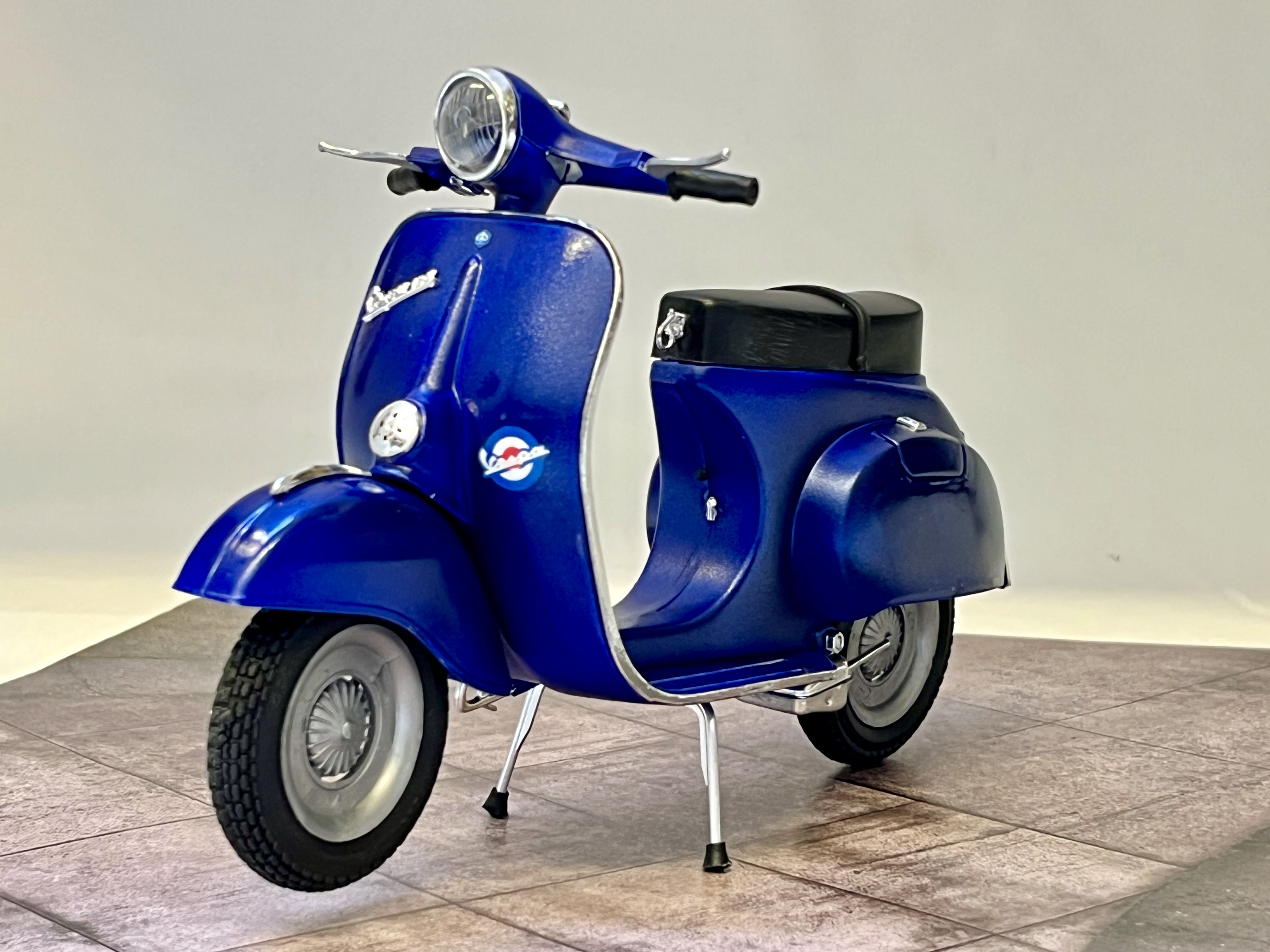
 Against the odds, I’ve just completed Italeri’s 1:9 scale Vespa 125 Primavera. 

This was “against the odds” as not only did Italeri’s instructions assume I knew more about the Vespa’s construction than I do, I had to perform a repair to the steering column, using a thick piece of sprue, fuse wire and a bomb casing from the spares box, as a major section had failed in the moulding process. 

I’ve never had the patience of many nor probably the required dust free environment to spray a showroom gloss finish, but that aside I’m liking the way Vallejo’s metallic arctic blue has performed and how it sparkles as I remember 1980s metallic paint did, in the sunlight. 

This very different build for me is a homage to my formative years and a project which has been a perfect refresh, giving me more than a few modelling challenges to complete!


-------

The Kit

Brand:       Italeri
Title:         Vespa 125 "Primavera"
Number:    4633
Scale:        1:9
Type:         Full kit
Released:  2019 New parts


Sunday, 16 July 2023

F-35 Lightening II

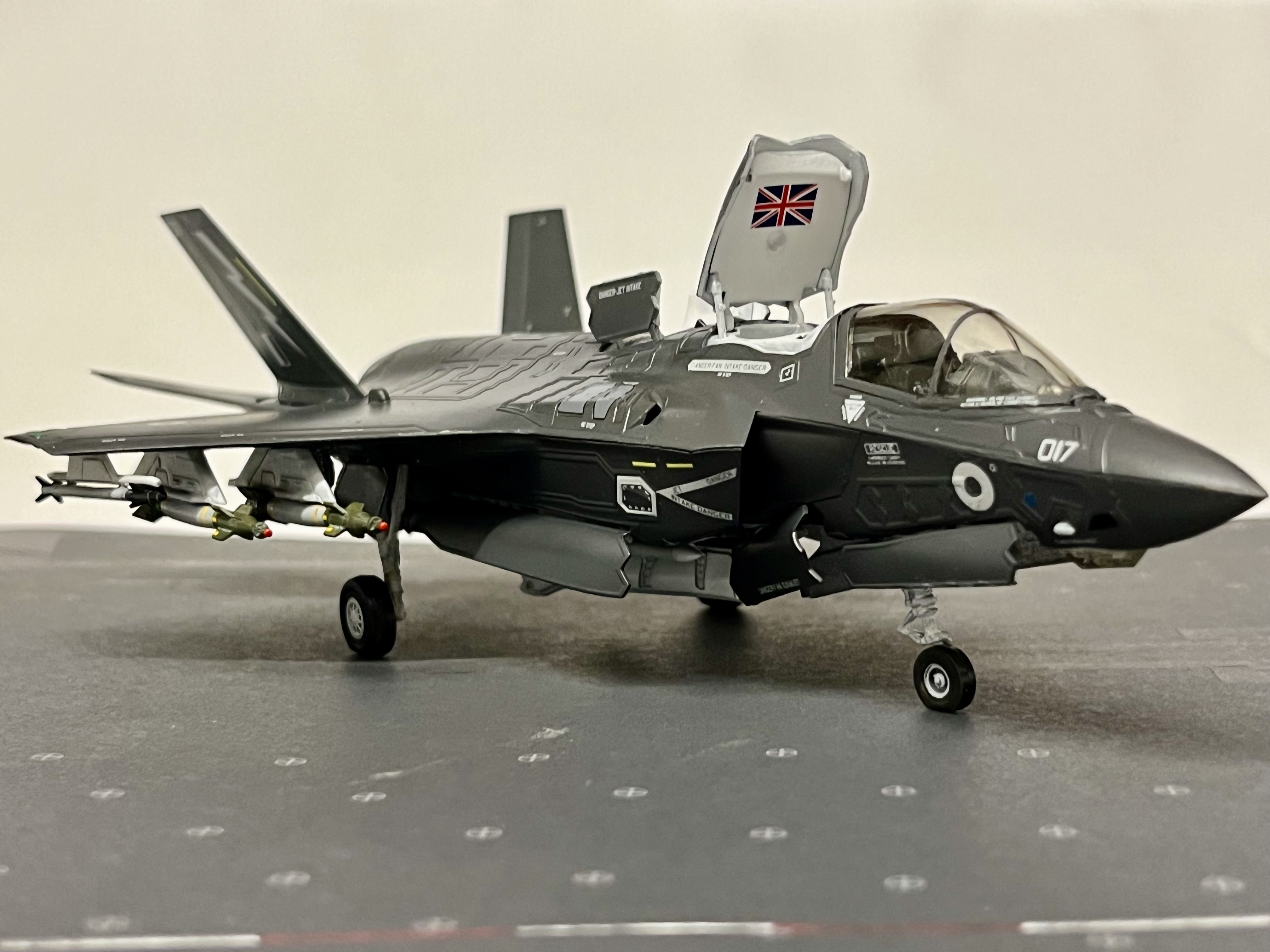
Now that was great fun. This is Italeri’s F-35 Lightening II in British markings with all vents open, all munitions loaded and jet pipe in the VTOL position. 

This is painted as an F-35 of Lightning Force XM151/017 from October 2019 aboard HMS Queen Elizabeth


I’ve used Vallejo’s sea grey with a few drops of gunmetal added and made up a 50:50 matt and gloss varnish mix to provide that silky finish peculiar to this stealthy aircraft. 


----

The kit


Tuesday, 17 January 2023

Sepcat Jaguar GR.1

I’m on a roll! After just 3 half days at the workbench, my 3rd build of 2023, Italeri’s Sepcat Jaguar GR.1, is done. 

I’ve finished it in the colours of XX733 “Pink Spitfire” of RAF 6th Squadron, flying from Thurrait Air Base in Oman in 1991 during Operation Desert Storm, when it took part in 39 missions against Iraqi forces. 


For a kit based on 30 year old tooling it is amazing quality and was great fun to build. It also comes with decals, paint instructions and ordinance for 4 different squadrons/aircraft. I was inspired to go for the Desert Storm variant after both coming across a No.6 squadron pin from my air cadet days and having both a Tornado and Buccaneer lined up for the same operational colour’s, the former having been built a while back. 

I was hoping this would have lasted me a little bit longer but it was just so much fun

Saturday, 14 January 2023

C-47 Skytrain

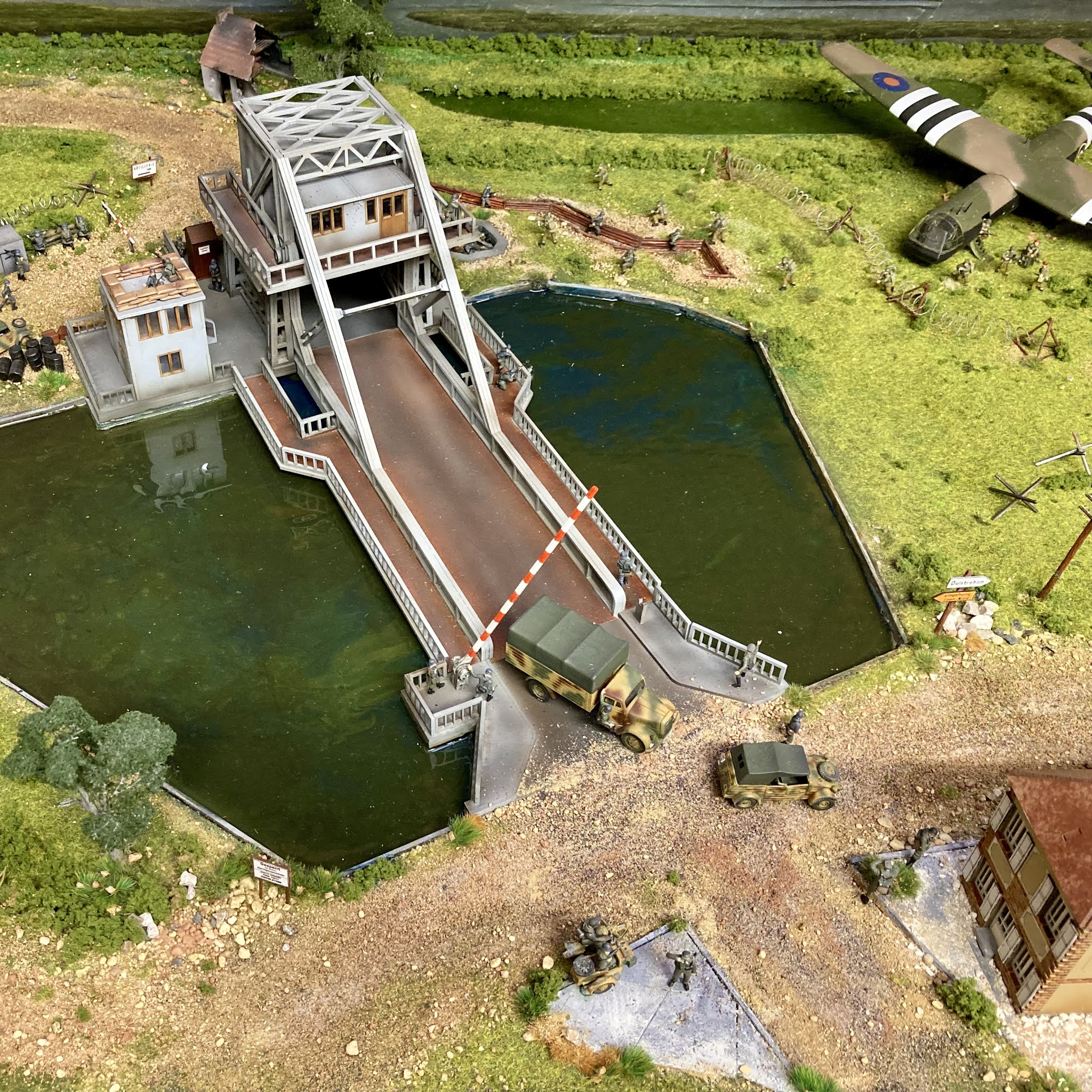
My latest scale model build and second of 2023 is Italeri’s C-47 Skytrain. I’ve had it in my stash since doing a Pegasus Bridge D-Day diorama some years back when I had a plan to have it flying overhead with paratroopers leaping out in support of the glider troops below. This never happened due to my short attention span and me having moved on to my next build! 

Having just read over Christmas the interesting book “The Lost Paratroopers of Normandy” I was inspired to dust off the C-47 and build it as D8 of 94th TCS commanded by Major Joseph A Beck II and then discovered was based at Station 462 Upottery, of Band of Brothers fame, here in Devon! 


This was a really nice kit to build. Very simple but lots of nice detailing. I’ve since seen that Airfix have recently re-released their 2014 moulding and this comes with decals for another of Upottery’s aircraft … how can I resist! 

Hope you like it.

Tuesday, 17 May 2022

Bofors 40mm Anti Aircraft Gun

I’m on a bit of a roll today! I finally finished this 1:35 scale Italeri Bofors 40mm Anti Aircraft Gun which I’ve had under construction since I started it in one of our club meetings back in February! 


The figures in this 2007 released kit are very simply moulded and strangely dressed like US Marines rather than typical WW2 Tommies. Interestingly the US did use the Bofors during the war, so I’ve stuck with it and created something in line with Italeri’s box art.


Tuesday, 17 August 2021

A Year's Scale Modelling Diorama

It's been a year now since I removed my old Scalextric track in the loft from its baseboard so as to showcase some of my 'lockdown' builds, and having now completed my latest diorama, the RAF Airfield from Autumn 1943, I can't believe I have finally run out of space! 🤦‍♂️


It has been suggested that there may be opportunities to display one or two of these at model shows etc, but how I not only cut them into their respective scenes, let alone bring them down from the loft, is somewhat perplexing me! 🤷‍♂️


I have, however, seen some folk building smaller dioramas, which I understand are called vignettes, using old picture frames, such that I may now have to do a tour of the house to see which pictures I can repurpose!🤭😂

Suggestions welcomed!

Thursday, 19 November 2020

Westland Wessex HU.5 & HAS.3 - Operation Paraquet

I'm ending my current helicopter builds with a flurry of Westland Wessex Junglie and Pinger whirly birds. Last month, I posted how the rarity of the Wessex, in scale modelling form, had resulted in a very unsatisfactory build. Then, just a few weeks later, like busses, two turn up together in exactly the configuration I was originally looking for; such better quality ones too! My approach to constructing this pair was exactly the same as with my earlier Junglie and Pinger Sea King duo, but with so many lessons learned from that experience, I think enjoyed these more and must say that the Pledge Floor Gloss worked so much better than Vallejo's gloss varnish!

As it's been a good few weeks since my first Wessex build, here's a reminder of the helicopter's pedigree. It was the Westland Wessex that replaced the Westland Whirlwind, first being used by the Royal Navy, in the form of the anti-submarine Wessex HAS.1, in 1961. The HAS.3 was brought onto service in 1961, with improved avionics and radar equipment; the sound of which gave the anti-submarine force the nickname of Pingers

1964, saw the Wessex HAS.1, operating from bases in Sarawak and Sabah, assisting Army and Marine detachments fighting guerrilla forces in Malaysia. Having removed much of the anti-submarine equipment to lighten the aircraft, during the subsequent campaign in Borneo, the Wessex was typically operated as a transport helicopter, capable of ferrying up to 16 troops or a 4,000-pound payload of supplies directly to the front lines. It is from these operations the Commando Helicopter Force gets its nickname of the Junglies and the commando assault variant, the Wessex HU5, was developed.


Italeri, Wessex HAS.3, as Humphrey

Matchbox, Wessex HU.5, as Yankee Alpha

In 1982, around 55 Westland Wessex HU.5 and 2 HAS.3 participated in the Falklands War, and it is 3 Wessex helicopters from this conflict that my scale models have been based on. 

The models and their intended Falklands War identities are:

  • Ark Models' Wessex HAS.1 as the HU.5 Yankee Foxtrot flown by Lt Mike Tidd
  • Matchbox's Wessex HU.5, as Yankee Alpha flown by Lt Ian Georgeson
  • Italeri's Wessex HAS.3, as Humphrey flown by Lt Cdr Ian Stanley
These 3 helicopters were key players in the opening days of Operation Paraquet, the code name for the attempt to recover South Georgia from Argentine military control using SAS elite troops, one of the first British acts of the War.

I recount below, much of their story discovered in the pages of Harry Benson's excellent book Scram! This is thrilling first-hand account of what it was like to be a helicopter pilot during Falklands War; from dodging Pucara attack aircraft, to landing special forces behind enemy lines, as told from the seat of his Westland Wessex. 


Operation Paraquet was an SAS planned mission to take control of South Georgia by the most unlikely and unexpected route. Inserted by two Royal Navy commando Wessex helicopters, of 845 Squadron, onto the Fortuna Glacier, the largest tidewater glacier on South Georgia, the plan was for these troops to march across the mountains and take the unknown Argentine force at the Leith whaling station by surprise.

Against the strong advice of a scientist, from the British Antarctic Survey team, who had only recently been extracted from the island himself, 22 mountain troops of D Squadron SAS were landed on the glacier. Overnight, on 21/22 April 1982, and as the Antarctic expert warned, the weather was to "defy human reason". A violent storm, the wind gusting to 100 knots and producing squalls of driving snow, stopped the SAS in their tracks. With frostbite and exposure a real concern, the SAS troop commander, Captain John Hamilton, radioed for the helicopters to return and rescue them.

Lieutenant Commander Ian Stanley in Humphrey, the single engined Wessex 3, but the only Wessex equipped with radar, acted as pathfinder for the 2, radar-less twin-engine, troop-carrying, Wessex 5s. Stanley guided Lieutenant Mike Tidd in Yankee Foxtrot and Lieutenant Ian Georgeson, flying the second Wessex 5, Yankee Alpha, in a close formation up to the top of the glacier.

Although dressed in white Arctic clothing, after exposure to a night of sub-zero temperatures, gale force winds and driving snow, the SAS troops were already in varying stages of hypothermia. Yankee Foxtrot, with Tidd at the controls and with half the frozen soldiers safely loaded, was the first to pull up into the icy but clear sky, when, without warning, it was enveloped in a tidal wave of a snow shower. In an attempt to return to the landing zone, the tail and left wheel of the Wessex hit the snow at about thirty knots, bringing the aircraft crashing down on its left side and sliding it onwards for fifty yards. The left side of the cockpit filled up with debris and snow as the windows imploded. Tidd slid open the cockpit window and clambered up onto the side of the aircraft to help open the rear cabin door.

Tidd slid open the flimsy cockpit window and clambered up onto the side of the aircraft

The snow shower passed as suddenly as it had appeared and visibility improved once more. Out on the snow, the soldiers were divided between the two remaining helicopters. With ten people now crammed into the Wessex 3 and fourteen in the Wessex 5, the depleted formation rose to the hover once again. As Stanley navigated over the ridge of the glacier with the use of Humphrey's Wessex 3 radar, Georgeson in Yankee Alpha followed a few rotor lengths behind. Then, another ferocious snowstorm hit the formation just at the wrong moment, barely ten seconds after launch. As Humphrey dropped down over the ridge-line of the steeply descending glacier, Georgeson lost sight of it in the now near blizzard conditions. Yankee Alpha's starboard wheel caught in a hidden and small ice crevasse and the aircraft toppled over onto its side. While it was amazing that no one was severely injured, Yankee Alpha was not so lucky, the second and last troop carrying Wessex was out of action.

Out on the snow, the soldiers were divided between the two remaining helicopters

With no radio contact, an overloaded helicopter and appalling weather conditions, there was nothing Stanley could do but to return to HMS Antrim, the County-class destroyer from which they had launched two hours earlier. After Humphrey received a thorough safety check by the engineers, Stanley decided to have another go at rescuing the survivors. As if taking to the air in arctic conditions which would ground any peace time flight, with only one engine to support them, was not bad enough, Stanley also had the added problem of how to fit fourteen large passengers into Humphrey's tiny cabin, already full of radar equipment! During the earlier rescue flight, Humphrey's rear cabin had been cramped with just two crew and six passengers and would now have to find room for an additional eight! Even if they could somehow cram everyone in, the Wessex would be dangerously overloaded way beyond the design limits of the rotor gearbox and the capacity of the single engine. 

Stanley and Humphrey have another go at rescuing the survivors

Stanley radioed ahead for the ship to get onto a heading that gave maximum wind, and thus maximum lift, over the deck. His final approach was judged to perfection. The helicopter descended straight towards the deck unable to maintain the usual careful hover due to its excessive weight. The air speed indicator showed around sixty knots at the moment they touched down. A controlled crash would have been good enough. Instead it was as close to as smooth a landing as you could get! Against the odds, Humphrey had brought all helicopter crews and SAS troops safely home.

Ending the day with one failed mission by the SAS and two crashed helicopters, this near disaster on Fortuna Glacier was a worrying start to Britain’s campaign to reclaim South Georgia and the Falkland Islands. But for the astonishing skill of Lt Cdr Ian Stanley and his Wessex 3 crew, it could have been so much worse. 

Julian Thompson, Commander 3rd Commando Brigade in 1982, has an insightful and somewhat amusing thought in his forward to Scram! ... What the SAS thought they were doing up there is another matter, and my opinions on the matter are best left unsaid

Imperial War Museum’s copy of an original photo taken from Humphrey

On 25th April, with a sense of reality restored, a more traditional helicopter assault by Special Forces and Royal Marines, with two Royal Navy vessels (Antrim and Plymouth) conducting a naval bombardment, brought a successful conclusion to Operation Paraquet with the surrender of the island's two Argentine garrisons. And this was just the start .... !

--------------

The Models

 Brand:      Italeri
 Title:        Wessex HAS.3
 Number:  1258
 Scale:       1:72
 Released: 2007 | Rebox (Updated/New parts)

 Brand:      Matchbox
 Title:        Westland Wessex HU.5/HAS.31
 Number:   PK-133
 Scale:       1:72
 Released: 1987 | Initial release - new tool


  Brand: Ark Models
 Title: Westland Wessex HAS Mk.1/31 Anti-submarine helicopter
 Number: 72032
 Scale:      1:72
 Released:2009 (Originally 1963 Frog)


BLOGGER IS DEAD LONG LIVE FACEBOOK & INSTAGRAM

It's been a blast Blogger, but not being able to upload any photos of my builds to this blog really makes you meaningless going forward....