Showing posts with label Air Display Team. Show all posts

Wednesday, 18 August 2021

Fouga Magister CM 170

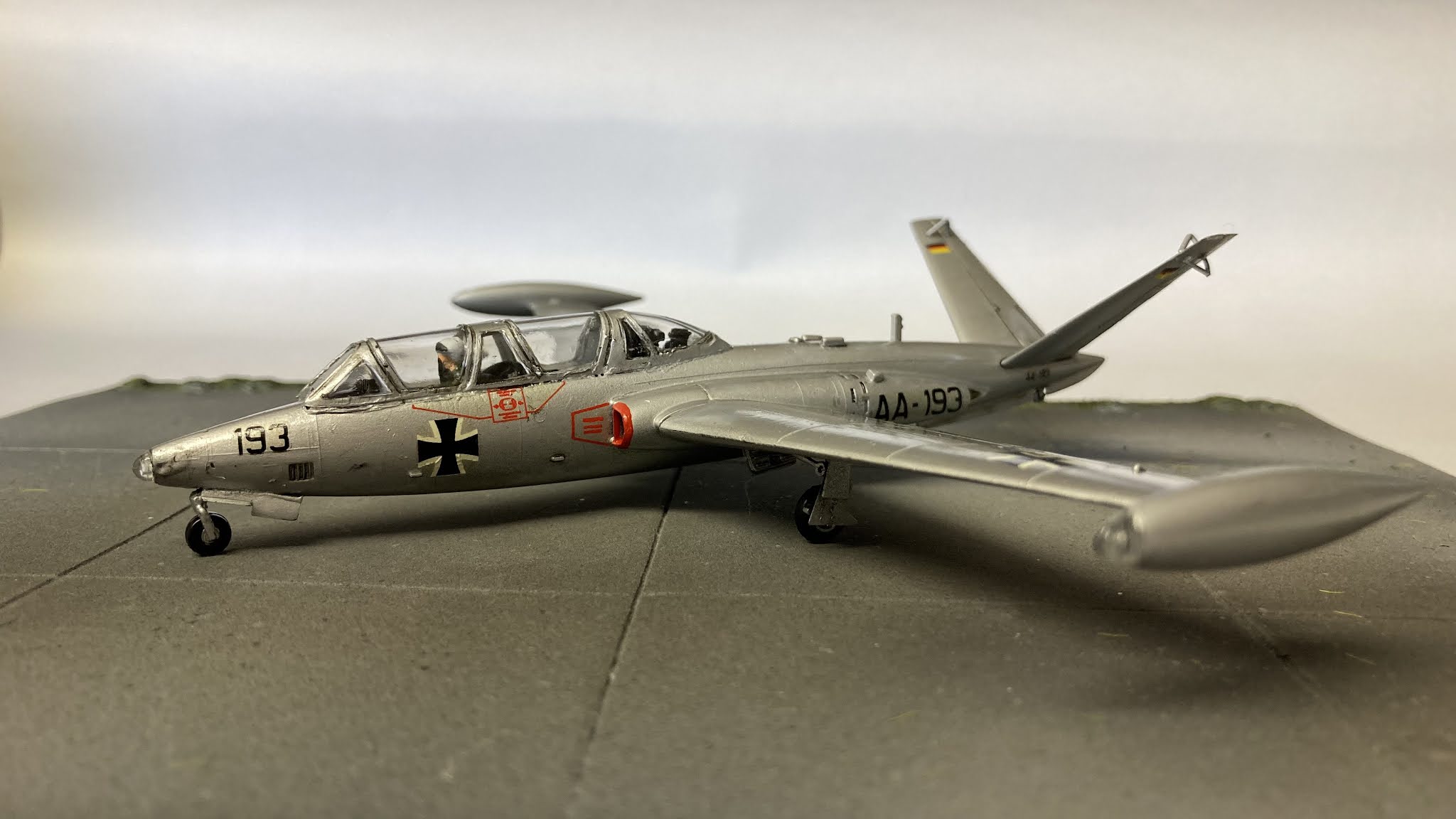
FSS ‘A’ Acro-Team's Fouga Magister

My final air display team aircraft build (probably) is a unique one. During early 1960 the FSS ‘A’ Acro-Team based at Landsberg in Bavaria, was formed equipped with French-built Fouga Magisters of the West German Air Force and flown by RAF flying instructors! Having had no Air Force in 15 years, the German pilots had insufficient experience for the 1960s displays, however, by April 1961 the team was joined by two Luftwaffe members. 


A tragic air accident in June 1962, involving a team of F-104F Starfighters, resulted in a ban on all military aerobatic flying and any opportunity for the RAF instructors to recommence display flying training faded when the British Mission (Germany) was terminated in 1963. 

For my Fouga Magister I managed to find a 1980s Heller kit. Just as with the Alouette, bought in the same transaction and being of the same era moulded in blue plastic, this was a simple build. The obvious version to complete would have been the Patrouille de France display Team from 1978, but I found the back story of the FSS ‘A’ Acro-Team, with its dedicated chapter in David Watkins’ excellent book “The History of RAF Aerobatic Teams from 1920”,  just too interesting!

-----

The Kit


Brand: Heller
Title: CM 170 Fouga Magister
Number: 220
Scale: 1:72
Type: Full kit
Released: 1980 | Initial release - new tool

Monday, 12 July 2021

A-4 Skyhawk - Blue Angels

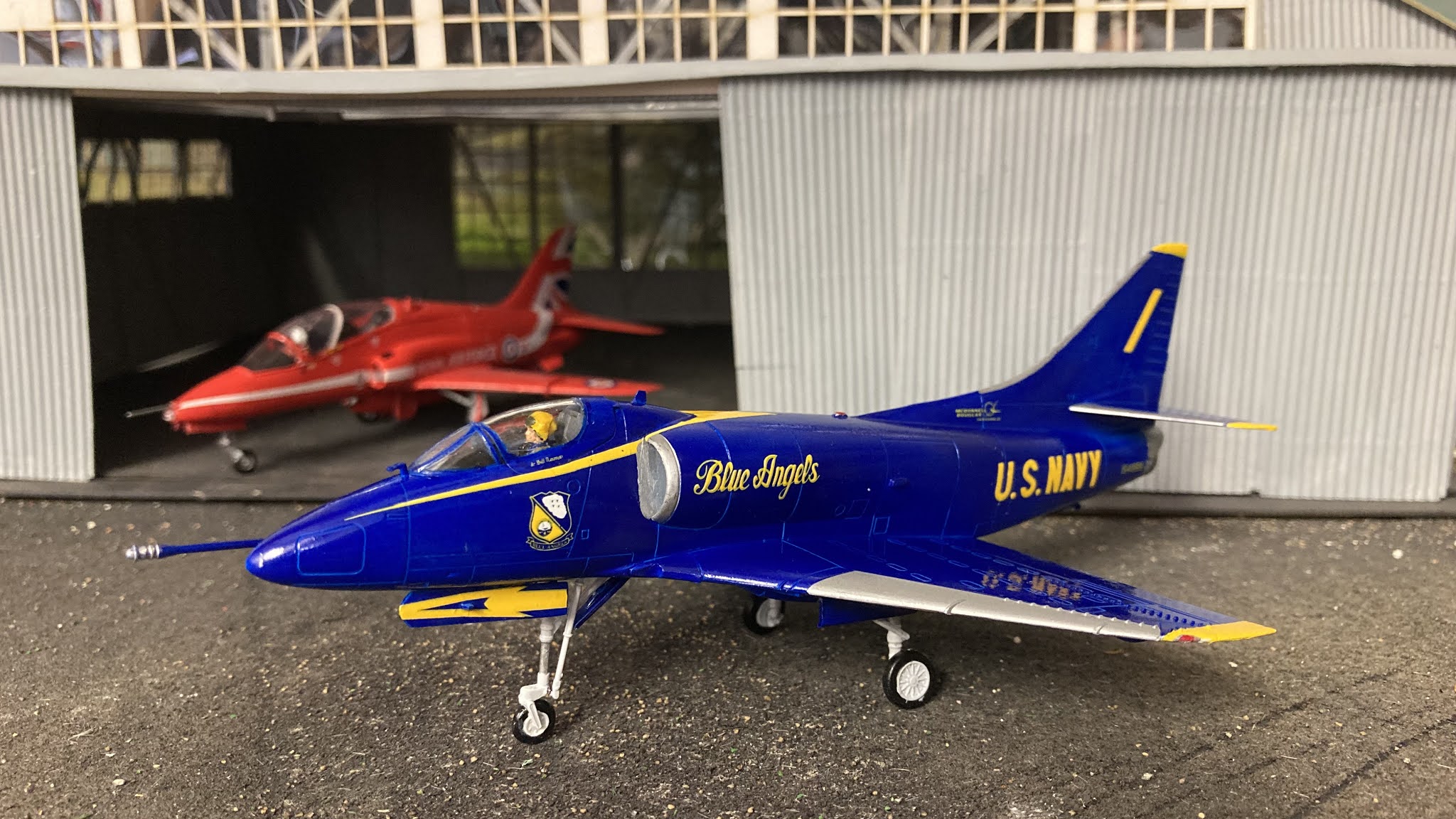
Continuing my scale modelling project on the subject of aerobatic display teams, I've today crossed the pond to the USA for something a little different. 


This build celebrates the 14 May 1983 when the Red Arrow Hawks performed over the US Navy Academy at Annapolis, Maryland where they met up with their Navy counterparts, the Blue Angels, flying A-4 Skyhawks. 


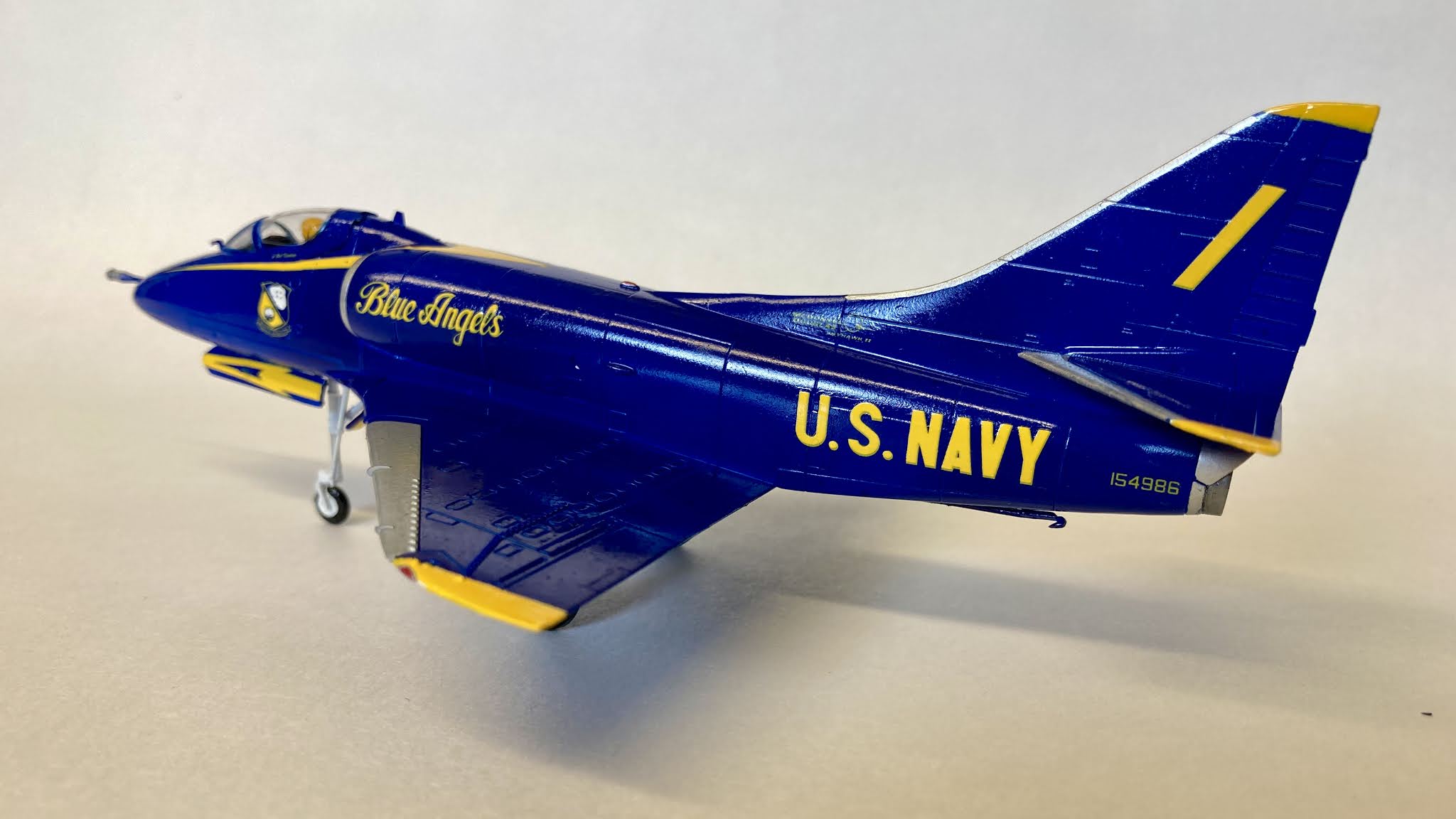
Pictured here are the Blue Angels leader #1 with Red 1 of the Red Arrows. Both built from Airfix kits, albeit the decals for the Blue Angels were an after market purchase of Cam Pro decals - not the best quality so will be a provider I’ll have to remember to avoid in future. 


On this NA tour they also met up with the USAF Thunderbirds flying the F-16 and the Canadian Snowbirds with their Canadair Tutors. Would love to build a model of the Tutor, but seeing old Hobby Craft kits currently going for around £60, I think I’ll skip that one!

Thursday, 1 July 2021

BAE Hawk - The Red Arrows

The RAF Red Arrows Display Team formed in 1965 and flew the Folland Gnat until its retirement in 1979. The Gnat’s replacement was the BAE Systems Hawk T1 (Trainer Mk.1) which entered RAF service in late 1976. The Red Arrows, who had been preparing to convert for some time, received their first Hawk T1 (XX251) on 16 August 1979. 


The remarkable fuel efficiency of the Hawk brought a new dimension to the way the team could operate. No longer did they need to operate from a base close to the display site and performing at two displays in the in flight could now be accomplished. The downside, quoted by Flt Lt Bob Lewis, the team’s Engineering Officer 1977-1980, was that the were fewer ‘back seat’ rides and overnight stays! 

The team’s Hawk aircraft were painted in a distinctive Signal Red, a brighter red to that of the Post Office Red used on the earlier Gnat Red Arrows and Jet Provosts of the Red Pelicans. Mirroring the MOD changes insisted on for the Gnats in 1979, the Hawks were also painted with a white centre-line flash bearing the CFS badge and Royal Air Force title on the forward fuselage.


The Hawk Red Arrow’s first public display was at Episkopi in Cyprus on 10 March 1980. On 17 May 1980 the the team suffered its first Hawk write-off when Sqd Ldr Steve Johnson struck the mast of a yacht along the seafront in Brighton. He ejected safely but the accident led to a subsequent ban on all display flying below 100 feet!

In May 1983, the Red Arrows relocated from RAF Kemble in Gloucestershire, their base since 1966, to RAF Scampton in Lincolnshire where, despite occasional attempts to suspend the team, they remain to represent the very best the RAF and UK aerospace industry, and is acknowledged as one of the world’s premier aerobatic teams. 


I built my Hawk from Airfix’s 2019 release of their 1:72 scale Starter Set selecting aircraft serial XX322 from the 9 provided. This was the number given to the Hawk T1 delivered to the RAF on 24 November 1980. In March 1984 it was then one of 89 which underwent T.1A conversion to replace the Hawker Hunter training pilots at the RAF Tactical Weapons Units (TWU).

This conversion was made to enable the Hawk to carry two underwing AIM-9L Sidewinder air-to-air missiles and a centreline Aden gun pod. The underbody gun pod was replaced on the Red Arrows with a fairing used to carry diesel fuel and dye for the display smoke system. XX322 remained with 151 SQN, 2 TWU, RAF Chivenor until January 2001 when it was transferred to the Royal Navy where it served for 9 years with their Fleet Requirements and Air Direction Unit (FRADU) at RNAS Culdrose. FRADU provided training for the Royal Navy by conducting simulated attacks on Royal Navy ships.

In July 2010, now 30 years old, XX322 received its call up to the Red Arrows at RAF Scampton, having moved from their original base at RAF Kemble in 1983 (I remember flying Chipmunks out of RAF Kemble in the early 1980s with the Air Cadets and having to land PDQ to clear the airspace for the incoming Red Arrows! My claim to fame - flying a Chipmunk with the Red Arrows!!). 

It is testament to the quality of this aircraft that now, at over 40 years old, it is still being put through some of the most rigorous manoeuvres required of any aircraft; serving its pilots 3-4 times as long as its Gnat predecessor, how amazing is that!

Interestingly, during the North American Tour, August – October 2019, XX322 was flown by Squadron Leader Martin Pert, in his final year leading the team as Red #1. This was the first time the Red Arrows had been to North America since 2008 and was the team’s largest ever visit to Canada and the United States. As part of the Hornby enterprise, Corgi have also produced a diecast model, Ref AA36017, of Red Arrows Hawk XX322 in the U.S. Tour 2019 Scheme, available on Summer 2021 pre-order for princely cost of £49.99!

Tuesday, 29 June 2021

Hawker Hunter - The Black Arrows

The Black Arrows, one of the predecessors to the current Royal Air Force Aerobatic Team the Red Arrows, were an aerobatic demonstration team formed in 1956 by Squadron Leader Roger L.Topp, then Commanding Officer 111 Squadron (Treble One). One of the many memorable feats accomplished by the Black Arrows was the execution of a world record loop of 22 Hawker Hunters in formation at the Society of British Aircraft Constructors' show at Farnborough in 1958. This was a world record for the greatest number of aircraft looped in formation, and remains unbroken to this day. After the loop the Black Arrows performed the world's first 16 aircraft barrel roll. 

Treble One and the Black Arrows

Although best remembered for the Black Arrows, 111 Squadron's tradition for display flying can be traced back to the Hendon Air Display of 1926, when flying two Armstrong Whitworth Siskins they competed against 17 Squadron's Sopwith Snipes and 23 Squadron's Gloucester Gamecocks (Douglas Bader would be flying with 23 Squadron in the same aircraft in the 1931 display just months prior to his horrendous crash in Bulldog K1676).

In December 1937, Treble One became the first RAF squadron to receive Hawker Hurricanes and made further history on 10 February 1938 when its CO, San Ldr J W Gillan, flew from Edinburgh to RAF Northolt, London, in 48 minutes recording an average speed of 409 mph.

Throughout the Battle of Britain, in the summer of 1940, the squadron flew in almost continuous action, claiming 94 enemy aircraft destroyed. They were re-equipped with Spitfires in July 1941 and relocated to the Mediterranean where they were involved in support of Operation Torch, the invasion of North Africa and Operation Husky, the invasion of Sicily. Treble One then moved on through Italy with the advancing Allied ground forces and remained there until the end of the war, before being disbanded in 1947. 

In 1953, the squadron were reformed at RAF North Weald, equipped with Meteor F.8s, however, any interest in reforming an aerobatic team on the squadron remained informal and while several pilots did indulge in the sport, being unofficial, their events were seldom recorded. When San Ldr Roger Topp took over the squadron in January 1955, he thought it a good idea. Finding the routine of squadron life to be dull, 'to bring back a bit of excitement' he took over the leadership of the Meteor team. The team continued following the squadron's conversion to Hawker Hunters.

The squadron's re-equipment with Hunter F.4s began in June 1955 and hit the headlines again in the following August when Roger Topp established a new Edinburgh to London speed record in 27 minutes 52 seconds at an average speed of 717.5 mph.

In April 1956, the 11 Squadron Hunter team had been nominated as the official aerobatic team of no.11 Group and made its debut at the French National Air Display at Bordeaux on 12 May. It received a great deal of praise for its precision aerobatics prompting one French commentator to refer to them as 'les Fleches Volantes' - 'The Flying Arrows'.

Training for the new season began in January 1957 with the squadron's new Hunter F.6s and with their appointment to the RAF's premier aerobatic team, the squadron was given permission to replace their standard grey/green day fighter camouflage scheme with a special display finish. After experimenting with various paint schemes, an overall gloss black was finally decided on. The colour was chosen for it was the colour of bar makings carried on various of the squadron's aircraft types between 1925 and 1937 and black would make the team highly visible and more impressive. 

Although the team had no official name other than that of the Squadron, it was a remark in a leading French newspaper, Le Figaro, following their appearance at the Paris Salon in June 1957 that referred to them as 'les Fleches Noir' - the Black Arrows - was considered an appropriate, albeit unofficial, name for the team by Roger Topp and quickly adopted. In October 1958, Roget Topp was succeeded as Co and leader of the team by San Ldr Peter Latham, a former member of 263 Squadron aerobatic team which flew in the 1950 Farnborough RAF Display. Following on from Roger Topp was going to be a challenge, but it was Peter Latham who increased the normal display number of aircraft from 5 to the 9 still flown today by  the Red Arrows. 

The Black Arrows marked their final appearance as the RAF's premier aerobatic team at Farnborough in September 1960 following which it stood down in readiness to reequip with the English Electric Lightening. 

The Model

For my model of the Black Arrows I struggled for 1/72 kit at a price which would not limit this serial model maker's ability to make another purchase. Airfix had moved it's Hunter into their 1/48 scale range and Revel's 1/72 kit was, for some reason, going for twice what I was prepared to pay. So a trawl of auction sites brought me an aged 1993 release of Airfix's Hunter FGA9.


The Black Arrows used the Hunter F.6 between 1957-1960. The FGA9 ground-attack fighter replaced the F.6 interceptor version in April 1963 and thus could never have been flown as Black Arrow. However, the visible differences are probably minimal. The FGA9 were all were modified from F.6 airframes to give it  better performance in its ground-attack role. It had strengthened wing to allow for a wider range of stores, 230 gallon inboard drop tanks (which I have left off), a tail chute a bobweight in its pitch control circuit to increase stick force in ground attack manoeuvres and increased oxygen capacity increasing its flying time.

I was also unable to acquire any aftermarket Black Arrows decals, the 1:48 scale model only currently being catered for. Most of the supplied Airfix decals were also unusable, the colour printer was was obviously not properly aligned on the day of production, as colour bleed and overtyping was awful. I therefore, improvised, using an old set of Lightening roundels and tail markings, the latter being a perfect match for the Black Arrows. The roundels would have been better had they had a thin white outline, a design which was added to the full sized aircraft in August 1957. I needed a Union flag for the starboard side of the nose, so cut one I had from a set of unused 1:32 scale Rally Mini Clubman decals and as I had no way of obtaining a 111 squadron badge - while admittedly I could have used another - I did have 2 flag and so applied one to both, and I think the symmetry at least works. The aircraft serial numbers should really have been in red, but having seen other models, may be, incorrectly wearing white numbers, I used the set which came with the kit - the only ones to be correctly printed due to probably being just one colour. 

Just out of interest, I looked up what may have happened to XJ673. It was converted to FGA.9 in 1960 by HSA. Joined 20 Sqn. on 7 September 1961 and was coded ‘XX’ as the OC’s machine. It met its end on 2 April 1969 when it was abandoned whilst on approach to Clark AB, Philippines. It had suffered an engine failure and loss of hydraulic fluid. The pilot, Flt. Lt. K.R. Barley, ejected safely.


The Kit

Brand: Airfix
Title: Hawker Hunter FGA.9
Number: 02073
Scale: 1:72
Type: Full kit
Released: 1994 | Rebox (Changed decals)

Friday, 25 June 2021

Folland Gnat - The Red Arrows

Prior to 1965, it had been the practice to provide official RAF acrobatic teams from existing squadrons, however, with the increasing sophistication and cost of fighter aircraft, together with the disruption to other activities, this became a tradition that the treasury saw as an unnecessary diversion of valuable resources.


It was decided, therefore, to form the first permanent display team known as the Royal Airforce Aerobatic Team administered by the Central Flying School at Little Rissington. After much deliberation and following the successful demonstrations by the Yellowjacks the previous year, the Folland Gnat was selected, being the most suitable aircraft available.


The official name chosen for the new team was the Red ArrowsRed to retain its links with the CFS display team - The Red Pelicans; while Arrows would not only be representative of the Gnat aircraft’s profile, it would also hark back to the famous Black Arrows Hunter team of 111 Squadron a few years earlier.


.

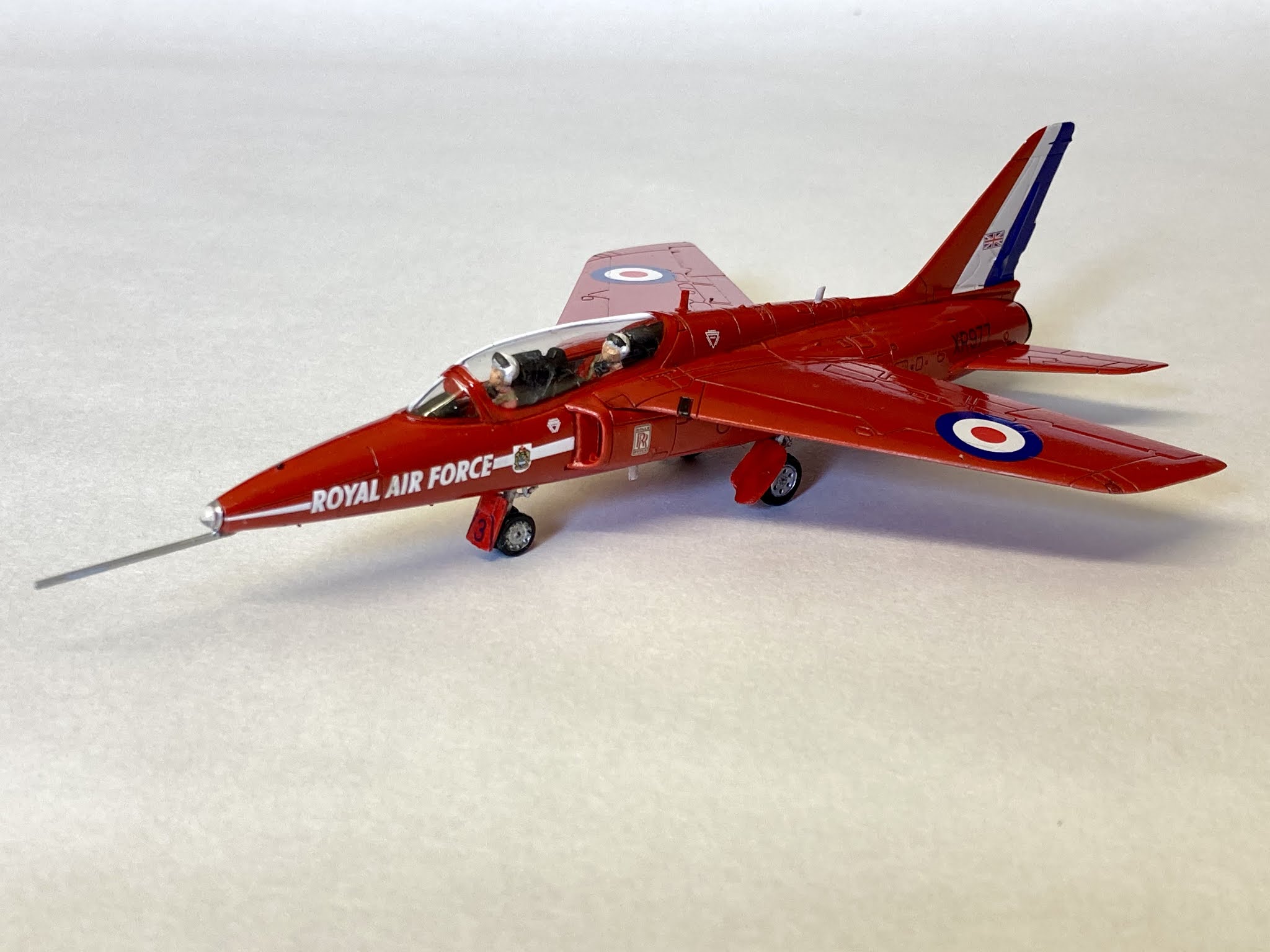
For my Red Arrow build, I used the 1:76 scale Red Arrows Gnat starter kit first released by Airfix in 2012. This uses the same tooling as on their later T.1 and Yellowjacks releases. As with my last  Yellowjack creation, I decided not to fit the underwing 'slipper' tanks as these were not usually carried during display flying. Otherwise it was an out of the box build in which I even used the Humbrol supplied Post Office red paint. 

The decals and paint scheme provided with this kit, reflect that which would have been seen during  the Gnats’ final 1979 season: with the full-chord red white and blue tail fins, first applied in 1967 to replace the standard RAF tail fin flash, and the words Royal Air Force and CSF badge within a white stripe on its nose. The latter marking was added for this final season, replacing the white lightening stripes they had worn for the previous 10 years. This final change, as confirmed by Flt Lt Bob Lewis, the team's Engineering Officer 1977-1980, was brought about following the arrival of privately sponsored teams, such as the Rothmans Pitts Specials, and rumours suggesting the possible sponsorship of the nine little jets. To dispel any doubts that the Red Arrows were not for sale, the MOD decided the words Royal Air Force should be emblazoned on the fuselage.   


The last public of the season were given at the Battle of Britain shows at Abingdon and St Athan on 15 September 1979, following which, the Gnat team gave their final performance at RAF Valley. Since their formation in March 1965 The Red Arrows Gnats had completed a total of 1,292 displays and visited 18 countries.  

….

The kit

Brand: Airfix
Title: RAF Red Arrows Gnat Starter set
Number: A55105 
Scale: 1:72 
Type: Full kit Released:2012 | Rebox (Changed box only)


.

Sunday, 20 June 2021

Hunting Percival Jet Provost T.4 - The Red Pelicans

The highly successful Jet Provost provided the RAF with a training solution for over 30 years. During this period many RAF stations operated aerobatic display teams and the Central Flying School's 'Red Pelicans' were amongst the most distinctive, often flying in the same programme as the Red Arrows.

In 1957, when the Jet Provost entered service, there were 29 air display teams representing their respective RAF squadrons, flying such aircraft as the de Havilland Chipmunk, Vampire and Venom, English Electric Canberra, Hawker Hunter, Gloucester Meteor, and now the Hunting Percival Jet Provost. There was no single official RAF team and their shows covered a standard 'Box' display, so as to best show off their formation flying skills, though unlike those pioneers of the 1930s, they did not go as far as to connect their wingtips with lengths of rubber cord! 

CFS The Red Pelicans XN468, RAF Little Rissington, Gloucestershire, 1966

The RAF's Central Flying School (CFS) received its first Jet Provost T.1 in November 1957. AOC-in-C RAF Flying Training Command, Air Marshal Sir Richard Atcherley, requested the CFS form a team with these jets and appear at the 1958 Farnborough Air Display. 

Norman Giffin, who was selected as leader of the CFS's first Jet Provost team, initially had five of his aircraft painted in a red and white scheme to emphasis the difference between the top and bottom surfaces. This was in anticipation of being able to do part of the display inverted.  The T.1 was, however, not ideal for display flying, being underpowered for formation aerobatics thus limited the team's early routines, and disappointingly also made inverted display impractical!

The team wanted to call themselves 'The Red Pelicans' but as the Meteor team of previous years had ambitions to continue into 1958 and were already using the name 'Pelicans', they had to settle for the rather uninspiring name - 'The CFS Jet Aerobatic Team'.


Airfix's 1:72 Hunting Percival Jet Provost T.4 in the Signal Red colour of The Red Pelicans 1966

In July 1959 the first batch of the more powerful Jet Provost T.3s were received and the team of four jets developed a show where, in addition to the standard 'Box Four' display, they would split into two pairs to carry out synchronised, mirror image manoeuvres; very different to what other teams were doing.

In March 1962, the number of display aircraft was increased to five and the team became the first to operate the newly-delivered Jet Provost T.4. This season also marked the occasion that would have greatly pleased Norman Giffin 5 years earlier, when the team, now lead by Flt Lt Ian ' Snowy' McKee, was finally allowed to be renamed 'The Red Pelicans'.

In 1963 The Red Pelicans was nominated as the official RAF aerobatic team. A sixth aircraft was added to the CFS team, which were repainted in a new all-over day-go red colour scheme. The Red Pelicans were the first teams to ever have put on a display rolling six aircraft in line abrest. by the end of the season, the Air Ministry eventually decided that the English Electric Lightening fighters, which at the time formed the Fighter Command's display team, were totally unsuitable for the type of aerobatics that an aid display now demanded  and so, The Red Pelicans was then nominated as the RAF's premier aerobatic team for 1964.

Head to Head - The Red Pelicans, Yellowjacks and Red Arrows

At the Farnborough Airshow in September of 1964, The Red Pelicans gave a series of synchronised displays with the RAF's first team of Folland Gnat aircraft - the 'Yellowjacks' from No.4 Flying Training School (FTS) RAF Valley. The success of the swept wing manoeuvrability and increased performance of the Yellowjack's Gnat, lead to the subsequent formation of the RAF Aerobatic Team - 'The Red Arrows' - in 1965 and the stepping down of The Red Pelicans as the premier team.

Although The Red Arrows had replaced the Jet Provost team, four enthusiastic volunteers, led by Flt Lt Bill Langworthy, convinced the authorities of the need to maintain a second team. While officially approved to fly the 1965 season, the team of four were denied the use of the Red Pelicans title and thus were called 'The 1965 CFS Jet Provost Aerobatic Team'. Common sense and the Red Pelican title was restored for the 1966 and subsequent seasons.


In 1966 The Red Pelicans receive delivery of a batch of new Jet Provosts finished in a new Signal Red colour scheme, a look they would keep for the next 4 years. 

When the new pressurised Jet Provost T.5 came into service in 1969, and The Red Pelicans received their aircraft in preparation for the 1970 season, they were in the standard training colour scheme of red, white and grey. The only concession allowed to the team was the addition of a Pelican motif in red on the fin and The Red Pelican title on the rear of their fuselage.

The Red Pelicans continued to perform with their JP.5s through to the final show of 1973 season at Linkenheim near Karlsruhe, Germany on 23 September 1973, following which they were disbanded as part of the Government's economy measures. 


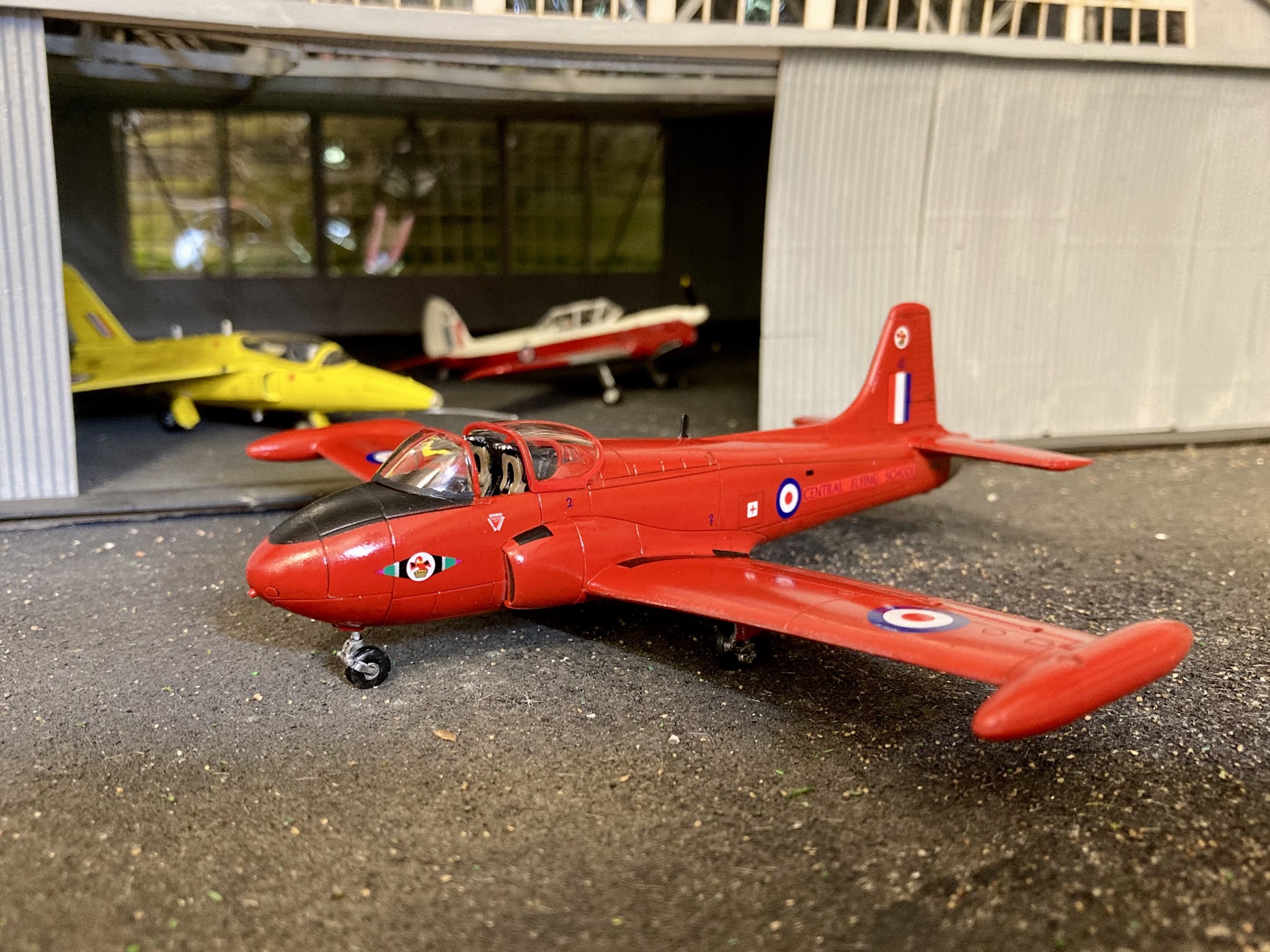
For my build, I managed to get hold of Airfix's current starter kit of the The Red Pelicans'  Jet Provost   from 1966, when they changed  to the Signal Red colour scheme, the same colour as used by the Gnat Red Arrows

------

The model kit ..


Brand: Airfix
Title: Hunting Percival Jet Provost T.4 Starter Se
Number: A55116
Scale: 1:72
Type: Full kit
Released: 2017 | Rebox (Model set)


Monday, 14 June 2021

Folland Gnat - Yellowjack

The Yellowjacks were the Royal Air Force aerobatic display team which flew Folland Gnat trainers painted yellow. 

The team was formed informally in the summer of 1963 by a group of flying instructors, led by Flight Lieutenant Lee Jones, at No 4 Flying Training School at RAF Valley, whose call sign was "Yellowjack". 

Yellowjack parked up at the airfield

I would normally go out of my way to select decals to match the actual aircraft used, but in this instance, apart from using a larger set of wing roundels from my stash, as were used by the Yellowjacks, I used the Airfix RAF Valley decals supplied with the kit. 

The Airfix Folland Gnat with a different paint job 

I think, with hindsight, I overdid the panel lines, but it was all the ‘weathering’ I was going to do and I wanted to add some detail for the eye. 


-----------------

The model kit ...

Brand: Airfix
Title: Folland Gnat T.1
Number: A02105
Scale: 1:72
Released: 2018 | Rebox (Changed decals)

BLOGGER IS DEAD LONG LIVE FACEBOOK & INSTAGRAM

It's been a blast Blogger, but not being able to upload any photos of my builds to this blog really makes you meaningless going forward....