Showing posts with label Railway. Show all posts

Friday, 25 April 2025

The Cernak Incident, June 1943

 I’ve just completed this railway and aircraft diorama for one of my local WW2 airfield museums.

On the 4th June 1943 “ A” flight from the Czechoslovakian Squadron 313 based at RAF Culmhead (Formerly RAF Church Stanton ) was ordered to take off and undertake low flying practice that included “mock” attacks on trains travelling on the Plymouth to Bristol main railway line near Bradford upon Tone, 4 miles west of Taunton. 

During the training flight a GWR express train from Plymouth to Liverpool was spotted heading North to Taunton and so the flight decided to undertake a mock “attack” on the train. 

One of the pilots, F/O Jaroslav Cermak, was sweeping in to make his attack when unfortunately either due to Pilot error or mechanical failure he suddenly lost power and instead of pulling up over the train the aircraft lost speed and hit the roof of the second coach with his port wingtip. It crashed into the adjoining field killing the pilot instantly. 

I’m proud to say that this diorama can be seen today in the RAF display at the Upottery Airfield Visitor Centre, the same airfield the 101st Airborne Division’s “Band of Brothers” departed from on the morning of 6 June 1944.  

Saturday, 18 November 2023

Rhubarb over Somerset

After more than 2 months in the making my “Rhubarb over Somerset” diorama is done. If it were to be displayed anywhere I’d add a frame and plaque but over time it will probably be dismantled and its parts repurposed for another creation as it is the building that I find most fun. 

The inspiration for this diorama is a mysterious incident which occurred 80 years ago in Somerset not far from where we live. It was on a summer morning of 4th June 1943 that a Czech fighter pilot of 313 Squadron stationed at RAF Church Stanton (renamed RAF Culmhead in December 1943) clipped the roof of a GWR railway carriage with the wing of his Spitfire Mk.Vc, causing him to tragically crash in a farmer’s field near Bradford on Tone. 

During this period of WW2 the squadron was engaged in ‘Operation Rhubarb’, offensive low-level sweeps over northern France harrying ground targets such as military convoys and trains. It is possible that this pilot was at the time of the incident practicing a low-level attack on a passing locomotive and approached too low to clear the carriages. 

In creating this diorama I’ve incorporated a number of images from the period which although having no historical link to the event of the 4th June could well have been seen at some time or another in the Somerset countryside during the summer of 1943. Look out for the men of the Home Guard manning a pillbox along the Stopline Way, originally built to prevent a German beach invasion getting to London.


The Tank Regiment’s 11th Armoured Division are on the move from Bovington Camp, the Armoured Fighting Vehicles School, preparing drivers, gunners and engineers for D-Day. On the railway bridge a Scammell tank transporter carries a ‘Hobart Funny’, the Churchill Bridge Layer (coincidentally Percy Hobart was the first commander of the 11th Armoured Division when it formed in 1941), while, in the absence of signposts, a group of officers are having to check their map for directions. 

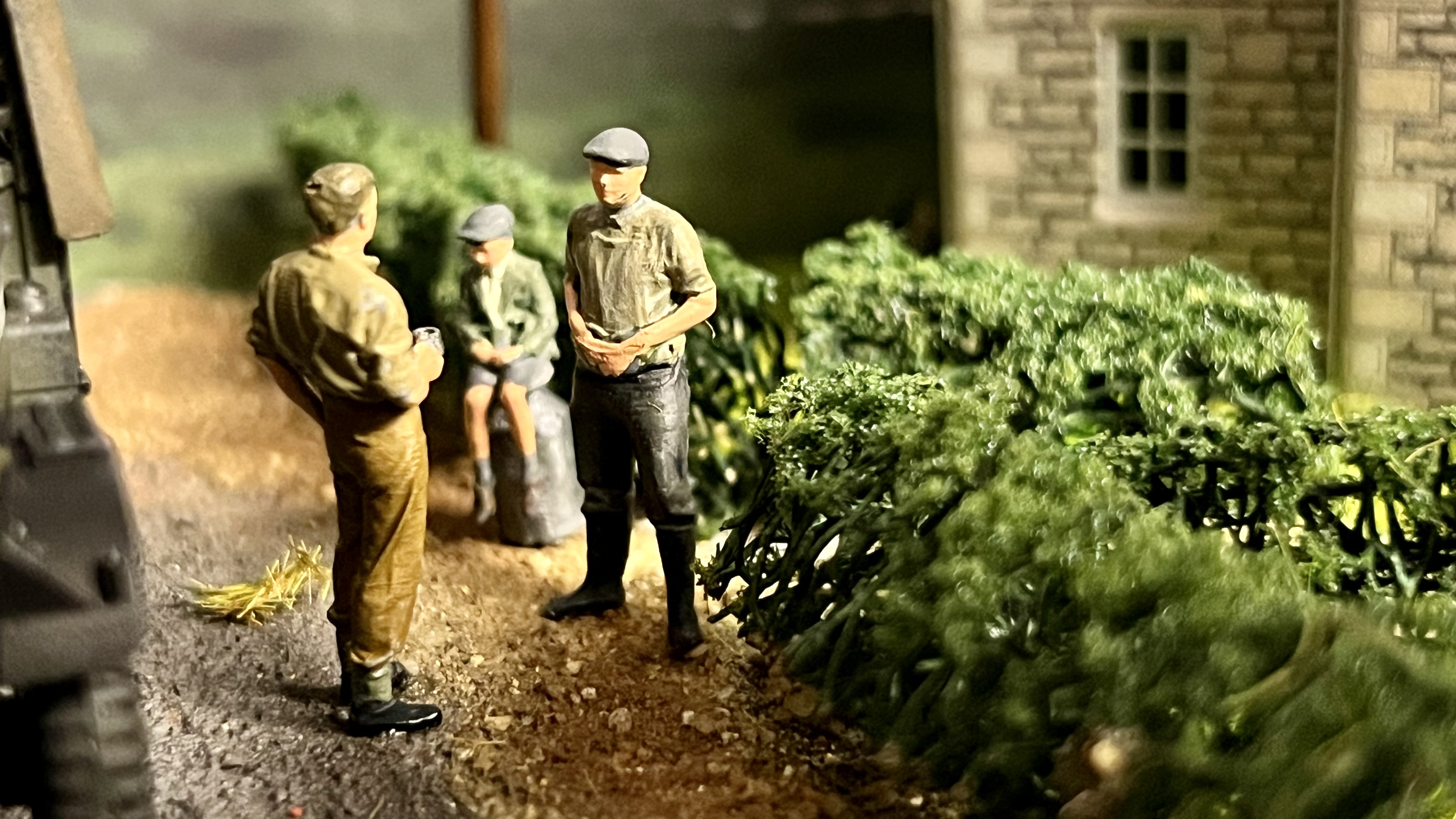
Meanwhile, a farmer shares a cup of tea with a soldier from 88 Brigade Workshop (REME) while a boy watches on sat on a milk churn. 

The railway signalman chats with a fellow soldier while he waits for the train to pass so that the rest of the convoy can proceed over the Bradford level crossing. I like to imagine that the tank transporter should be part of this convoy but they got separated hence now being lost! 

The stars of the scene are the Castle Class locomotive which I’ve repainted in a drab GWR wartime livery and a couple of clipped wing Spitfire Mk.V in RAF Church Stanton markings. The wings are clipped as this configuration was found to improve manoeuvrability at low level. 

Phew!

For those interested, here’s a list  of the 20+ models and figures I’ve used in the making of this diorama:

Airfix 1:72 Spitfire Vc, 1:76 Scammell Tank Transporter, Churchill Bridge Layer, Bedford QLT & QLD Trucks & Willies Jeep. 

Modelu military, farm and railway figures 

Ratio Plastic Models 1:76 Telegraph Poles, Crossing Gates, GWR Signals & Signal Box

Metcalfe 1:76 Stone Style Railway Bridge, Manor Farm House & Pillbox. 

Peco 1:76 Lamp Hut & Wooden Sleeper Tracks. 

Ancorton Models 1:76 Anderson Shelter.

Monday, 28 August 2023

Spitfire & GWR 6100-class - Rhubarb Over Somerset 1943

This, my second scale model build of an aircraft and train, is inspired by a local story I recently came upon of which there is much supposition - thus any inaccuracies in my understanding or retelling are solely my own! 

The Story as I understand it  …

Between June 1942-June 1943 No.313 Squadron, the third Czechoslovakian fighter squadron to be formed within the RAF, was stationed at Church Stanton, near Wellington in Somerset. During this time the squadron, flying the Spitfire Mk Vb and Vc, took part operation ‘Rhubarb’, the offensive low-level sweeps over northern France to destroy ground targets. 

Having escaped the advancing German army a 26 year old Czech pilot, Jaroslav Čermák, joined the RAF on 26th February 1941. Over a year later he earned his RAF wings, was promoted to Flying Officer and on 12th April 1943 assigned to No. 313 (Czech) Squadron RAF.

On 4th June 1943, at 10:05 hours, Čermák and three other pilots took-off on an operation ‘Rhubarb’ training flight. Their task was to practice a low-level attack on a train. They came across a GWR locomotive and carriages en route from Plymouth to Liverpool near Bradford-on-Tone, Somerset. After one successful pass they made a second approach on the target. Čermák flying his Spitfire Mk.Vc serial AR512 this time applied insufficient power, got too close and when his Spitfire lost stability, it clipped the roof of one of the carriages with a tip of port wing. The aircraft rolled over and crashed approximately 100 metres from the line, in a field at Langs Farm, Bradford on Tone, just to the east of what is known today as Three Chimneys. Čermák was instantly killed in the crash and at least one Wren aboard the train was reportedly injured by flying glass.

The models …

For the Spitfire I repurposed a low-level configuration clipped wing 1:72 scale Revell Mk.Vc from my collection and added the Church Stanton “RT” Squadron markings. We’ve yet to identify the correct aircraft letter so I left my original aircraft’s “V” in place, and, although we know Čermák’s serial was AR512, for those with a mind to look, I’ve also left it with the old serial number too. 


The actual locomotive is unknown and may probably have been a Castle Class, however, as a scale model of this 4-6-0 type was not available, I’ve gone for Dapol’s OO scale GWR Prairie Tank 6100 Class while my friends at Buffers Model Railways remain on the lookout for a Castle Class. I also managed to get hold of a slightly damaged GWR carriage which I repainted in war colours of red brown sides, gold band and black roof.


Update - September 2023

I now have a Castle Class engine and more carriages. New diorama will be constructed and I will share as soon as I can.


Wednesday, 23 August 2023

Train Busters - Hawker Tempest

This is the 2022 tooled Aifix kit A02109 - Hawker Tempest Mk.V which I’ve finished in the colours of JN751/R-B, the aircraft flown by Wing Commander Roland Prosper ‘Bee’ Beamont, when in command of No.150 Wing, Newchurch, Kent in June 1944 and the 1982 tooled and re-released in 2021 Revell 1:87 scale Schnellzuglokomotive, heavy express locomotive, BR 01 & Tender 2'2' T32.

The inspiration for this “dogfight double” was the picture “Train Busters - Hawker Tempest” painted by Roger H. Middlebrook which I came across while researching the idea of another train v fighter project I still have in plan! Having both the Revell and Airfix kit in my stash, it was just great fun being able to bring the two together. 

A bit of history:

Wing Commander Roland Beamont seems to have been a true British hero. He passed out as a pilot officer on 21st October 1939, flew Hurricanes of No.87 Sqn in France as part of the British Expeditionary Force and earned status of ‘ace’ during the Battle of Britain. He become part of Britain’s fledgling nightfighter force and at the end of his tour of duty took up a position as a production test pilot with the Hawker company. In July 1942, he returned to operational flying with No.56 Sqn and then given command of No.609 Squadron, both units operating the Typhoon. In 1943 he was charged with forming the RAF’s first Tempest Wing (No.150 Wing), used extensively in a home defence role and particularly in combating the V-1 ‘Doodlebug’ threat.


By 12 October 1944 Beamont’s second tour was completed and his replacement had already arrived. Unfortunately, 'Bee' was determined to complete one last sortie. At 1455 hrs he took off from the Wing’s post D-Day base at Volkel in Holland at the head of eight No. 3 Sqn Tempests, and in the Rheine area a stationary train was spotted. With little, if any, flak apparent, ‘Bee’ led them in one and then a second attack, and, totally out of character, and out of ammunition himself, he went on to lead the Tempests back in for a third time. His Tempest EJ710/JF-L (Beamont's own 'RB' aircraft - as I have depicted in my little vignette - was under repair) was hit in the radiator, and 'Bee' was forced to put down well inside enemy territory. Soon captured, he spent the rest of the war as a PoW. 

“Train Busters - Hawker Tempest” painted by Roger H. Middlebrook

Post War, “Bee” retuned to the role of Test Pilot with first flights of the Canberra, lightening, TSR2 and Tornado MRCA to his credit.


The Kits:


Monday, 30 May 2022

Here's perhaps my most unusual model build to date. It’s Modelcollect’s 1:72 scale WW2 Germany V1 Missile Railway Car kit which some may recall, I picked up earlier this year, at the SW Model Show at Bovington. 

The parts on the sprue bore little relation to those in the instructions; with the bogies being 3 wheeled not 2 and having enough parts left over to build a strange looking finned missile and two launching platforms! Despite this oddity, it was a fun and quite a refined kit to build. The detail, for instance, in the flying bomb, is far superior to that produced by Airfix some years back. The Airfix V1 was then included in a dogfight double kit with a Meteor … I’m still somewhat bitter to this day that the second full model in that kit was one which came on a sprue of only 5 parts! 

This V1 Missile Railway Car is also a bit of a crazy model in itself, having never actually existed. I would be surprised, however, if it wasn’t something that would have been considered at the time to provide the V1 with mobility. Being a flying bomb rather than a missile, the V1 needed a long ski ramp to launch making them relatively easy to locate and destroy. The V2 rocket, meanwhile, was very mobile … but that’s a story for another build 😉

As this never existed, I felt free to go with my own camouflage and so assuming the idea was not to be easily found, I went with some more of that Normandy 1944 scheme. I so enjoyed using this on the 1:35 Panther that I thought I’d try scaling it down to 1:72, something I found quite a bit more challenging.

BLOGGER IS DEAD LONG LIVE FACEBOOK & INSTAGRAM

It's been a blast Blogger, but not being able to upload any photos of my builds to this blog really makes you meaningless going forward....