Showing posts with label Modelu. Show all posts

Saturday, 3 August 2024

Austin K2/Y Ambulance

Next up on the bench is an old favourite from a few years ago, with interest rekindled by Modelu’s release of the Flying Nightingale figures. 


This is the Airfix Austin K2/Y Ambulance for which Modelu printed me a special set of 1:35 figures. I’m so looking forward to seeing this completed.

Working on the wood floor and interior painting. 


I applied some chipping fluid to the cab floor  between the wood effect and top coat painting. 

Today I had a little fun chipping that top coat off to reveal a weathered bit of wood below. Probably won’t see much of this but I’ll know it’s there.

I’m loving this Airfix Austin K2Y Ambulance. 

I built one of these 2 years ago but as I completed it with the rear doors closed, I never looked to paint or fit the stretcher carriers and am now having so much fun building this bit up. I also never remember the PE around the roof vents, is this a new addition or did I skip this? 

I now have all the main bits sprayed up for the grand construction. If I can get away with a firm dry fit, I’m also thinking of leaving the roof un-glued so that I can pop it off to view the detailed interior which may just have a Flying Nightingale within.

Wheels and chassis joined with the body and I’ve lowered one of the beds as seen in photos kindly shared with me by a fellow modeller.  

Lowering that bed should allow me to install my Flying Nightingale Modelu figures which I’ve given a spot of paint to and am now trying them out for size. 

Decals on … oh my these Airfix transfers were so much more delicate than I remember they were last time.

I lost ‘Pat’ somewhere on the table, will probably find it stuck to my arm later and needed to dig into my spares for the medical badge which I somehow stuck in the wrong place and then it wouldn’t lift again.

It’s amazing how even after all these years and the thousands of decals I must have applied I can still have so many challenges.

Airfix 1:35 Austin K2/Y Ambulance finished as a vehicle from 30 Corps, Royal Army Service Corps, with a couple of Modelu British soldiers receiving treatment from the RAF Flying Nightingales following the 1944 D-Day landings. 

I’ve left the roof unglued to give better access to the inside view which I hope you agree works. Having been torn with how much weathering to do I feel I held back a bit too much and so I’m less pleased with the finish I attained than with the pure enjoyment I had in the build itself. 

Next up will be another of these Ambulances which I’m keen now to build as a North African campaign version as seen in that classic film “Ice Cold in Alex”

Two down, one to go!


Tuesday, 9 July 2024

RAF Douglas Dakota Mark III

Airfix 1:72 Douglas C-47 Skytrain finished as an RAF Douglas Dakota Mark III using Xtradecal after market decals for aircraft FZ692, known as ‘Kwicherbichen’, of No. 233 Squadron. Figures are the two sets of RAF Flying Nightingales, one with Wounded, from Modelu and the base is just something I threw together. The painting was predominantly airbrushed using Vallejo, including the D-Day stripes. 


It was 13 June, one week since D Day, when three nursing orderlies, Corporal Lydia Alford and LACWs Myra Roberts and Edna Birkbeck; each travelling in an RAF Douglas Dakota, departed from RAF Blakehill on the first casualty evacuation flights to Normandy. The moment of their return was captured by an official RAF photographer. The welcoming party of newspaper correspondents dubbed them the ‘Flying Nightingales’ and the name stuck. They were the first British women on active service to be flown into a war zone.

In recognition of their courage, Douglas Dakota ZA947 in the Battle of Britain Memorial Flight has been know to be painted to resemble Douglas Dakota FZ692 which took part in casualty evacuation flights with ‘Flying Nightingales’ after D Day.

Nice kit, fabulous figures and great fun all round. 

Wednesday, 3 July 2024

D-Day Spitfire Mk.Vc

A bit of 1:72 scale fun with an Airfix Spitfire MkVc and Modelu figures.


Here ground crew quickly apply D-Day invasion stripes to a Spitfire which tomorrow, 6th June 1944 will be engaged across the Normandy coast directing naval gunfire against stubborn enemy positions. 


Wednesday, 24 April 2024

D-Day Air Assault

Airfix 1:72 D-Day Air Assault kit A50157A built to interpret ALG. B5/Le Fresne-Camilly, Normandy, France, home of Typhoon MN625 MR-B of No.245 (Northern Rhodesian) Squadron, 121 Wing, 2nd TAF. June 1944.

MN625 was flown by Fg.Off. W Smith who, on 10 June 1944, was made famous as being the first Allied pilot to land at one of the Advance Landing Ground (ALG) airfields in Normandy. This is how the Squadron’s Operations Book recorded it: 

“At 0520 hours eight aircraft with R.P. and two fighters airborne to attack reported position of H.Q. Panzer Division. Intense flak of all types was encountered but despite this and much cloud the target was located and successfully attacked. F/O W.Smith was hit by flak and reported excessive vibration and much oil on the windscreen. He was instructed by W/Cdr. Green (who was leading) to put down on the ALG at Banville (B3/Ste Croix-sur-Mer) east of Bayeux. This he did successfully. He was met by a swarm of photographers and high officers who informed him that he was the first pilot to make a wheels down landing in France since D-Day. Apparently this honour was being saved for Air Vice Marshal Broardhurst who arrived some time later in a Spitfire!”

On 17th June, the Advance Landing Ground (ALG) B5/Le Fresne-Camilly was to be 245 Squadron’s new home. This was the fifth airfield to be established in the British and Canadian sector of the Normandy landings. Only about four miles inland from the invasion beaches, it had only recently been freed from shell-fire which had come from German units dug into surrounding woods. 

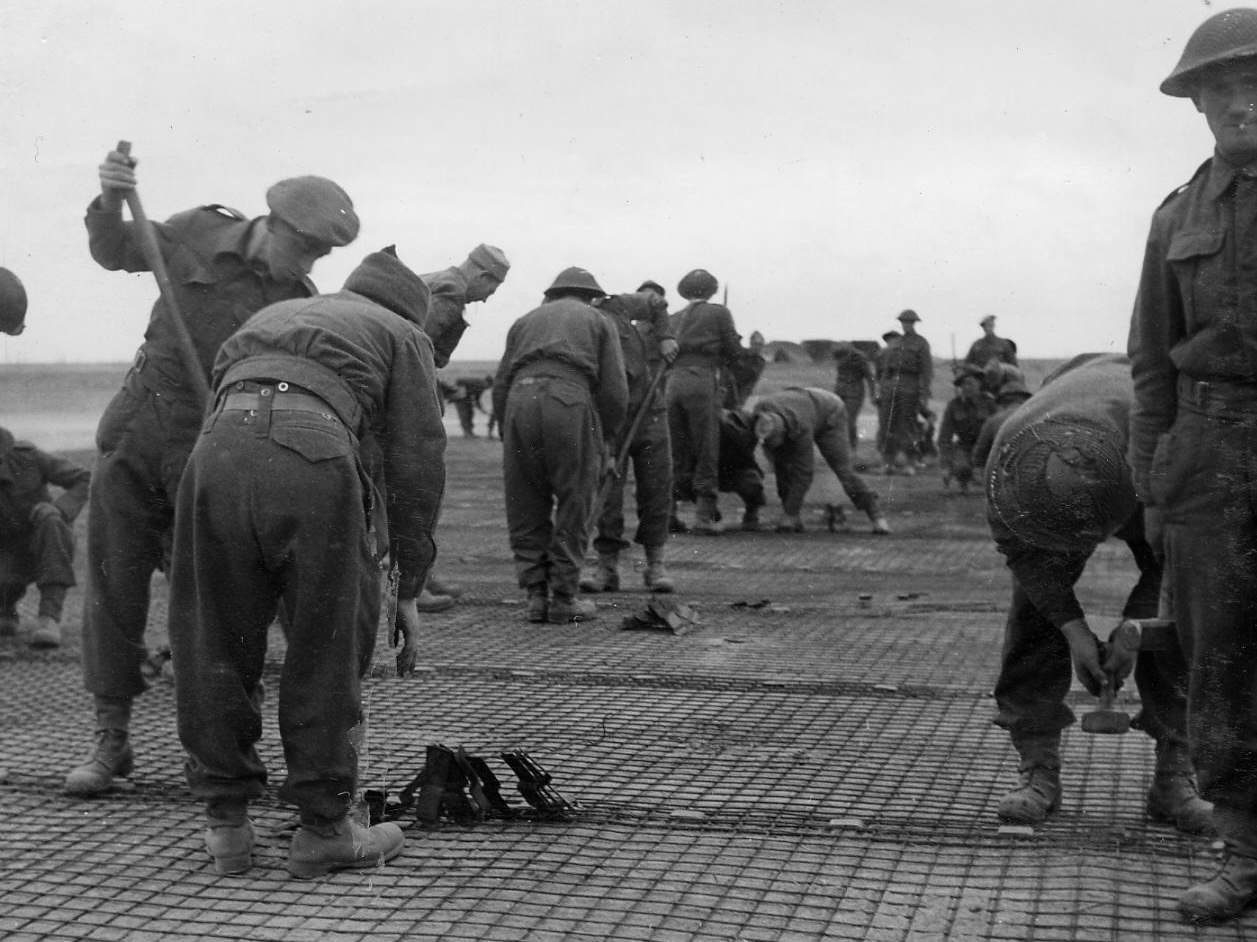
The wire mesh strip or Square-Mesh Track (SMT) which served as a runway was over 5,500 feet long and ran from north to south along the plateau. Surrounding orchards were used to give cover for maintenance hangars and as dispersal points for aircraft requiring servicing. The main HQ was situated at the southern end of the runway and the three squadrons were dispersed to the east and west of it. Anti-aircraft defences were dug in around the perimeters, and slit trenches were adjacent to all working areas.


The observant may notice that I’ve used my Airfix Club kit/decals in this diorama as the one provided with the D-Day Assault kit were for an aircraft which took part in the September’s Operation Market Garden/A Bridge Too Far and not June’s Operation Overlord/The Longest Day

The final diorama 


Saturday, 18 November 2023

Rhubarb over Somerset

After more than 2 months in the making my “Rhubarb over Somerset” diorama is done. If it were to be displayed anywhere I’d add a frame and plaque but over time it will probably be dismantled and its parts repurposed for another creation as it is the building that I find most fun. 

The inspiration for this diorama is a mysterious incident which occurred 80 years ago in Somerset not far from where we live. It was on a summer morning of 4th June 1943 that a Czech fighter pilot of 313 Squadron stationed at RAF Church Stanton (renamed RAF Culmhead in December 1943) clipped the roof of a GWR railway carriage with the wing of his Spitfire Mk.Vc, causing him to tragically crash in a farmer’s field near Bradford on Tone. 

During this period of WW2 the squadron was engaged in ‘Operation Rhubarb’, offensive low-level sweeps over northern France harrying ground targets such as military convoys and trains. It is possible that this pilot was at the time of the incident practicing a low-level attack on a passing locomotive and approached too low to clear the carriages. 

In creating this diorama I’ve incorporated a number of images from the period which although having no historical link to the event of the 4th June could well have been seen at some time or another in the Somerset countryside during the summer of 1943. Look out for the men of the Home Guard manning a pillbox along the Stopline Way, originally built to prevent a German beach invasion getting to London.


The Tank Regiment’s 11th Armoured Division are on the move from Bovington Camp, the Armoured Fighting Vehicles School, preparing drivers, gunners and engineers for D-Day. On the railway bridge a Scammell tank transporter carries a ‘Hobart Funny’, the Churchill Bridge Layer (coincidentally Percy Hobart was the first commander of the 11th Armoured Division when it formed in 1941), while, in the absence of signposts, a group of officers are having to check their map for directions. 

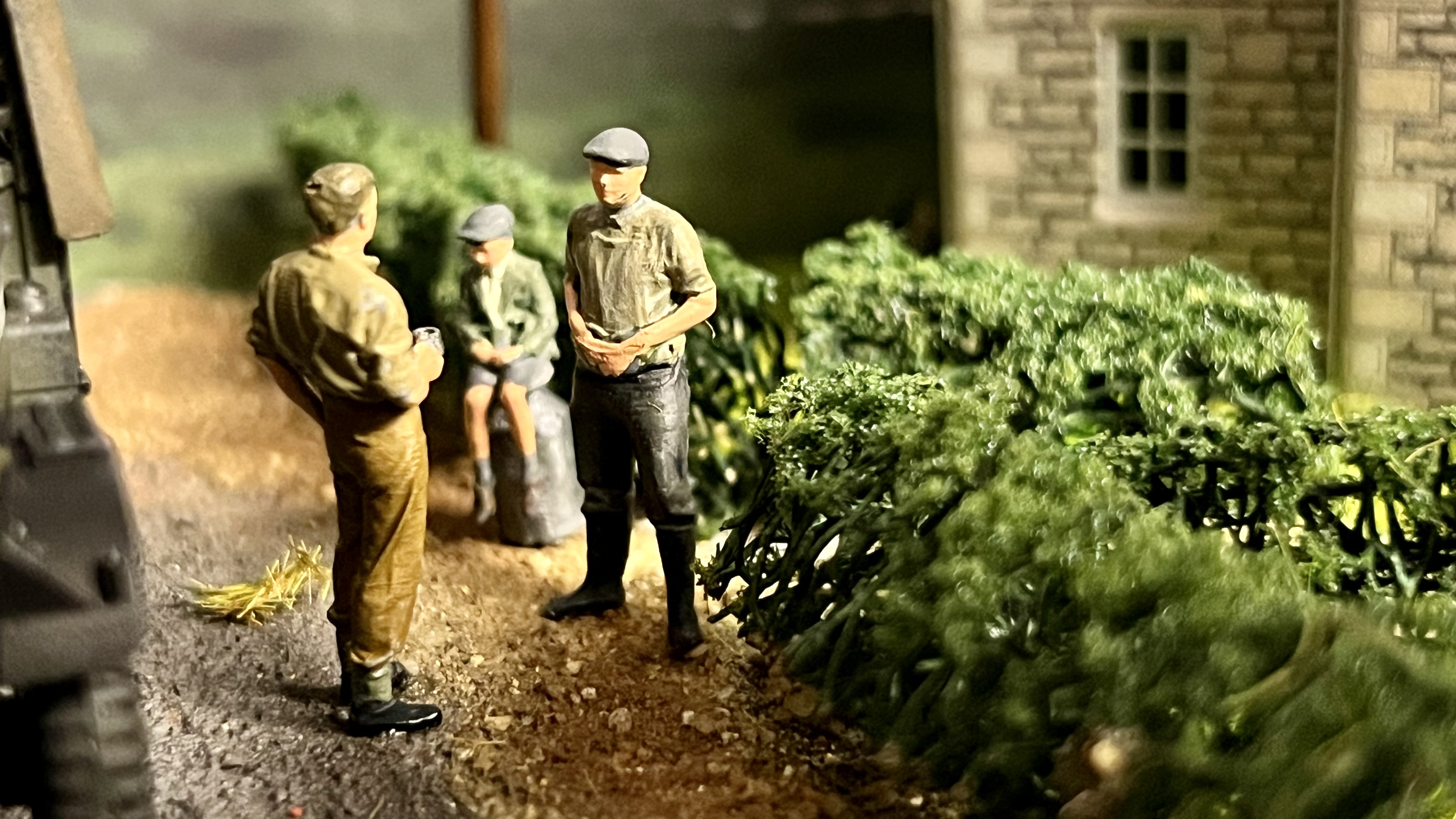
Meanwhile, a farmer shares a cup of tea with a soldier from 88 Brigade Workshop (REME) while a boy watches on sat on a milk churn. 

The railway signalman chats with a fellow soldier while he waits for the train to pass so that the rest of the convoy can proceed over the Bradford level crossing. I like to imagine that the tank transporter should be part of this convoy but they got separated hence now being lost! 

The stars of the scene are the Castle Class locomotive which I’ve repainted in a drab GWR wartime livery and a couple of clipped wing Spitfire Mk.V in RAF Church Stanton markings. The wings are clipped as this configuration was found to improve manoeuvrability at low level. 

Phew!

For those interested, here’s a list  of the 20+ models and figures I’ve used in the making of this diorama:

Airfix 1:72 Spitfire Vc, 1:76 Scammell Tank Transporter, Churchill Bridge Layer, Bedford QLT & QLD Trucks & Willies Jeep. 

Modelu military, farm and railway figures 

Ratio Plastic Models 1:76 Telegraph Poles, Crossing Gates, GWR Signals & Signal Box

Metcalfe 1:76 Stone Style Railway Bridge, Manor Farm House & Pillbox. 

Peco 1:76 Lamp Hut & Wooden Sleeper Tracks. 

Ancorton Models 1:76 Anderson Shelter.

Wednesday, 25 October 2023

Centurion Tank Mk 5/1

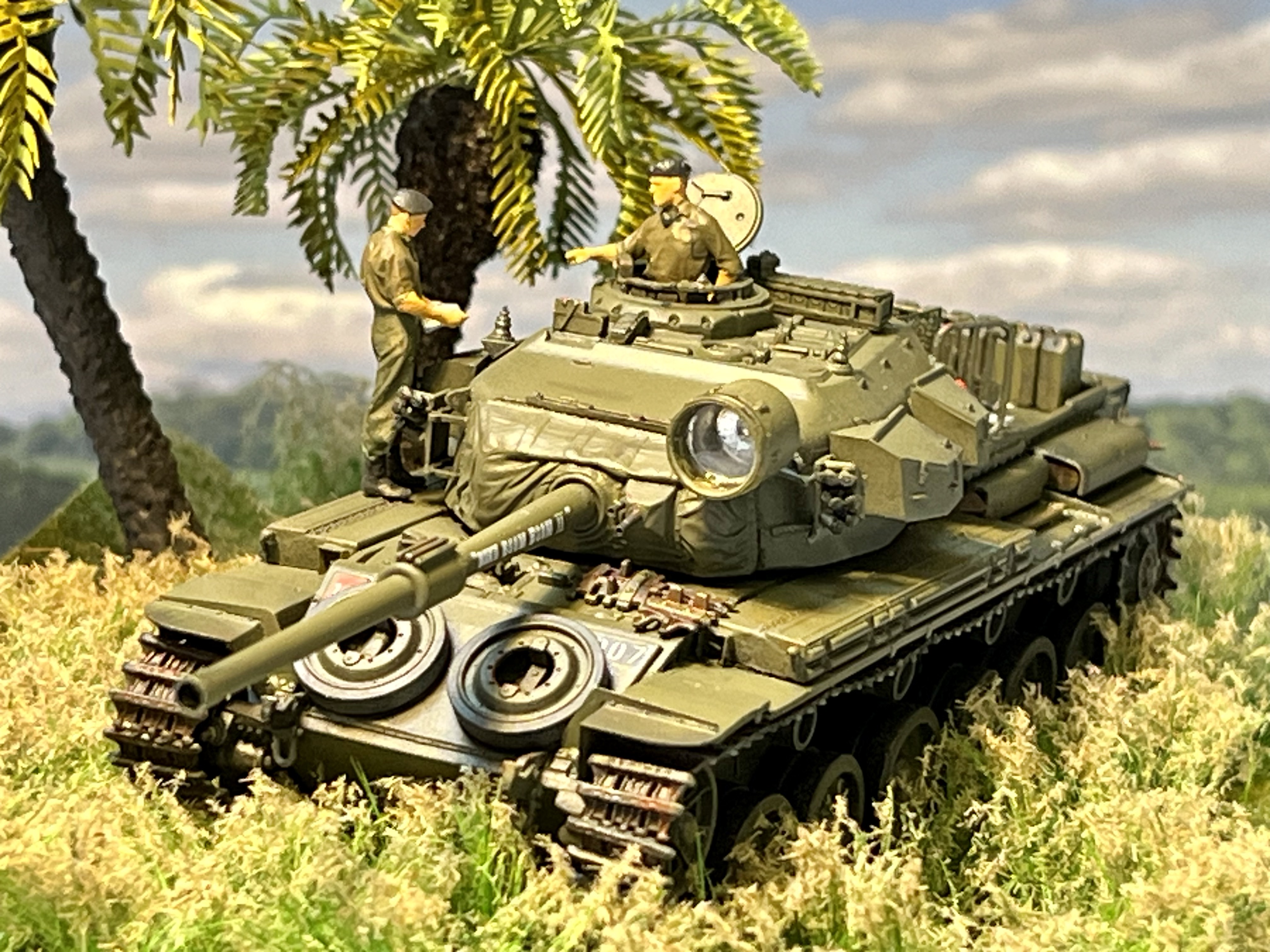
Vespid Models1/72 scale Centurion Tank Mk 5/1. The scheme I’ve gone for is for that of the Australian Army’s ARN 169007, call sign 24A of B Squadron, named “Buku Boom Boom” from 1969 in Vietnam. I’ve also added a couple of excellent Modelu tank crew figures. 

In February 1968 the announcement that a squadron of Centurion tanks was to reinforce the Australian forces in South Vietnam was greeted with skepticism. Critics suggested that the mobility of the heavy tanks would be so curtailed by the rice paddies and jungle that they would eventually become static pillboxes defending the perimeter of bases. It was also argued that an enemy with modern anti-tank weapons could easily destroy the slow and cumbersome Centurions. However, such criticisms were soon to be disproved.

On the morning of 6 June 1969, two Australian Centurions of 4 Troop, B Squadron were making their way northwards along Route 2 in support of infantry when they came under fire from houses in the village of Binh Ba, north of Dui Dat in the Phuoc Tuy province. The Battle of Binh Ba, Operation Hammer, raged for two days, ending on the second mass tank and infantry assault. The battle marked the end of such large-scale clashes, and ranks as one of the major Australian victories of the war.

One of the Centurions involved in the battle was named “Buku Boom Boom”, or more formally ARN 169007, call sign 24A of B Squadron, and it is in the colours of this Centurion Mk. 5/1 that I have finished this excellent Vespas Models 1:72 scale kit. To complete theme, I’ve built a small vignette using a fantastic couple of 3D printed tank crew figures from Alan at Modelu and a super mat of sedge grass and a pair of palm trees from Steven at The Model Tree Shop. I’m liking the finish and hope you do too. 

Friday, 6 January 2023

SS-100 Gigant Transporter & V2

Revell’s SS-100 Gigant Transporter & V2 and 1/72 Special Armour’s A-StoManhänger "Liquid Oxygen Tank for V2 Rocket" mounted with a few British and German figures for effect. I acquired this unusual selection of kits from fellow modelling club member, Roy last year and it’s been really rewarding to complete something a little different. 


I’ve built and finished these complementary kits to reflect a moment during October 1945 when a total of 3 V-2 rockets were launched from a test site at Cuxhaven, Germany, by German POWs under the British supervision, into the North Sea as part of ‘Operation Backfire’. The explosive material in the warheads was steamed out and replaced with sand and for tracking purposes, these rebuilt missiles were painted in a black-and-white checkered pattern, similar to the early Peenemünde rocket schemes that were first tested 3 years earlier. 


In June 1945, General Eisenhower approved Operation Backfire, the British initiated Operation put forward by J. C. C. Bernard, A.T.S., Personal Assistant to Major-General Cameron, head of the British Air Defense Division. The objective of the Operation was to provide the knowledge and skills of guided ballistic missiles, to ascertain the German technique of launching long-range rockets and to prove it by performing an actual launch. Following the successful conclusion of the tests, the War Office in London issued a 5-volume report detailing these operations. Operation Backfire resulted in one of the most comprehensive evaluations and documentation of the total V-2 weapons architecture, not only by the Allies, but also the Germans!

If you’re interested in reading more, then check out this amazing article with photos and links to the 5-volume report. http://www.v2rocket.com

BLOGGER IS DEAD LONG LIVE FACEBOOK & INSTAGRAM

It's been a blast Blogger, but not being able to upload any photos of my builds to this blog really makes you meaningless going forward....