Showing posts with label Tim Peake. Show all posts

Friday, 2 April 2021

International Space Station (Phase 2007)

Just to recap, for Christmas, I received the gift of Tim Peake's autobiography 'Limitless'. As the subjects of my scale models are inspired by events and observations, it should be no surprise that this inspiring book has steered me to kick off a mini project focussing on 3 of vehicles which feature in the 3 phases of Tim's flying career. The Army Air Corps helicopter pilot, test pilot and astronaut. 

Tim Peake the Astronaut

In 2010, following his initial 4 years with the Army Air Corps as a Gazelle helicopter pilot and 12 years as  instructor and test pilot on the AH-64 Apache helicopter, Tim graduated as an Astronaut with the European Space Agency. 

On 11th December 2015 Tim became the first Britain in space when he was assigned to Expedition 46 to the International Space Station (ISS). Tim launched on the Russian Soyuz TMA-16M rocket from the Baikonur Cosmodrome, Kazakhstan with fellow astronauts, Sergey Volkov, Mikhail Kornienko, Yuri Malenchenko and Timothy Kopra, for the 4 hour flight to join Commander Scott Kelly who would be remaining on ISS while the earlier Expeditions' crews, whom Tim and team were replacing, departed for earth.

ISS Expedition 46 patch, 2015

The 46 icon in the foreground of the patch represents the forty-sixth expedition mission to the International Space Station. Earth is depicted at the top with the flags of the countries of origin of the crew members: the United States, Russia and the United Kingdom. The Union flag of the UK is displayed in a position of prominence in recognition of the significance of the first British ESA astronaut to fly in space. The outer border is in the shape of a triangle with an unbroken border, symbolising the infinite journey of discovery for past, present and future space explorers. The names of the six Expedition 46 astronauts and cosmonauts are shown in the border.

Tim's mission of gravity free experiments and even a space walk, concluded on 1 March 2016 when he bounced down to earth landing on the Kazakh Steppe, a vast region of open grassland in northern Kazakhstan. His was possibly a harder landing than this counterparts on Apollo missions I remember from my youth landing in the Ocean! or better still that experience by the Shuttle crews of the 1980s. 

The International Space Station (ISS)

NASA's idea of the space station was first publicly shared in 1963 at the most unlikely venue, the Ideal Home Exhibition! The space station would be the springboard to the planets but it took until 1984 for President Reagan to actually authorise NASA to begin work on a space station and to 'do it within a decade'. 

The Soviet space program, having lost the race to the moon, meanwhile, had been launching space stations for 20 years. Their Salyut series of space stations first launched in 1971were followed up with the Mir (peace) space station in 1986. Mir presaged a new capability for keeping people in space, using the building block approach to expand the facility into a fully equipped laboratory.

After the collapse of the Soviet Union on 25 December 1991, Russia lost territory, natural resources, manpower, factories and government facilities now located in what, almost overnight, became foreign countries. There was just enough money to maintain the Mir programme but their shuttle Buran was abandoned. In June 1992, President George Bush of USA and President Boris Yeltsin of Russia signed an agreement pledging cooperation through Shuttle missions to Mir. This resulted in the setting up of frequent ferrying flights of Russian cosmonauts aboard the Shuttle and Americans aboard a Soyuz between Earth and the Mir Space Station.

International Space Station ISS (Phase 2007)

This relaxation in political tension led in 1993 to Bill Clinton's presidential decision requesting NASA bring in Russian expertise and forge a new working relationship within a five-team partnership comprising the USA, Russia, Europe, Japan and Canada to create a truly International Space Station - the ISS.

ISS Phase One - missions to Mir. Following agreement to merge their efforts, NASA and its Russian counterpart set to work planning a series of missions that would prepare the way for assembly of an international laboratory in space - one hosing astronauts from several countries. 

ISS Phase Two - the assembly. By 1995 the scale of the ISS had grown to 75 assembly flights in a complex schedule of launches planned to start in November 1997 and finish in June 2002. By 1997 this had been paired back to 45 and the final configuration settled. The agreement was for a 'T' configuration for the ISS modules with 8 solar panels, 4 extending from each end of the top of the "T' called the truss assembly. Nodes would be sighted down the length of the 'T' connecting the European Colombus and Japanese JEM modules to the US and Russian modules which were the first to assembled. 

The first module launched was planned to be built by Boeing in the US, but as costs spiralled NASA pushed for Boeing to cancel their build and pay Russia for a replacement. In November 1998 the Russian built Zarya (Sunrise) model was launched. Visually similar to the Mir core module and designed primarily for living and working in, it would initially serve as a powerhouse and tug. 

The second ISS element lifted into space in December 1998, was the first of 3 nodes called Unity, it was the first piece of US hardware. The nodes are places where engineering and systems equipment are located while doubling as connectors between modules and other structures. 

The third element was the Russian-owned Service Module Zvezda (Star), launched in July 2000, delayed 2 years by holdups in manufacturing and postponed launch dates.

Annotated with ISS Phases Two to Three

ISS Phase Three - permanent habitation. The arrival of the Solar Arrays in December 2000 would enable the station to provide a permanent home and work environment for its occupants. February 2001 saw the Space Shuttle Atlantis attach the 13 tonne US Destiny science laboratory to the Unity Node delivered 3 years earlier. Additional trusses and solar arrays followed.

ISS Phase Four - final assembly. With the anticipation high for an early completion of the giant station, hopes were dashed when the only vehicle capable of transporting large loads into space was grounded. The loss of the Shuttle Columbia in 2003 held up assembly for almost four years, while the Russians ferried crews back and forth to ISS. 

In August 2007 Endeavour was the first Space Shuttle since 2003 to resume flights to the space station and enable the final assembly to be completed. Between 2007 and 2011 the final elements comprising, 4 further solar arrays, the final 2 nodes, the European Lab - Columbus Orbital Facility, Japan's Jem modules, Canada's remote arm, and the Science Power Platform were all delivered, completing - for now at least - the ISS assembly.

The Model

I was amazed to learn that anyone had created a scale model of ISS, so was thrilled to lay my hands on this Dragon 1:400 scale kit, even if it was based on its assembly as at 2007, prior to the Shuttle flights resuming after the 2003 Columbia tragedy. 

Dragon's 1:400 Scale Kit and my Haynes Owner's Workshop Manual to assist in construction!

This kit, therefore, shows ISS as it would have looked after completion of Phase Three rather than how Tim would have seen it when he arrived in 2015.

Just need to put it together now 


The finished model before adding the CGI background


The Model

Brand: Dragon
Title: International Space Station (Phase 2007)
Number: 1102
Scale: 1:400
Type: Full kit
Released: 2020 | Initial release - new tool


Monday, 15 March 2021

Westland Gazelle SA.341 / AH.1

For Christmas, I received the gift of Tim Peake's autobiography 'Limitless'. As the subjects of my scale models are inspired by events and observations, it should be no surprise that this inspiring book has steered me to kick off a mini project focussing on 3 of vehicles which feature in the 3 phases of Tim's flying career. The Army Air Corps helicopter pilot, test pilot and astronaut. 

Tim Peake's Gazelle

In 1993, at the age of 21, Tim's Army Pilot's Course began. Once he'd mastered the Chipmunk fixed wing training aircraft, it was onto the Gazelle helicopter, nicknamed the 'screaming chicken leg' on account of its shape and high-pitched, whining engine. 

After earning his wings, Tim signed up for 4 years of operational service. His first posting as a rotary wing pilot was at Gutersloh in Germany, with 1 Regimental Army Air Corps (AAC) 652 'Chosen Few' Squadron. Here, he learned to ski, parachute and witnessed the failing of the Gazelle's rota blade fixings causing them to be grounded for some time. Apart from routine flying, in the absence of a plane, he would also assist the ACC parachute team with their Friday practice, taking the doors off his Gazelle, removing one of the front seats and fly up to 10,000 feet and let them jump out!

With flying in Germany being a little too tame, in May 1995, Tim opted for a short flying tour in Northern Ireland. Working closely with the RUC and intelligence services, he flew the City Flight, providing overwatch for Belfast city. Having his Gazelle loaded with sights and sensors, attached to a stores boom, and additional armour protection, it was heavier than any he'd previously flown. There were also a couple of new flying manoeuvres to master. Being based at Palace Barracks in the city, necessitated the 'rapid descent landing', to avoid any chance of being shot down as he came in to land. This manoeuvre required him dropping the Gazelle from 3000 feet to the ground, reaching a downward speed of up to 130 mph! 


In the spring of 1996, now freshly promoted to captain, Tim was sent on a six-week detachment to Laikipia County, Kenya as flight commander of 652 Squadron's Gazelle flight. Here, his first duty of the day was to take off from his base at Nanyuki, shortly before dawn, to run Exercise Grand Prix. This involved herding elephants off the live firing range at Maple Farm, something which some of the elephants took unkindly to, with the large bull elephants coming close to swatting his helicopter from the sky! As well as flying casualty evacuation and VIP transportation, he also assisted a wildlife conservation team in darting rhinos for tagging purposes; very different flying action to the usual AAC operations. Following this, Tim deployed to Bosnia for Operation Resolute where he dodged AK47 small arms fire and finished his tour by flying the Gazelle the 2,000 km home to Wattisham, Suffolk!

In 1997, with his 4 year tour coming to an end, Tim took his Gazelle to Canada to take part in the BATUS (British Army Training Unit Suffield) military exercises, providing reconnaissance support and casualty evacuations. Following the exercise, he returned to his unit in Germany to complete his operational service, and then moved back to the UK to train as a Qualified Helicopter Instructor, a step closer to becoming a test pilot.

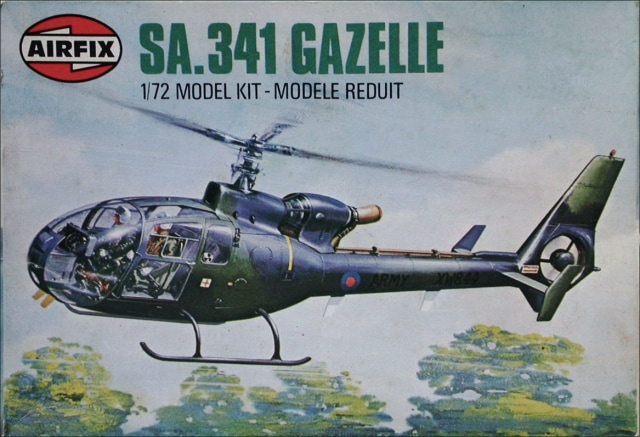
I have painted my Airfix 1:72 scale model of the SA.341 Gazelle in the grey / green camouflage of that Tim's helicopter would have been painted in during his 1995 City Flight and 1996 Kenya assignments. Prior to this, from the 1970s through to the 1982 Falklands War, it would have been seen in its earlier black / green scheme, as depicted on the kit's box and in the instructions. 

The 1980s decals were well past their best and the 1970s red, white & blue roundels unsuitable for this variant. I, therefore, had to dig into my extensive spares box for an unused set of XT131 Bell Sioux AH Mk1 'Army' label and 'XT131' serial number and a Sea Harrier's set of small roundels, all of which were just the right size.

The History of the Gazelle

The Westland Gazelle entered service with all branches of the British Armed Forces from 1973/4, with the SA.341B being especially equipped to a specification for the Army Air Corps as the Gazelle AH.1 (from Army Helicopter Mark 1).  It was designed by Sud Aviation, later Aérospatiale, and manufactured in France and the United Kingdom through a joint production agreement with Westland Aircraft. Originally based on a French Army requirement for a lightweight observation helicopter, it was enlarged to carry 2 crew and 3 passengers to enable greater versatility and make it more attractive for the export market. 

The type was also frequently used to perform airborne patrols in Northern Ireland. On 17 February 1978, a British Army Gazelle crashed near Jonesborough, County Armagh, after coming under fire from the Provisional IRA during a ground skirmish.

During the Falklands War, the RNAS Gazelles operated from the flight decks of Royal Navy ships where they were fitted with 68mm SNEB rocket pods and various other optional equipment such as armour plating, flotation gear and folding blade mechanisms. Two Royal Marines Gazelles were shot down on the first day of the landings at San Carlos Water. In a high-profile incident of friendly fire on 6 June 1982, an Army Air Corps Gazelle was also mistaken for a low-flying Argentine C-130 Hercules and was shot down by HMS Cardiff', a British Type 42 destroyer.

The Gazelle was operated in reconnaissance and liaison roles during the 2007 War in Afghanistan where it was reported that, while many British helicopters had struggled with the conditions of the Afghan and Iraqi theatres, the Gazelle was the "best performing model" with roughly 80% being available for planned operations. Gazelles have also served in other theatres, such as the 1991 Gulf War against Iraq and in the 1999 intervention in Kosovo. 

In 2009, the Army Air Corps was the sole operator of the Gazelle with approximately 40 in service with the expectation they be decommissioned in 2012. However, in July 2016, the Ministry of Defence announced that the Gazelle would remain in service until 2025 taking the Gazelle past its 50th anniversary in UK military service and making it the oldest helicopter in active UK inventory.

----


The Model

Brand: Airfix
Title: SA.341 Gazelle
Number: 9-61059
Scale: 1:72
Released: 1981 | Rebox (Changed box only)


BLOGGER IS DEAD LONG LIVE FACEBOOK & INSTAGRAM

It's been a blast Blogger, but not being able to upload any photos of my builds to this blog really makes you meaningless going forward....