Showing posts with label Diorama. Show all posts

Friday, 25 April 2025

The Cernak Incident, June 1943

 I’ve just completed this railway and aircraft diorama for one of my local WW2 airfield museums.

On the 4th June 1943 “ A” flight from the Czechoslovakian Squadron 313 based at RAF Culmhead (Formerly RAF Church Stanton ) was ordered to take off and undertake low flying practice that included “mock” attacks on trains travelling on the Plymouth to Bristol main railway line near Bradford upon Tone, 4 miles west of Taunton. 

During the training flight a GWR express train from Plymouth to Liverpool was spotted heading North to Taunton and so the flight decided to undertake a mock “attack” on the train. 

One of the pilots, F/O Jaroslav Cermak, was sweeping in to make his attack when unfortunately either due to Pilot error or mechanical failure he suddenly lost power and instead of pulling up over the train the aircraft lost speed and hit the roof of the second coach with his port wingtip. It crashed into the adjoining field killing the pilot instantly. 

I’m proud to say that this diorama can be seen today in the RAF display at the Upottery Airfield Visitor Centre, the same airfield the 101st Airborne Division’s “Band of Brothers” departed from on the morning of 6 June 1944.  

Wednesday, 24 April 2024

D-Day Air Assault

Airfix 1:72 D-Day Air Assault kit A50157A built to interpret ALG. B5/Le Fresne-Camilly, Normandy, France, home of Typhoon MN625 MR-B of No.245 (Northern Rhodesian) Squadron, 121 Wing, 2nd TAF. June 1944.

MN625 was flown by Fg.Off. W Smith who, on 10 June 1944, was made famous as being the first Allied pilot to land at one of the Advance Landing Ground (ALG) airfields in Normandy. This is how the Squadron’s Operations Book recorded it: 

“At 0520 hours eight aircraft with R.P. and two fighters airborne to attack reported position of H.Q. Panzer Division. Intense flak of all types was encountered but despite this and much cloud the target was located and successfully attacked. F/O W.Smith was hit by flak and reported excessive vibration and much oil on the windscreen. He was instructed by W/Cdr. Green (who was leading) to put down on the ALG at Banville (B3/Ste Croix-sur-Mer) east of Bayeux. This he did successfully. He was met by a swarm of photographers and high officers who informed him that he was the first pilot to make a wheels down landing in France since D-Day. Apparently this honour was being saved for Air Vice Marshal Broardhurst who arrived some time later in a Spitfire!”

On 17th June, the Advance Landing Ground (ALG) B5/Le Fresne-Camilly was to be 245 Squadron’s new home. This was the fifth airfield to be established in the British and Canadian sector of the Normandy landings. Only about four miles inland from the invasion beaches, it had only recently been freed from shell-fire which had come from German units dug into surrounding woods. 

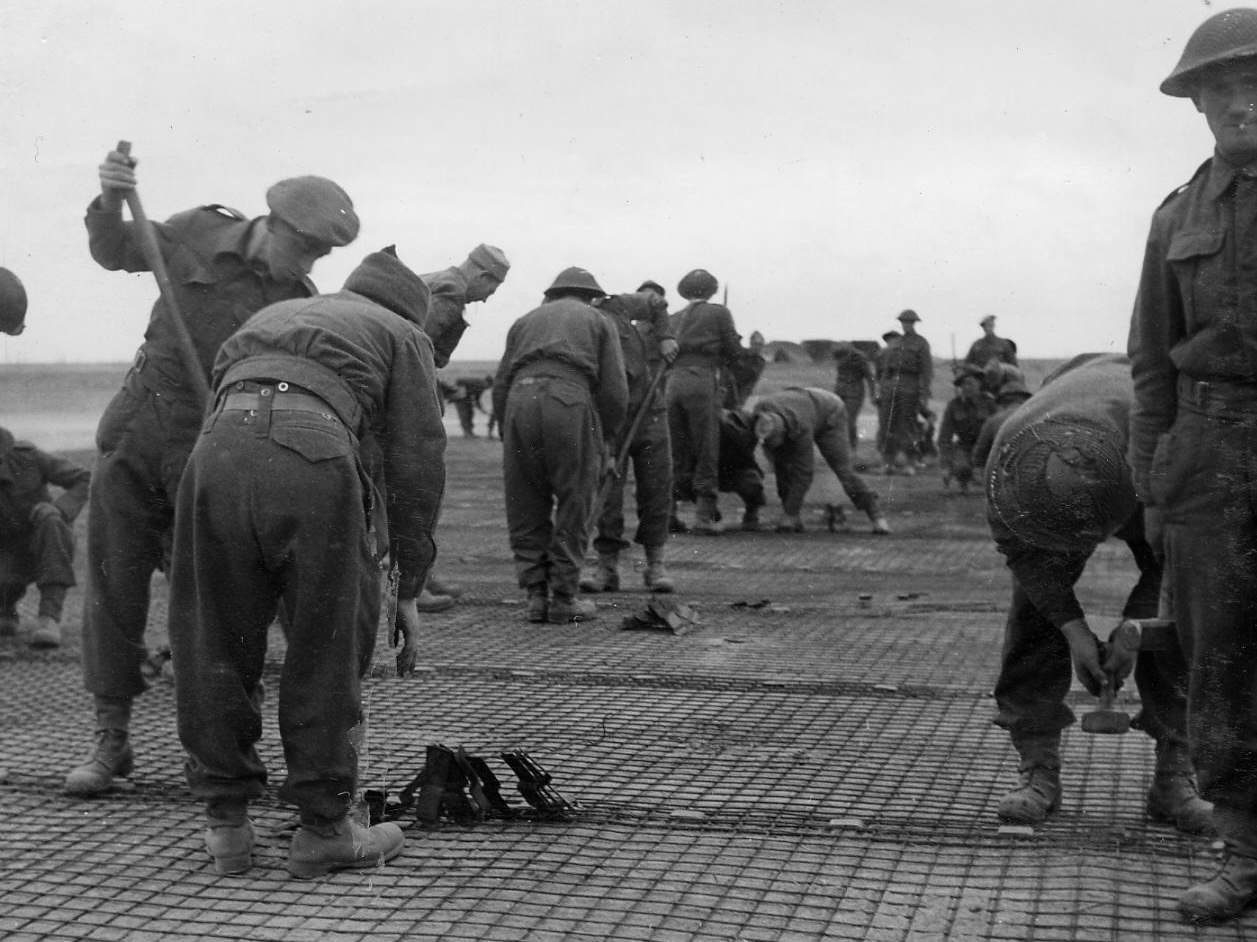
The wire mesh strip or Square-Mesh Track (SMT) which served as a runway was over 5,500 feet long and ran from north to south along the plateau. Surrounding orchards were used to give cover for maintenance hangars and as dispersal points for aircraft requiring servicing. The main HQ was situated at the southern end of the runway and the three squadrons were dispersed to the east and west of it. Anti-aircraft defences were dug in around the perimeters, and slit trenches were adjacent to all working areas.


The observant may notice that I’ve used my Airfix Club kit/decals in this diorama as the one provided with the D-Day Assault kit were for an aircraft which took part in the September’s Operation Market Garden/A Bridge Too Far and not June’s Operation Overlord/The Longest Day

The final diorama 


Saturday, 18 November 2023

Rhubarb over Somerset

After more than 2 months in the making my “Rhubarb over Somerset” diorama is done. If it were to be displayed anywhere I’d add a frame and plaque but over time it will probably be dismantled and its parts repurposed for another creation as it is the building that I find most fun. 

The inspiration for this diorama is a mysterious incident which occurred 80 years ago in Somerset not far from where we live. It was on a summer morning of 4th June 1943 that a Czech fighter pilot of 313 Squadron stationed at RAF Church Stanton (renamed RAF Culmhead in December 1943) clipped the roof of a GWR railway carriage with the wing of his Spitfire Mk.Vc, causing him to tragically crash in a farmer’s field near Bradford on Tone. 

During this period of WW2 the squadron was engaged in ‘Operation Rhubarb’, offensive low-level sweeps over northern France harrying ground targets such as military convoys and trains. It is possible that this pilot was at the time of the incident practicing a low-level attack on a passing locomotive and approached too low to clear the carriages. 

In creating this diorama I’ve incorporated a number of images from the period which although having no historical link to the event of the 4th June could well have been seen at some time or another in the Somerset countryside during the summer of 1943. Look out for the men of the Home Guard manning a pillbox along the Stopline Way, originally built to prevent a German beach invasion getting to London.


The Tank Regiment’s 11th Armoured Division are on the move from Bovington Camp, the Armoured Fighting Vehicles School, preparing drivers, gunners and engineers for D-Day. On the railway bridge a Scammell tank transporter carries a ‘Hobart Funny’, the Churchill Bridge Layer (coincidentally Percy Hobart was the first commander of the 11th Armoured Division when it formed in 1941), while, in the absence of signposts, a group of officers are having to check their map for directions. 

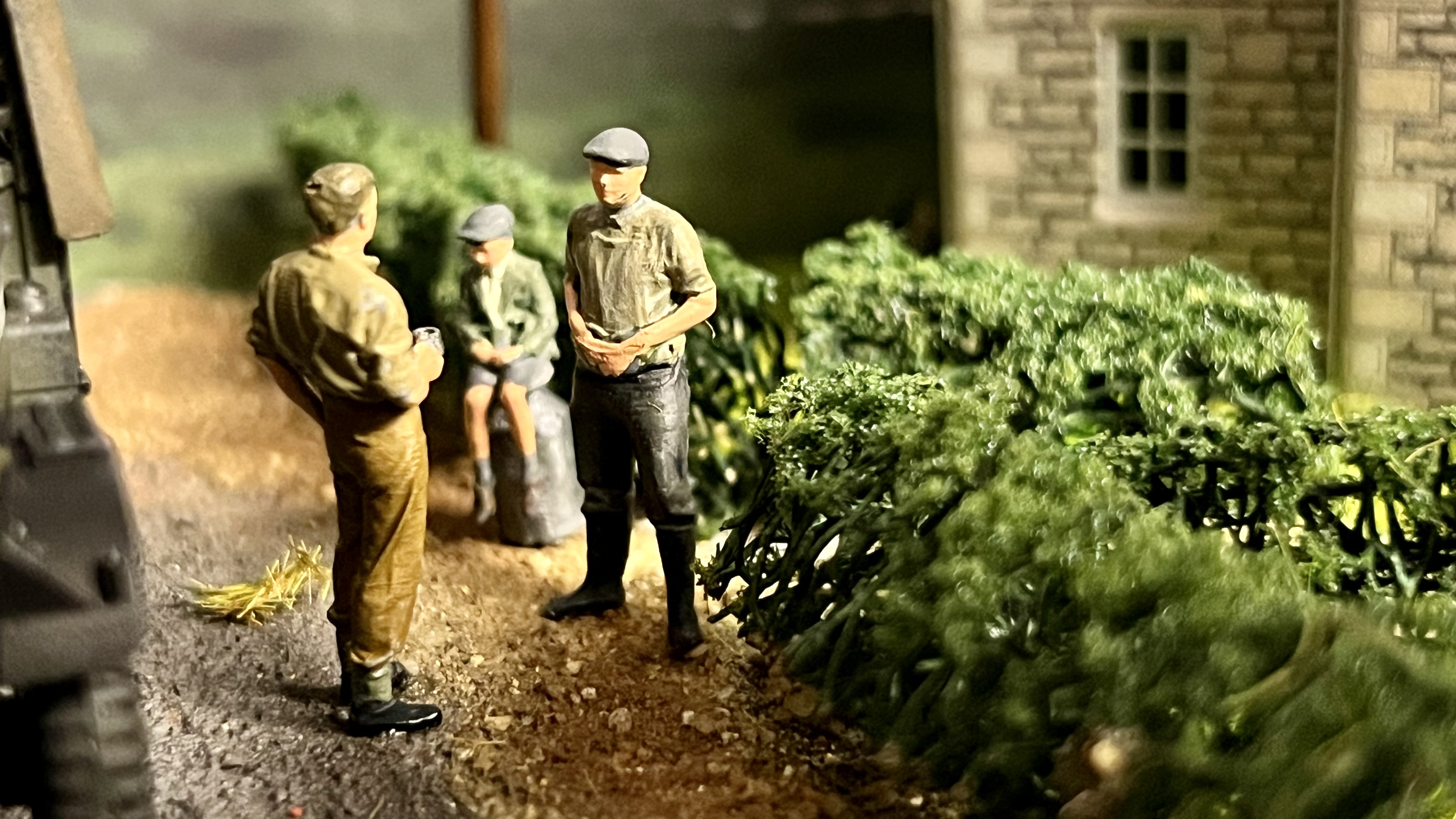
Meanwhile, a farmer shares a cup of tea with a soldier from 88 Brigade Workshop (REME) while a boy watches on sat on a milk churn. 

The railway signalman chats with a fellow soldier while he waits for the train to pass so that the rest of the convoy can proceed over the Bradford level crossing. I like to imagine that the tank transporter should be part of this convoy but they got separated hence now being lost! 

The stars of the scene are the Castle Class locomotive which I’ve repainted in a drab GWR wartime livery and a couple of clipped wing Spitfire Mk.V in RAF Church Stanton markings. The wings are clipped as this configuration was found to improve manoeuvrability at low level. 

Phew!

For those interested, here’s a list  of the 20+ models and figures I’ve used in the making of this diorama:

Airfix 1:72 Spitfire Vc, 1:76 Scammell Tank Transporter, Churchill Bridge Layer, Bedford QLT & QLD Trucks & Willies Jeep. 

Modelu military, farm and railway figures 

Ratio Plastic Models 1:76 Telegraph Poles, Crossing Gates, GWR Signals & Signal Box

Metcalfe 1:76 Stone Style Railway Bridge, Manor Farm House & Pillbox. 

Peco 1:76 Lamp Hut & Wooden Sleeper Tracks. 

Ancorton Models 1:76 Anderson Shelter.

Monday, 25 September 2023

Malayan Emergency Casualty Evacuation (1955)

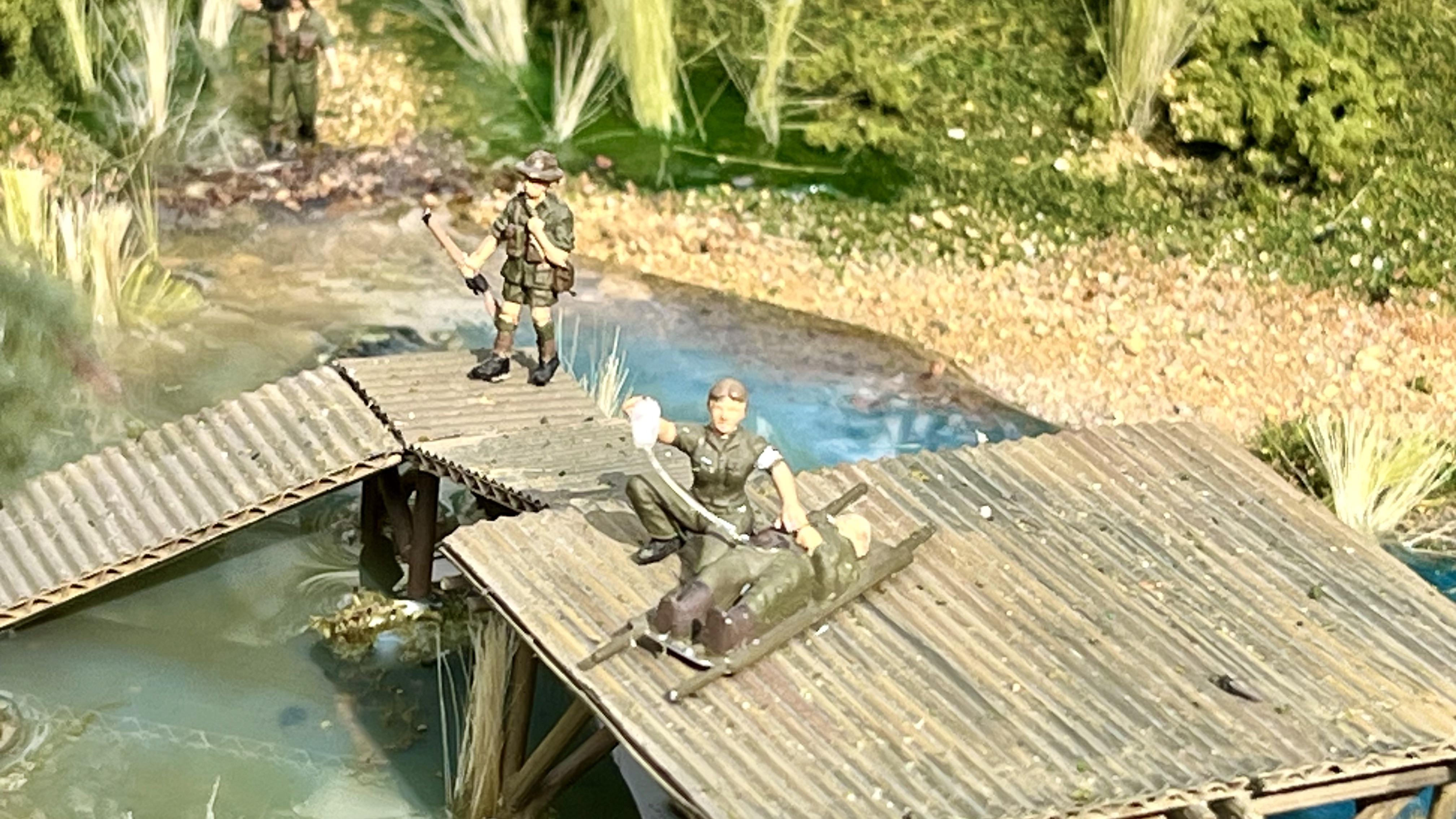
When in 2020, I built Glencoe Model's Bristol Sycamore, I placed it in a jungle casualty evacuation scene set during the 1950s Malayan Emergency. My focus then was on the model and the historical backstory that was more important to me than the diorama I created to display it. After 3 years exposed to modelling fumes and paint spray in the loft, time had taken its tole on both diorama and model. Had it not had such historical and emotional connection, and with a new project in the planning and space being a premium, I would have just 'black bagged' it - a fait already met by my early Vietnam, Korea, and Falklands dioramas! 

Having a plan for a new epic diorama, I thought refreshing this old Malayan scene, keeping true to my original vision but applying skills honed over the past few years - this one having been my first ever proper scale modelling diorama - would give me some much needed practice. 


I dusted down the old diorama clearing all the loose foliage and figures and built my own wooden frame in which to both display it and to give it extra strength, its original base having been just cardboard glued to a larger 'multi diorama' base.


As well as giving the land a new layer of grass and a good covering of undergrowth, I 'borrowed' trees from my Pegasus Bridge diorama - it will be due its own makeover in a year or so - and dug out an old bottle of scenic water. I got a bit carried away with the water, adding a feeder river to my lake, which on reflection probably adds a bit more realism to the scene.


I strategically placed reeds around the new river and dusted off the figures. I didn't think they looked too bad for their years, so left them with their original paint. 


The old Sycamore model was also looking OK to my eye. Yes, if I were building it today, I'll have added a bit of weathering but I was keen to keep it as original to my 3 year old self and so just gave it a clean.


When doing a little more research on the period I came across this picture of a Westland Whirlwind ... 


 .. so as I hast happened to have a Whirlwind in my collection, thought why not!

Finally, here's a little video to complete the project ...


I now feel suitably ready to move on to the next one :) 


Monday, 28 August 2023

Spitfire & GWR 6100-class - Rhubarb Over Somerset 1943

This, my second scale model build of an aircraft and train, is inspired by a local story I recently came upon of which there is much supposition - thus any inaccuracies in my understanding or retelling are solely my own! 

The Story as I understand it  …

Between June 1942-June 1943 No.313 Squadron, the third Czechoslovakian fighter squadron to be formed within the RAF, was stationed at Church Stanton, near Wellington in Somerset. During this time the squadron, flying the Spitfire Mk Vb and Vc, took part operation ‘Rhubarb’, the offensive low-level sweeps over northern France to destroy ground targets. 

Having escaped the advancing German army a 26 year old Czech pilot, Jaroslav Čermák, joined the RAF on 26th February 1941. Over a year later he earned his RAF wings, was promoted to Flying Officer and on 12th April 1943 assigned to No. 313 (Czech) Squadron RAF.

On 4th June 1943, at 10:05 hours, Čermák and three other pilots took-off on an operation ‘Rhubarb’ training flight. Their task was to practice a low-level attack on a train. They came across a GWR locomotive and carriages en route from Plymouth to Liverpool near Bradford-on-Tone, Somerset. After one successful pass they made a second approach on the target. Čermák flying his Spitfire Mk.Vc serial AR512 this time applied insufficient power, got too close and when his Spitfire lost stability, it clipped the roof of one of the carriages with a tip of port wing. The aircraft rolled over and crashed approximately 100 metres from the line, in a field at Langs Farm, Bradford on Tone, just to the east of what is known today as Three Chimneys. Čermák was instantly killed in the crash and at least one Wren aboard the train was reportedly injured by flying glass.

The models …

For the Spitfire I repurposed a low-level configuration clipped wing 1:72 scale Revell Mk.Vc from my collection and added the Church Stanton “RT” Squadron markings. We’ve yet to identify the correct aircraft letter so I left my original aircraft’s “V” in place, and, although we know Čermák’s serial was AR512, for those with a mind to look, I’ve also left it with the old serial number too. 


The actual locomotive is unknown and may probably have been a Castle Class, however, as a scale model of this 4-6-0 type was not available, I’ve gone for Dapol’s OO scale GWR Prairie Tank 6100 Class while my friends at Buffers Model Railways remain on the lookout for a Castle Class. I also managed to get hold of a slightly damaged GWR carriage which I repainted in war colours of red brown sides, gold band and black roof.


Update - September 2023

I now have a Castle Class engine and more carriages. New diorama will be constructed and I will share as soon as I can.


Friday, 6 January 2023

SS-100 Gigant Transporter & V2

Revell’s SS-100 Gigant Transporter & V2 and 1/72 Special Armour’s A-StoManhänger "Liquid Oxygen Tank for V2 Rocket" mounted with a few British and German figures for effect. I acquired this unusual selection of kits from fellow modelling club member, Roy last year and it’s been really rewarding to complete something a little different. 


I’ve built and finished these complementary kits to reflect a moment during October 1945 when a total of 3 V-2 rockets were launched from a test site at Cuxhaven, Germany, by German POWs under the British supervision, into the North Sea as part of ‘Operation Backfire’. The explosive material in the warheads was steamed out and replaced with sand and for tracking purposes, these rebuilt missiles were painted in a black-and-white checkered pattern, similar to the early Peenemünde rocket schemes that were first tested 3 years earlier. 


In June 1945, General Eisenhower approved Operation Backfire, the British initiated Operation put forward by J. C. C. Bernard, A.T.S., Personal Assistant to Major-General Cameron, head of the British Air Defense Division. The objective of the Operation was to provide the knowledge and skills of guided ballistic missiles, to ascertain the German technique of launching long-range rockets and to prove it by performing an actual launch. Following the successful conclusion of the tests, the War Office in London issued a 5-volume report detailing these operations. Operation Backfire resulted in one of the most comprehensive evaluations and documentation of the total V-2 weapons architecture, not only by the Allies, but also the Germans!

If you’re interested in reading more, then check out this amazing article with photos and links to the 5-volume report. http://www.v2rocket.com

Thursday, 9 June 2022

B-24 Liberator & Ju88

My 1:144 scale B-24 Liberator & Ju88 kits are built for another Dunkeswell diorama.


This one will be set on  4th September 1943 when six Ju-88 of 13/KG40 intercepted VB-103’s Lt James H Alexander’s B-24 ‘G’ B-7 “Impatient Virgin” off the Spanish coast. 


B-24 Liberator v Ju-88 diorama at Dunkeswell 

4th September 1943

VPB103: Lt. James H Alexander intercepted by 6 Ju-88s. 

During an antisubmarine patrol from Dunkeswell, Lt James H Alexander and crew were intercepted by six Ju-88 C fighters over the Bay of Biscay. During the attack, Alexander’s gunners shot down one of the Ju-88s flown by Lt Gerhard Blankenberg and crippled three others. His B-24 Liberator, numbered B-17 “G” and named Impatient Virgin was, however, damaged and unable to return to Dunkeswell. With flying instruments rendered inoperative and her four engines badly damaged, despite a painful head wound, Alexander effected a safe landing at sea.


Successfully abandoning the aircraft, he and his crew rode out a severe storm in a rubber life raft for 36 hours before being rescued by a passing Spanish fishing vessel. 

After a month recuperating, they were all repatriated back to England.

Lt James H Alexander was awarded the Navy Cross, his co-pilot and navigator the Distinguished Flying Cross and his crew the Air Medal. 

Sadly, on 3rd December 1943, Alexander, like so many of his fellow airmen, was to die in a training accident, at the age of just 23 years old.  

He has a cenotaph in Memorial Park Cemetery, Sioux City, USA

Thursday, 31 March 2022

Forward Operating Base

Completed updating my Falklands forward operating base for the RAF '1F' Harrier under protection of a Rapier missile battery. 


Thursday, 17 March 2022

Models To Dunkeswell

I packed up my B-24 US Navy Liberators and U-Boats this morning for the short trip to their new home at the Dunkeswell Memorial Museum / Dunkeswell Airfield WW2


I’m so pleased these can be put to such a great educational use, rather than gather dust in my loft or display cabinet! I highly recommend a visit to Dunkeswell should you ever be down this way. 

https://www.southwestairfields.co.uk

Thursday, 9 September 2021

M18 Hellcat

I've just finished a new mini diorama after fancying a very different challenge after picking up this Airfix Hellcat from the new stock that had just landed at my local Seaton Hobby Shop. 

This is my first foray into 1:35 scale modelling which I thought would provide an interesting take on the 3rd 'Saints and Soldiers' film "The Void". To complete the scene I wanted to portray, I added a Jeep, recently purchase from my first collector’s fair in 2 years, and as Airfix don’t include figures, a box of Tamiya's tank crew was needed to give a bit more reality to the diorama which I’ve placed on this Heller base. Phew!


The story here, opens in Germany 1945 where the crew of the Hellcat have been informed by the MP in the Jeep, that a bridge along their intended route has been destroyed by enemy forces and they need to take a detour. 


In the scene I have built, one of the Hellcat's tracks has been playing up and is being worked on by one of the crew. Meanwhile, the presence of enemy forces has lead the commander to request more ammunition be brought closer to hand within the Hellcat, while he, with another member of the crew, check out the new route. 

I love a backstory to my model making! 😊

------

The Kits


Brand: Airfix
Title: M18 Hellcat GMC Tank Destroyer
Number: A1371
Scale: 1:35
Type: Full kit
Released: 2020 | Rebox (Changed decals)


Brand: Tamiya
Title: Jeep Willys MB 1/4ton 4X4 Truck
Number: 35219 (Also listed as MM219)
Scale: 1:35
Type: Full kit
Released: 1997 | Initial release - new tool


Brand: Tamiya
Title: U.S. Tank Crew set (European Theater)
Number: 35347
Scale: 1:35
Type: Figure
Released: 2015 | Initial release - new tool

BLOGGER IS DEAD LONG LIVE FACEBOOK & INSTAGRAM

It's been a blast Blogger, but not being able to upload any photos of my builds to this blog really makes you meaningless going forward....