Showing posts with label Aircraft. Show all posts

Sunday, 11 May 2025

Supermarine Spitfire F Mk.XVIII

 Next up, another Spitfire! 

This is one I’ve been waiting for the right moment to build as it has a bit of a story. 

Today would have been my father’s 90th birthday. He passed Christmas 2021 and while I was up at my parents’ Cumbria home doing that eldest brother thing, I got a call from Airfix’s Michael Clegg asking if he could use two of my Sea King helicopters in a spread he was working on for his Workbench blog.


See here: https://uk.airfix.com/community/blog-and-news/workbench/mitchells-masterpiece-inherits-griffon-power

This not only helped take our minds off the  reason why I had had to dash north but also introduced me to a fact about one of my favourite aircraft which I had not previously known. 

One of the last fighter versions of the Spitfire, the Mk.XVIII flew on “Operation Firedog” in Malaya during the 1950s Emergency just my father was out there with the British Army, or at least en route. 

At the time I was talking to Michael Clegg about the Sea Kings he kindly offered to send me an Airfix kit in return for using my models and story. I naturally suggested the Spitfire would be the perfect one considering its significance:  my father having served in Malaya at more or less the same time, and for it being unveiled in the same article as my Sea Kings. Anyway, despite many a friendly follow up on my part, nothing ever arrived from Michael and so, I was fortunate enough to have sufficient  Airfix flying hours to ensure I secured a kit before it sold out, and it’s been in my stash ever since. 

It now seems only right to mark this, my father’s 90th birthday, to finally build it. 

Development of the Spitfire F Mk.XVIII the 'Super Spitfire' was started towards the end of 1943 and the first Mk.XVIII Griffin 65 powered Spitfire was delivered to the RAF on 28 May 1945. 99 aircraft were completed for the fighter/bomber role with the provision for wing mounted bombs and rockets. 

One of the first tasks when building this kit  is to drill out holes for either bombs or rockets. Airfix’s painting instructions, state they were in Kuala Lumpur in 1947, but it wasn’t actually until the end of June 1948 that 60 Sqn provided a detachment of their Spitfires to the Taskforce at Kuala Lumpur, which was also the first time they used rockets too which is what I’ve gone for. More on their use in the Malayan Emergency later.


Some will hate my approach with the cockpit interior. Being so beautifully moulded it seems horrifying not to paint and weather every nook and bump. However, having built the Spitfire FR Mk.XIV last year with pilot installed, I know you can see nothing at all of that interior once it's all put together. So as my new mantra is, only paint what you can see I've fitted the pilot in his seat and added a little of putty to his arm joints ready for one of my favourite bits, the detail brush painting. 

Meanwhile, here’s how and when the first Spitfire to be delivered was reported. 

JANUARY 1947 (OPERATIONS)  F/O QUILTER

“There has been little flying on the Squadron this month, principally because of a shortage of aircraft.  On the 15th our first Spitfire Mk.XVIII was flown from Seletar by the Commanding Officer, Squadron Leader Constable Maxwell DFC, DFC but apart from this one Spitfire there has only been our Harvard and another Harvard obligingly loaned by 81 Squadron. 

Our home field, Tenah, only became serviceable for limited flying as recently as the 29th, of this month when our two aircraft were flown over from Seletar. The flying we had managed to do previously had entailed our making the tiresome journey to Seletar by road everyday, thereby shortening our airborne hours even further.

Next month, fortunately, holds brighter prospects as several more of our keenly awaited Spitfires are very near completion and the Tenah runways should become closer to full serviceability.”

I feel my building of of TP222 is one of the Spitfires keenly awaited though it is still some way off being completed 

Wednesday, 22 January 2025

F-51D Mustang

My 5th model of 2025 is Airfix’s F-51D Mustang, which I’ve selected to build as part of my current Korean War project. 

I found this a very nice kit to build. Although I had a number of different after market decals for both US and Commonwealth UN markings, I decided to run with the Airfix set and finished it in the colours of Mustang 44-74625/FF-625 of 67th Fighter Bomber Squadron stationed at the forward operating base at Hoengsong, South Korean in 1950.

I used my new favourite silver paint, Vallejo’s Liquid Metal, for most of the aircraft and added Vallejo’s standard aluminium acrylic to provide lowlights to the wings. This was a mistake as not only do I think the effect detracts from the overall finish, subsequent masking of the red wing tips removed some of the aluminium! Time to acquire the rest of the Liquid Metal range. The decals went on very nicely, and to be honest, this was probably what finally swayed me to go with Airfix’s and not the aftermarket ones, you know what you’re getting with the new Airfix kits. In view of my feelings towards the paintwork, I finished the model with a layer of satin varnish.

The aircraft features the nose markings ‘ROTATION BLUES’ on the starboard side cowling, presumably after the record of the same name which was popular in the US at that time.

As a result of the North Korean invasion of South Korea in June 1950, the squadron was moved from the Philippines to Taegu Air Base, South Korea in July. At Taego, the squadron exchanged its Lockheed P-80 Shooting Star jets for propeller-driven North American F-51D Mustangs which were more suited to the ground attack and support role. I thought, therefore, that it would be OK to use one of Academy's standing F-86 pilots with helmet rather than the WW2 dress figure supplied with the kit.

Next up will probably be a Chinese T-34 followed by a North Korean MiG-15 … I fancy a piece of armour!

Saturday, 11 January 2025

Curtiss Tomahawk Mk.II

Build No.3 of 2025. This is Airfix's 1/48 scale Airfix P-40 Tomahawk MkIIB. 

I've completed the build in the colours of AK128 BT-H, which was an aircraft of No.1686 Bomber (Defence) Training Flight at RAF Hixon in Staffordshire attached to 30 OTU (Operational Training Unit), in 1942. This is an unusual assignment for a fighter as 30 OTU was part of No. 93 Group RAF Bomber Command.

No.1686 Training Flight were equipped with P-40 Tomahawk aircraft formerly used by No. 112 Squadron in North Africa and it is suggested that this is why they retained their distinctive Sharks Teeth markings. The aircraft of this unit were required to fly simulated fighter attacks against Wellington bombers, of 30 OTU, so that the turret gunners could practice against a fighter attack whilst airborne.

This Tomahawk met its end  in a taxiing accident at RAF Hixon on 23rd December 1943, when RNZAF pilot, F/Lt L.M. Ralph, inadvertently struck a fuel bowser whilst heading either too or from the main runway at the airfield. Whilst he escaped the incident without  serious injury, his aircraft was less fortunate and was immediately scrapped.

_______

The kit: 


Brand: Airfix
Title: Curtiss Tomahawk Mk.II
Number: A05133A
Scale: 1:48
Released: 2024 New decals


Tuesday, 24 December 2024

F-86F Sabre - Mikes Bird

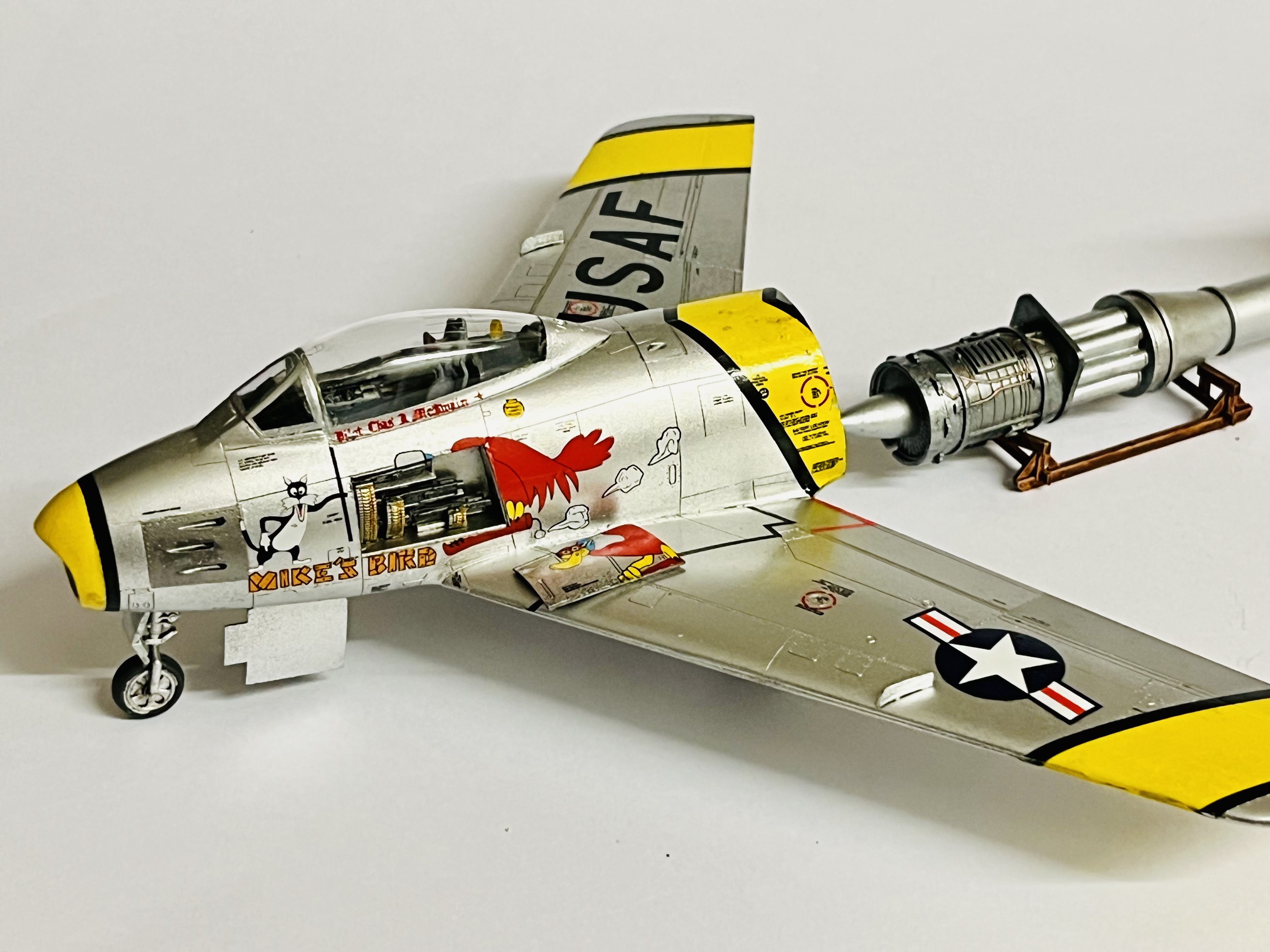
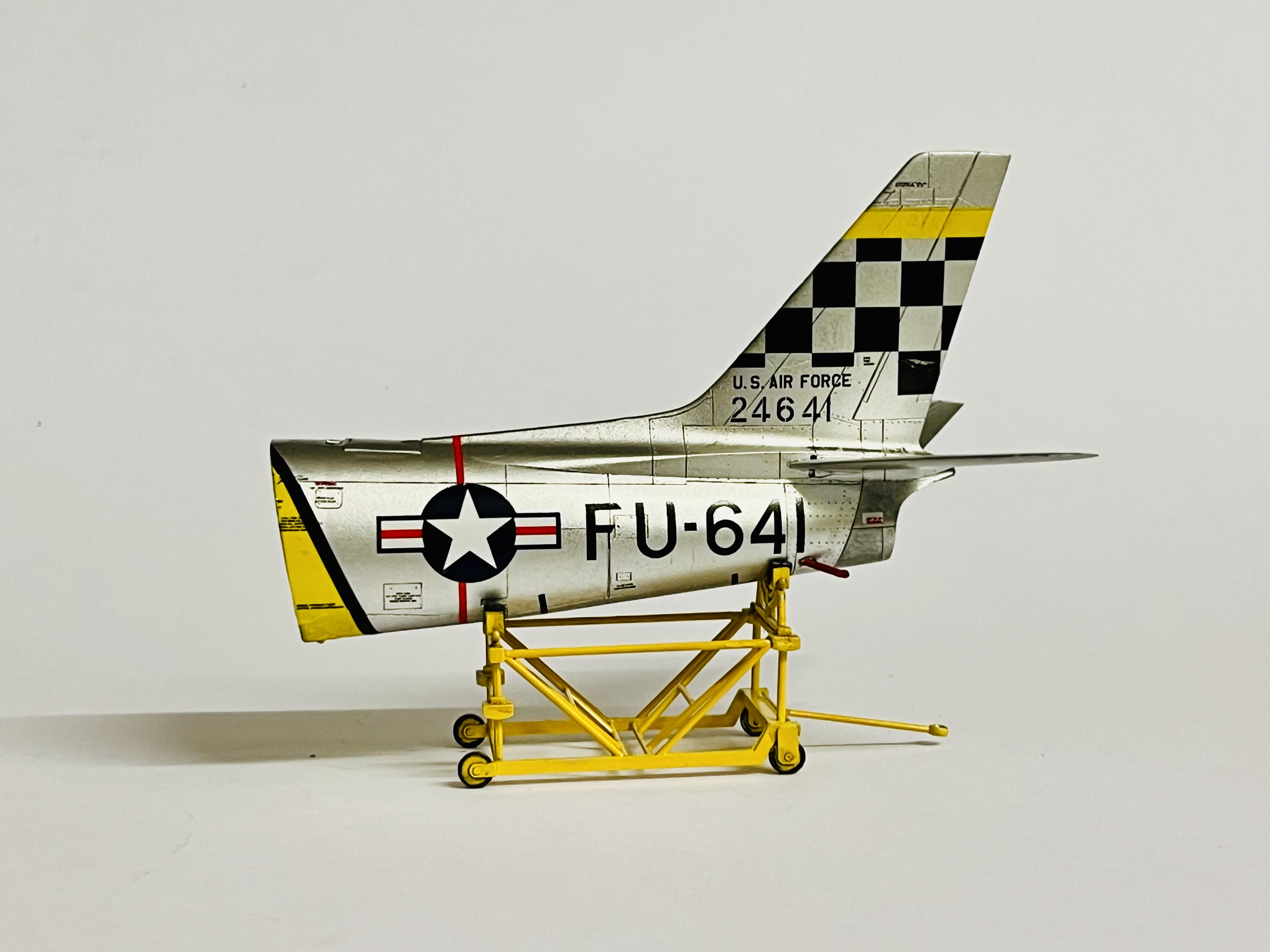
Here’s my second Christmas F-86F Sabre, Capt. Charles McSwain’s “Mikes Bird”, which coincidentally flew in the same squadron as my first F-86, “The Huff”: 39th FIS / 51st FIW, Suwon (K-13), South Korea.

Although I can not find anything about the history of “Mike’s Bird”, I did learn an interesting fact relating to why it and its fellow squadron aircraft wore yellow bands and had checks on their tails. 

When the Americans arrived in Korea with their F-86 Sabre it became apparent that it looked dangerously similar in flight to that the Soviet MiG-15. Therefore, the 4th Fighter Interceptor Wing (FIW) started to paint forward-slanting black-and-white stripes on their fuselages - similar to 'D-Day invasion stripes - to prevent F-86 Sabre pilots from mistaking each other for the MiGs. When in  November 1951, the 51st FIW Group transitioned to the F-86 Sabre, their commander, Lt Col George Jones, didn't want to just copy the 4th FIW stripes, so he asked Capt Ed Matczak, his group material officer and budding artist, to design something different. He came up with the rearward-slanting yellow band on the fuselage, and yellow bands on the wing and tail. Later, the wing also went on to add the black checkered markings copying the WW2 design used by 325 Fighter Group the 'Checkertails’.


In my build of “Mike’s Bird” I used Academy’s amazing 1998 moulding of their 2011 “The Huff” kit and while I used the kits “The Huff” decals on the 1:48 scale Airfix kit I shared earlier, these “Mike’s Bird” decals were gifted to me by a good friend from the original 2011 Academy kit that he had in his stash. However, while the moulding has stood the test of time the decals less so, but if you’ve been following you’ll know that I pressed on regardless!


If you were looking to build an F-86F Sabre and were undecided over whether to go 1998 Academy or 2022 Airfix, unless you wanted to show the earlier model’s extended leading edges, I’d have to recommend Academy every time. From quality of design to crisp moulding, detailing through out from interior to engine, guns to airbrakes and most surprising of all, two excellently crafted pilots!

Happy Christmas all! 

Monday, 23 December 2024

F-86F Sabre - The Huff

Finished for Christmas. The 1:48 scale Airfix F-86F Sabre. 

Lieutenant Jim Thompson's F-86F "the Huff", famous for being photographed with the most astounding nose art of any USAF fighter in Korea. 

Thompson, was a wingman in the 39th Fighter Interceptor Squadron (FIS) of the 51st Fighter Interceptor Wing (FIW), at Suwon (K-13), South Korea, in 1953. 

When he shot down a North Korean MiG-15 in May 1953 that had a dragon painted on its nose he convinced his Crew Chief to put a dragon on his Sabre. He must have eventually shot down another MiG as the decals come with the option of one or two kill star markings. I went with two, just three more required to make him an ace! 


I am not sure why, but on the starboard side of "The Huff" there is artwork for ‘Miss Jenny" & "Bill’s Baby" with the names of JW Manney and LD Cromwell. I've yet to find any reference to why or when these were added ... so most interesting! 


The kit I’ve used here is the 2022 release of Airfix’s F-86F Sabre with "The Huff" decals from the 1998 (2011 release) Academy F-86F kit. The Airfix kit does allow for the modeller to have gun covers and air brakes open and even forward wing slats extended but I wanted to show the aircraft ready for flight and use the second more detailed Academy kit as an aircraft under going maintenance. I’ve also installed Academy’s pilot which in addition to be better detailed is also more historically accurate. 

Paints used were all Vallejo and the silver was their unique alcohol based Liquid Metal. 

Wednesday, 4 December 2024

De Havilland Mosquito B Mk.XVI

My second Mossie, the Airfix Mosquito Mk.XVI, is the bomber variant of this amazing aircraft which could carry a payload as great as the American's B-17 Flying Fortress!

I’ve finished this Mossie in the markings of ML963, 8K-K ‘King” of 571 Squadron. It was based at RAF Oakington, near Cambridge from April 1944 as part of the No. 8 (Pathfinder) Group. Its main role was to carry out independent precision raids on German industrial targets using a 4,000 lb "Cookie" bomb (that's massive). Having completed 84 operations with the Squadron, 31 of them to Berlin, its  final mission was on 10/11 April 1945, following which it had to be abandoned with an engine fire; not good when the majority of the aircraft was constructed of wood!


An example of the type of missions it was tasked with, was that flown by the Squadron Commander, Wing Commander R J Gosnell DSO, on New Years Day 1945.  This was a low-level sortie to skip a 4,000 lb bomb into the Bitburg Railway Tunnel, in Germany; that's precision bombing. Although the tunnel was destroyed by another of the squadron's Mosquitos, Gosnell himself reported "Special Duties against Railway Tunnel - Run up target to plan. No bomb burst seen, opposition nil, light flak from Trier, excellent visibility".  So, not his best mission, but he at least returned to fight another day. Interestingly, he's the only one listed in this aircraft in the squadron mission report, which is unusual as the Mossie usually has a crew of 2

Monday, 2 December 2024

De Havilland Mosquito Mk.VI

This is Tamiya De Havilland Mosquito Mk VI which I was inspired to build after this year’s visit to France where I saw evidence of 613 Squadron’s Mosquito attack on the Chateau de Trevarez, 30 July 1944. 

Unfortunately the decals I had for this build didn’t work out so I went with the boxed set, which isn’t all bad ...


as they are for 487 Sqn. (RNZAF) MM417, EG-T which in February 1944  took part in the amazing Operation Jericho!

Tuesday, 5 November 2024

Handley Page Hampden

This Airfix Vintage Classic release of the Handley Page Hampden Mk.I has been great fun but as a finished model it’s not going to be winning any prizes. 

I do feel these Vintage Classics are an acquired taste. There are some amazing modellers out there who could probably make a real silk purse out of this kit, but I’m definitely an “out of the box” modeller. What’s in the box, is normally what you’ll get. 

I really did like the impressive detailing Airfix put into the undercarriage and engines and way they could both be added at the end, thus avoiding breakages and allowing the spinners to spin!

Thursday, 10 October 2024

Spitfire Mk.VII

 I’m back after a bit of a break!

First on the bench is the Airfix Spitfire Mk XII which I’m building for the Jadlam Racing Models Group Build but why just one, I thought to myself! So I’m parallel building an another clipped wing Spitfire, the Mk XIV with the later teardrop canopy. 

More research will be done but in the meantime, this is what I know of the two Mks …

Mark XII - Fighter version based on the Mark V but fitted with the Griffon III engine with a single-stage supercharger. Built in moderate numbers as a low-altitude fighter, with clipped wings. Entered service in February 1943.


Mark XIV - Fighter version similar to the Mark VIII but fitted with the Griffon 61-series engine with two-stage supercharger. This variant entered service in February 1944. A fighter-reconnaissance version of the Mark XIV also appeared. The variant was built in large numbers and final production aircraft featured a cut-back rear fuselage and teardrop canopy.


I did a little more work on the interiors yesterday, spending what seemed an inordinate amount of time on the pilots. I’m usually OK at painting figures but for some reason I just couldn’t get the finish I wanted on these. However, as I’m not going for an open canopy I’m thinking you’ll not see too much of them anyway. 

I’m also unsure as to whether I should cut out the rear wheel bay only to fit a set of closed doors. Will it really be worth the effort for little visible difference? I think this moulding for this Mk.XII must also be used for the Mk.V which didn’t have the retractable undercarriage. the Mk.XIV kit already comes with this removed. 

Back on the Airfix Spitfire Mk.XII and I’ve managed to get my pilot thinned down sufficiently to fit in his cockpit! I don’t know what the Airfix team were on when they designed this kit back in 2011 but it’s falling well short of their current high standards.

You’ll notice that I’ve also had to fit the propeller. This is such a bad design point and one which has fortunately not been followed on my parallel build subject, the Mk.XIV. 

I like to paint the canopy in place and so this means taking a sharp knife and much patience to some masking tape. 

I think I’m about ready for adding some colour.

Oh how grateful I have been for a wet Sunday afternoon! Primed, camouflaged, invasion stripes and sky band masked and painted. Unfortunately while attempting to mask the spinner it came off in my hands!  So I will now end up, as all recommended, with having to fix it post the build but with the added annoyance of having the back plate rattling around within the aircraft.

Couldn’t resist getting started on the Spitfire MkXII decals and having already committed to the June 1944 variant its the EB-Z 41 Sqn markings that are required. 


I’m not however that happy with the colour match of those squadron markings. They seem far too bright. I would have expected something closer to Sky Type A or Belge Green as the Airfix colour scheme calls it. The 595 Sqn lettering for the second scheme are, however spot on. I’ve heard from others that their decals are the same correct colours, so I guess I’ve got a bad batch!

Oh well it is what it is. 

I’ve also, rather stupidly, not painted the yellow leading wing edges. Don’t know what I was thinking here, so I’m going to have to revisit this once I’ve given it a good covering of varnish, else those roundels are going to come off with the masking tape.

Other than that, it’s not the best Airfix Spitfire kit out there but I’m sort of liking it.

Well that varnish went down very nicely yesterday afternoon so I set to work on adding those yellow leading edges this morning and DISASTER! 

The yellow went on beautifully but when carefully removing the sparingly applied masking tape I pulled up a thin layer of acrylic varnish, like pealing back skin, revealing the matte paint beneath. With this varnish layer came much of the clean yellow edges I’d just painted and half of both upper wing roundels! 

I’ve trimmed back and tidied the loose layers and completely removed both roundels. I can probably find spare roundels in my stash but I’m beginning to think this build is doomed.

New set of XtraDecals roundels applied (not as good as the Airfix originals but better than nothing) and some odds and ends black lines applied to replace those lost in the masking tape versus varnish debacle.

From a distance and after I’ve added a little light weathering, I’m hoping it will all blend together OK


That's my Jadlam Racing Models Spitfire XII done, I'm calling it a day. It's been quite a journey.

I was going to have it flying side by side with the Mk.XIV that I kicked off at the same time, but that one, to me, is looking much more presentable such that I'm now thinking of going for an undercarriage down and open canopy format.

So, I dug out a Messerschmitt Bf 109, built earlier this year as part of the Dogfight Double with the Mk.Vb. As I had originally finished this with wheels and flaps down, I had a bit of work to return it to flight mode but now, using the old stand, I have my Spitfire Mk.XII in a close dogfight with an old Bf 109E, it hasn't got a chance!

Anyway, it’s done. Fortunately, thanks to Jadlam’s event, it didn’t cost much and I have to admit to strangely enjoying the challenge and all the chat with fellow scale modellers also participating in the group build. It’s not going to win any prizes but I think I should still be receiving a money off voucher

Friday, 26 July 2024

Supermarine Walrus

Having a rest from my Airfix Austin K2/Y ambulance and the Flying Nightingales to build the Supermarine Walrus I picked up from last week’s North Somerset Show. 

I’ve been on the lookout for one of these for some time. My inspiration for this build, for as you know there always has to be one, is an event in November 1939 when a plane struck a power cable at the RAF base in Malta sadly killing Flt Lt Patrick Booth R.N. and Leading Aircraftman Norman Burns. Norman Burns was my grandmother’s fiancée. 

While there had been vague family stories of this, full details were only discovered when clearing through old paperwork which included not only paper cuttings but letters, photographs and the saddest thing of all, the telegram!

So this has to be among one of closest builds to home that I’ve done. 

This old Walrus kit naturally has a good deal of flash to it, needed a touch of seam filling and I’m going to have to do something with the front of that engine!

The moulding for this same engine was lacking a hole for the propeller and instructions omitted this important feature too. I think the designer for this part definitely had his/her mind elsewhere when they threw this together. 

As this is going to be a pre-war 1937 Walrus, the next step is to give it all a coat of black primer ahead of a silver body and a return to that engine for some colour and detailing. 

Having masked that rather horrible canopy and given it a coat of silver / aluminium, I also decided on adding a missing hole where the air intake should have been and then reached for some pre- war roundels and random numbers from the stash. I do love the foot 👣 “walk here” markings which I used as Airfix intended directly from the kit.  

Once dry, I’ll add the wheels as although it would have been attached to HMS London’s catapult while at sea, while docked in Malta it was based on land at the RAF local airfield. 

Completed! 

Airfix’s 1957 tooled 1:72 scale Supermarine Walrus A02002 re-released with Adam Tooby box art and new decals in 2011. 

I chose to finish the kit inspired by the Walrus’s of 711 Sqn FAA RAF Catapult Flight flown from RAF Kalafrana Malta and attached to HMS London in 1937. Against my better judgment I even chose to add rigging to the wings and realise now why I build so few biplanes! 

Decals are a mix of Xtradecal 1920-1939 Pre-War Roundels and a random set of Model Alliance Wings of Silver aircraft numbers which look the part rather than me having any intention for them to exactly match the fated K8345, my inspiration for this build. 

BLOGGER IS DEAD LONG LIVE FACEBOOK & INSTAGRAM

It's been a blast Blogger, but not being able to upload any photos of my builds to this blog really makes you meaningless going forward....