Showing posts with label Lancaster. Show all posts

Wednesday, 14 December 2022

Avro Lancaster B.III (Special) Dambuster

On the night of 16 to 17 May 1943, Lancaster AJ-T (T-Tommy) was 617 Squadron’s reserve aircraft, prepared with Barnes Wallace’s bouncing ‘Upkeep’ bomb, for Operation Chastise, the Dambuster raids. 

I decided to finish my Airfix 1:72 scale Avro Lancaster B.III (Special) Dambuster in the markings of T-Tommy, rather than the more famous G-George flown by 617’s Squadron Leader, Guy Gibson, in recognition of the recently departed “last surviving Dambuster”,  Geroge ‘Johnny’ Johnson, the aircraft’s bomb aimer.


Having been detailed to attack the Sorpe Dam and flying the longer, northern route, Flt Lt Joseph Charles "Big Joe" McCarthy (an American serving in the RCAF) and crew, with four other aircraft of Formation No. 2, were to be the first of the 3 waves and 19 Dambusters to take off. After McCarthy's bomber developed a coolant leak, the crew had to take T-Tommy, the reserve aircraft, and followed on half an hour later.

Being an embankment dam , with concrete core covered in soil, the Sorpe dam was the one least likely to be breached, unlike the Eder and Möhne concrete-and-steel gravity dams that were so successfully breached. The attack on the Sorpe also differed from the previous ones in that the topography of the valley required the approach to be made along the length of the dam and not at right angles over the reservoir. The 'Upkeep' bomb, therefore, had to be dropped on top of the dam rather than being spun and then bounced on the water. The specialist bombsight developed especially for the raid would also be of no use. It is also amazing that the five crews detailed to attack the Sorpe Dam received their briefing on the afternoon prior to the raid.

None of the other 4 Lancasters of Formation No. 2 made it to the dam, and so McCarthy at the controls of T-Tommy was the first to arrive. McCarthy made nine attempted bombing runs before bomb aimer George “Johnny” Johnson, was sufficiently satisfied to drop the 'Upkeep' bomb on the tenth run. The bomb exploded but only a section of the crest of the dam was blown off; the main body of the dam remained. The planners of the Operation had estimated that it would take 5 of the ‘Upkeep’ bombs placed correctly to weaken the dam sufficiently for water pressure to complete the break. Only McCarthy and one other aircraft, from the Formation No.3, made it to the Sorpe with their bomb. Even a second British Operation on 15 October 1944 with five-ton Tallboy bombs failed, leaving behind only several huge craters and causing minor spillage.

Monday, 7 November 2022

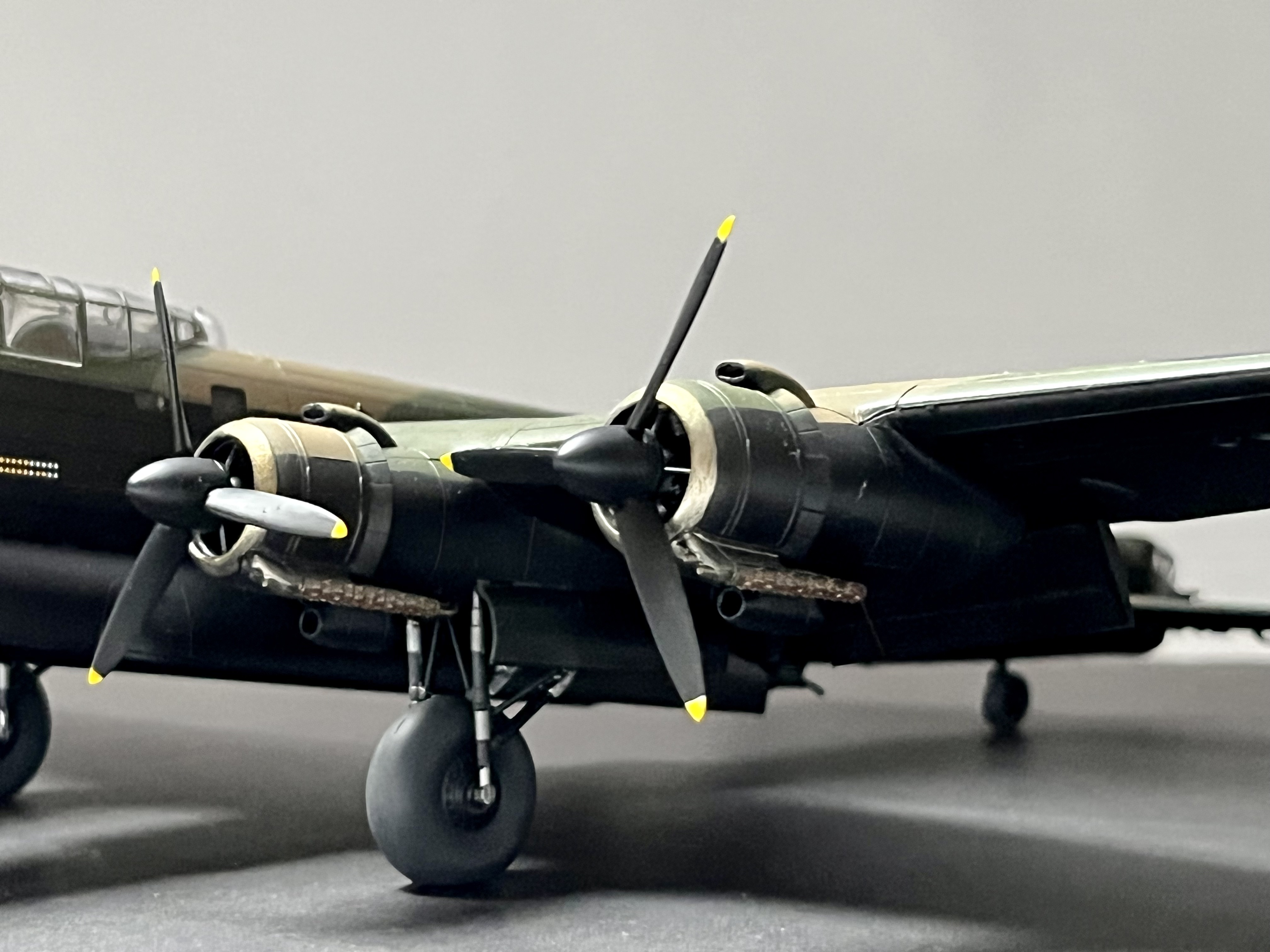
Avro Lancaster Mk II

While not the classic Lancaster we’re used to seeing, I just had to build this rare incarnation of probably the most iconic bomber of the War. It is indeed a rarity, in that it made up just 4% of the total number of Lancasters produced, it remained in frontline service for no more than a year and none survived beyond 1950.


The uniqueness of this aircraft is that rather than having the standard Rolls-Royce Merlin engines, the Lancaster Mk II. due to concerns over the supply of the Merlins, were fitted with Bristol Hercules radial engines. As it happened, by the time the Mk II entered service in October 1942, the threat to the Merlin supply was already receding and as such only 300 Mk IIs were produced. 


The Hercules engine’s performance was found to be not as good as the Merlin. The maximum operational altitude the Mk II could achieve was between 14,000 - 18,000 feet as opposed to the greater and considerably safer altitude of 22,000 feet of the Mk I. Fortuitously, in not requiring the merlin’s liquid cooling systems, the Mk II could take a little more punishment. 


The Mk II also received an additional protection in the installation of a FN64 ventral turret situated behind the bomb bay; though many crews removed these to save weight. A second problem with the Mk II was that it could only carry 14,000 lbs of bombs, compared to the 18,000 of the Mk I. Thus, by the end of 1943, it was no surprise to find the Lancaster Mk II being phased out.

A couple of additions I made to the completed build were the set of bombs sourced from the RAF Resupply Set as Airfix no longer provide these with the kit, and I drilled out and filled with liquid glazing the windows in the escape hatches. It seems odd to me that in their 1960s kit these were included while in the 2020s moulding, the many side windows are added, but the escape hatch windows are omitted!


In it being Halloween, it seemed only right to finish my Airfix Mk II in the markings of “Z-Zombie”, LL725, of No. 408 (Goose) Squadron, 6 Group, Royal Canadian Air Force, based at RAF Linton-on-Ouse, Yorkshire, in July 1944. 


And in researching the back story as to why this aircraft carries the Zombie Nose Art, I dredged up the following account by the aircraft’s rear-gunner and nose artist, George Oliver:

… for some reason the call sign at Linton-on-Ouse, Yorkshire, was changed from Z-Zebra, to Z-Zombie. On their 8th operation to Essen, Germany on 24 March 1944, they lost an engine and had the option to dump their bomb load and return to base or to carry on. The crew agreed to press on but arrived over the target late and all alone. After the release of their bomb load they were met with intense ack-ack and were lucky to escape. On return to base they discovered that they had been posted as lost in action. It was following this experience they all agreed “Zombie” [return of the living dead] should become the nose art, and so it was. 


Sunday, 11 September 2022

Avro Lancaster B.Mk.III

The next of my Somerset show purchases on the bench was the 1980’s Airfix release of the Avro Lancaster B.Mk.III. This was the version fitted with the US built Packard Merlin 28 engines, the only difference between the Mk.I & Mk.III. The Mk.II was different again, but more on that later.


I purchased this 40 year old Airfix Lancaster kit at an excellent price due to the box being opened and thus the risk of it missing parts and with the absence of any instructions. Its age showed through its raised rivets and lack of any interior detail. I pondered on rectifying this by buying up a few after sales bits and pieces and it was while awaiting delivery that I kicked off that ill fated AZ Model Spitfire HF Mk VI build.

The next challenge was the decals. I wanted to use those which came with this kit of M for Mother, the Lancaster completing the highest number of WW2 missions. I had great success in reviving these original decals with extreme UV light treatment that the then heatwave was providing. This removed most of the yellowing but on application they were as thick old boots so a liberal coating of softener was called for. The reaction to this was, however, quite extreme; it was as if they were in tune with Dorian Gray and the fluid revealed their long live’s picture .. all wrinkled!

I therefore, had to fall back on a set of Xtradecal aftermarket decals which I had the good fortune to obtain from the same seller at the show. I obviously had an inkling something like this would happen. I, therefore, finished the build in the interesting look of Avro Lancaster B.Mk.III LM583, PO-T of 467 (Australian) Squadron, piloted by Flying Officer David John Sandell, which took off on 29 August 1944 from RAF Waddington, Lincolnshire to bomb Konigsberg and was lost without trace, believed to have been one of the 15 of a force of 189 RAF bombers shot down by nightfighters during the raid.

The interesting feature of this aircraft is its white painted tail fin which indicated it as a G-H Leader's aircraft, i.e. an aircraft carrying blind-bombing H2S radar, which would lead the rest of the Squadron to the correct aiming point. Each squadron of No.5 Group, Bomber Command, had its own distinctive G-H tail markings, that of 467 Squadron being a blue cross on a white background.

There is much debate on line as to the accuracy of this Xtradecal sheet X72195 as to whether PO-T should actually be PO-O, as referenced in an number of other sources, and how this could be an easy typo with O and P being next to each other on the keyboard. Also the decal sheet contains black crosses for the tail rather than the correct blue ones, perhaps as historical photos are black and white? Interesting ….

Back to the scale model. I decided, for a change, not to complete this kit wheels down, but rather to mount it airborne, as if flying at hedge hopping height atop an old Airfix stand sprayed black, blending with its night camouflage black underside … I can almost hear those 4 Merlins! 

The after sales bits’n pieces of wheels, guns and interior I plan to use on a Mk.II I just had to buy in the recent Airfix Club sale .. it will be interesting to compare and contrast this build with the the much newer kit.

BLOGGER IS DEAD LONG LIVE FACEBOOK & INSTAGRAM

It's been a blast Blogger, but not being able to upload any photos of my builds to this blog really makes you meaningless going forward....