Showing posts with label Bristol. Show all posts

Monday, 22 May 2023

Beaufighter VIF

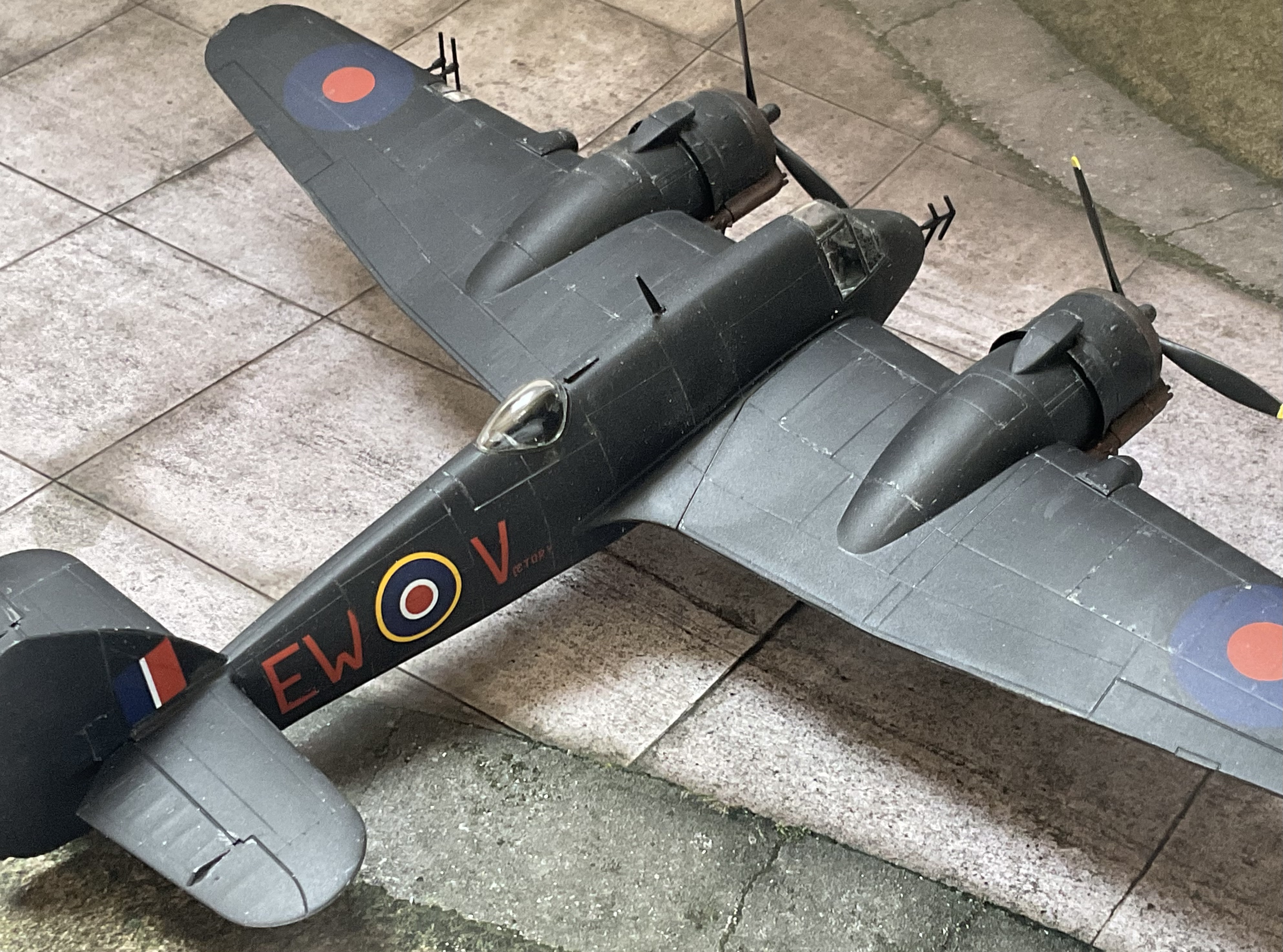
Built side by side with my Airfix Coastal Command Beaufighter that I shared yesterday, this is the Hobby 2000 (Hasegawa) kit of the Beaufighter VIF finished in the colours of 307 Squadron, Polish nightfigher unit in 1942. Between April 1941 - 1943 the squadron was based at RAF Clyst Honiton, now Exeter Airport, defending the SW England from enemy night bombers. 

From a model building view, this was one of the best quality 1:72 kits I’ve built and that’s saying something! 

I struck on building this aircraft after pausing at a memorial to two nightfighter pilots overlooking Beer beach. This remembers the night of 12th April 1942, when Beer Coastguards saw an aircraft crash into the sea one mile south of Beer Head. The aircraft was a Bristol Beaufighter IIF from 307 Squadron, based at RAF Exeter, operating in the nightfighter role, patrolling Lyme Bay to intercept German bombers which passed through this area en route to targets such as Bristol, Cardiff and Liverpool.

In response to the crash 2 Beer fishermen took their boat to look for survivors, but found only small pieces of wreckage. Both members of the crew were killed in the crash. The body of the observer, Flying Officer Mieczyslaw Swierz, was recovered from the sea by an RAF rescue launch from Lyme Regis. The body of the pilot, Squadron Leader Roman Smok, was never found.

The Beaufighter being flown on 12 April was the rarer and less reliable Merlin engined Mk.IIF introduced late in 1941 when the Short Stirling bomber programme was given a higher priority for the Hercules engine. The squadron re-equipped with the improved Beaufighter Mk VIF in May 1942 and it is this aircraft I have recreated in my model. 

In total, Beaufighter crews shot down 15 enemy bombers with three probables and 6 damaged; the last victory was the shooting down of a Do 217 on 24/25 September 1942.


On 15 November 2019, the Polish 307 nightfighter squadron was honoured for defending the British city of Exeter from a German blitz campaign during the second World War. A Polish flag fluttered over the city honouring the pilots who prevented the destruction of Exeter in the 1942 Luftwaffe attack.

Sunday, 21 May 2023

Bristol Beaufighter TF.X

I’ve finished this very nice 1:72 scale Airfix Bristol Beaufighter TF.X in the colours of 404 Squadron aircraft EE-H / NE355 apparently set in June 1944 when stationed at Davidstow, Cornwall. 


Having recently built a later Beaufighter with rockets, I thought this time I’d go with the torpedo. Airfix suggest these are interchangeable on this model, though I decided, however, to forgo the D-Day stripes, preferring its all grey appearance. I completed the look with a set of Vallejo’s Coastal Command paints and AK’s weathering pencils. 


Now for a bit of interesting background: 

In 1942, Coastal Command began to take delivery of the torpedo-carrying Beaufighter. The TF Mk.X (Torpedo Fighter), commonly known as the 'Torbeau', was the Beaufighter for precision attacks on shipping at wave-top height with torpedoes or '60lb' RP-3 rockets. 

In April 1943, after a spell in Cornwall flying missions over the Bay of Biscay, 404 moved to Scotland in support of 144 (RAF) Squadron’s torpedo-carrying Beaufighters in what was to be their new anti-flak role. Using machine-gun, cannon and rockets, their mission was to engage and neutralise defending flak ships and fighters, while 114’s torpedo bombers closed in on the high value merchant vessels.

In May 1944, 404 and 144 moved back to Cornwall, to Davidstow Moor. According to 404 Squadron’s website, this Airfix kit is based on one of the most famous photos of a Canadian Beaufighter taken during the War; that of the Commanding Officer’s (W/C Gatward) aircraft.  The ‘EE-H’ unit code and D-Day invasion stripes are interesting. I understand this picture was probably taken in August, long after D-day and that on D-Day, aircraft no. NE355 actually wore the unit code ‘2-H’, the ‘2’ signifying Davidstow Moor. 

So, this model is a bit of an oddity. For one, I have built it with a torpedo which although correct for the Beaufighters of 114 Squadron, not necessarily for 404 which were fitted with rockets; and while the unit code “EE” may have been correct as early as August, not so June. Discuss … 🧐

Either way, I always enjoy a ‘what-if’ build!

Wednesday, 5 August 2020

Bristol Sycamore HR.14

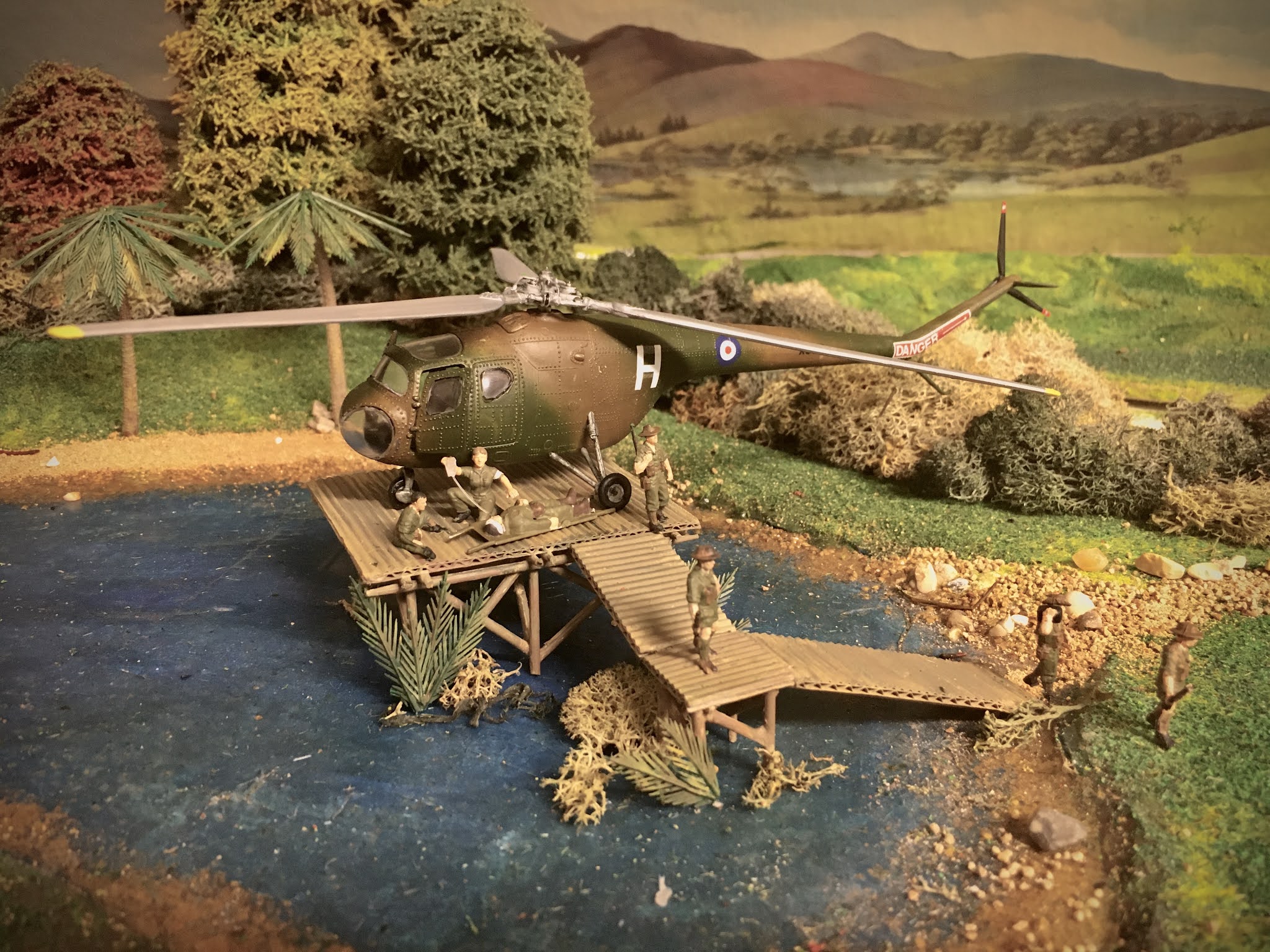
I was asked when I first started this scale model building project whether I'd ever constructed any helicopters. To my memory, there can only have been one or two, and one would have been James Bond's gyrocopter! ... Does that count? For some reason they have never captured my imagination as much as aeroplanes, that is until now, as my 20th model of lockdown begins with not just one, but a flight of whirly-bird creations and has kindled a new fascination with this most versatile of aircraft.

"Hot Lips" Houlihan delivers aid to a casualty

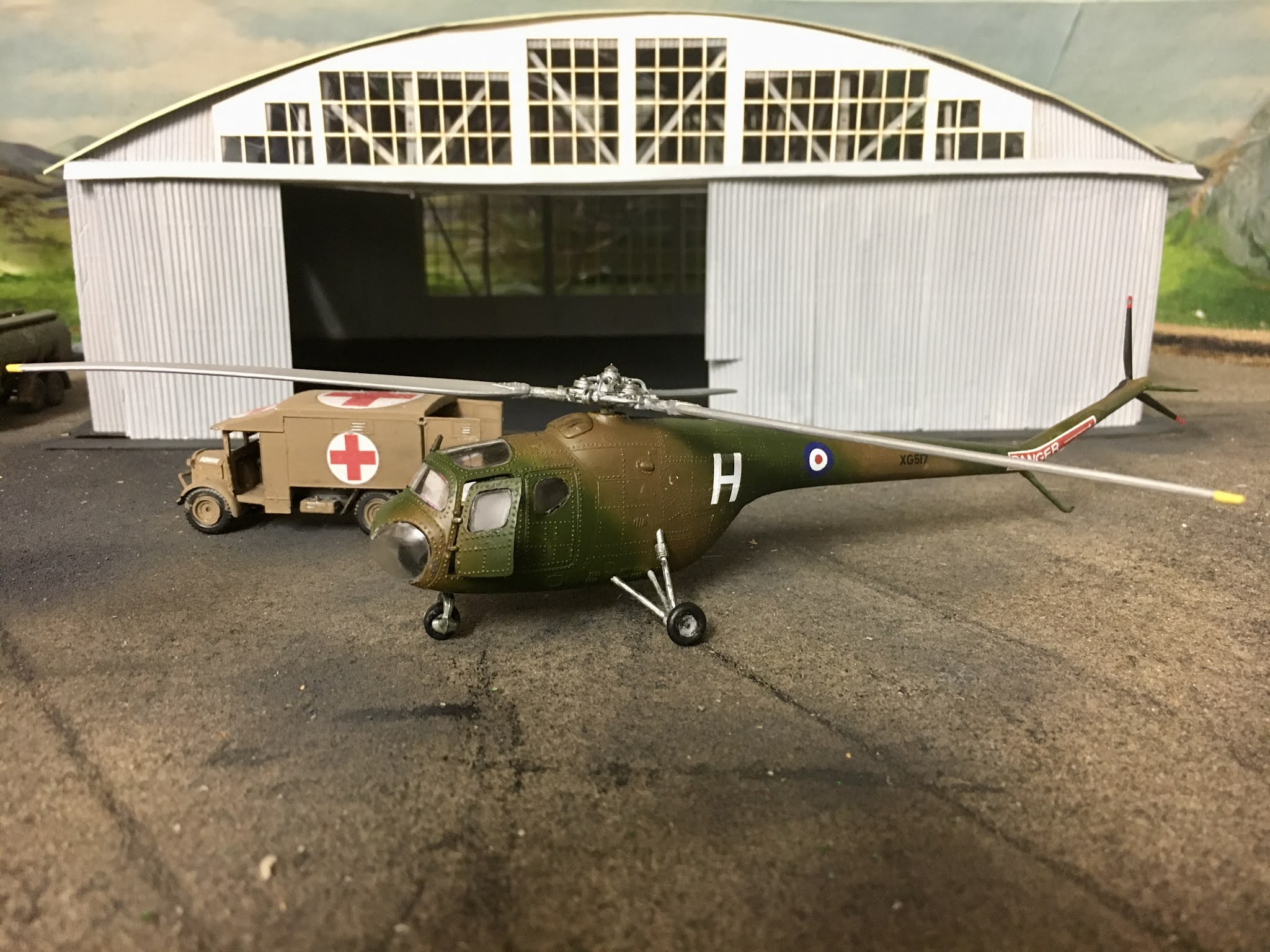
My first helicopter build is also one of Britain's, the Bristol Sycamore HR.14, the first practical British helicopter to enter production.  It took me quite a while to locate this kit, owing to the fact that, just as with my de Havilland Hornet, no one has produced it for a very long time. I finally purchased a 1991, Glencoe Models kit from a private seller for rather more than was really sensible. Glencoe Models, who I've not come across before, was created by Nick Argento in 1987, with the aim to reissue many classic model kits from earlier years and were the last company to release the Sycamore.

The instructions were sparse but the kit went together relatively cleanly, and the decals provided worked surprisingly well. It did, however, come with a pre-cut hole in its underside for a stand. This must have been a feature of the original moulding that Glencoe acquired, although they themselves chose not to provide the stand! Had I a tube of filler to hand, I would have sealed it up, but as it's hidden beneath and I have no plans to hang it from my ceiling, I left it alone. I also attempted my first ever blended airbrush camouflage which I think turned out OK. 

From my Dad's Photo Album!

The camouflage scheme applied was that used on the Sycamores when first supplied to the RAF during the Malayan Emergency. The above black and white photo of a Sycamore, snapped by my Dad while serving in Malaya with the army was no help with this, but it was behind the passion to secure and build the model. I have read many a publication from the time, stating that finding a sufficient clearing in the jungle to land even a helicopter was close to impossible, so specially built platforms had to be erected over obstacles, and landing strips had to be cleared in forested areas by machete. I, therefore, decided to build a Malayan diorama with a precipitous landing platform over a typical mosquito infested lake to showcase my model. Also, as the primary purpose of the Sycamore was to airlift wounded soldiers from the combat zone, I added a larger than life, MASH inspired "Hot Lips" Houlihan to the scene. If you look closely you'll see her providing plasma to the casualty laid out on the stretcher prior to be evacuated by the helicopter!

Back at base delivering the casualty to the ambulance

-----

My helicopter's backstory ...

Although Leonardo de Vinci had dabbled with the basics of rotary flight in the eighteenth century, the lack of any practical propulsion put a stop to it becoming a reality. That was until the Russians, led by the likes of Igor Sikorsky, finally cracked the problem in the late 1930s. Although Sikorsky later moved to America, Russia has interestingly always been ahead in helicopter technology.

Meanwhile, in Britain, the Royal Navy were well ahead of the RAF in recognising the possible use of the helicopter and even placed an order with Sikorsky for 240 of their R-4Bs, or Hoverfly MK1, during the Second World War, but with the end of hostilities this was cancelled. The RAF then took delivery of a small number of Hoverflys for trials and one was even used to deliver urgent mail to the Queen at Balmoral! With the acute post war shortages they were returned to the US in 1950 when parts became too scarce to keep the Hoverflys in the air. 

Bristol Sycamore  "... taking a casualty to hospital"

It was the challenging terrain found in Malaya during the Malayan Emergency which brought to the fore the necessity for a more versatile aircraft. The Chiefs of Staff were first informed in early March 1949 that operations were being hampered by the length of time it was taking to evacuate casualties. With two thirds of the country consisting of dense, mountainous jungle, almost to the beaches, there were too few accessible landing strips, resulting in missions having to be frustratingly curtailed in the event of a casualty. The helicopter not only had the ability to land in tight spaces, its presence also brought a major boost to the moral of soldiers, who knew they would have a quick way out of the jungle should anything untoward happen to them.

Artist impression of the Sycamore evacuating a casualty

The first RAF helicopters to arrive were Dragonfly, one of which was used to undertake their first Casualty Evacuation Flight on 14th June 1950, some weeks ahead of the first American sortie in Korea using their H-13 Sioux helicopters. The Sycamore entered service in 1953 and in just 3 years had replaced the Hoverfly as the RAF's primary casualty evacuation helicopter. The Sycamore was a much improved design with side by side seating for the crew and space for 2 stretchers in the rear.

In October 1964, RAF Squadron were re-equipped with Whirlwinds, resulting in the withdrawal of the Sycamore from front-line service.

Finally, you couldn't make this up, but similar to my last model, the Hornet, Biggles again enters the scene! In two derivative Biggles action comics, the Sycamore makes an appearance ... first, in the Pyrenean Manhunt, an international gang of diamond thieves kept a Sycamore helicopter which they intended to use as their getaway vehicle and then in the Rescue Mission, a Sycamore comes to pick up Biggles and Ginger after they've rescued General Sir Robert Hordern.

Biggles in the Rescue Mission


---

The model

Make: Glencoe Model
Model: Bristol Sycamore HR.14
Scale:1/65 Marketed as 1/72
Item Code: 04001
Year of Release: 1992

BLOGGER IS DEAD LONG LIVE FACEBOOK & INSTAGRAM

It's been a blast Blogger, but not being able to upload any photos of my builds to this blog really makes you meaningless going forward....