Showing posts with label 1/72. Show all posts

Tuesday, 22 July 2025

Hawker Hurricane IV RP

Reading the “Boy’s Book of Airfix” by Arthur Ward I was surprised to read of Airfix in 1957 releasing the Hawker Hurricane Mk.IV RP (Pattern No. 1396) a version of the Hurricane I’d never actually come across before. I just could not resist the challenge of tracking one down, a model kit moulded before I was even born, this is going to be fun and a privilege model to build!

They didn't go into many parts back in 1957 so I'm going to have to take my time and savour this one!

From what I read, the Mk IV had a wing configured able to mount two 250 or 500 lb bombs, two 40 mm (Vickers S guns, two 40 mm Rolls-Royce B.H. type guns, two SBC (small bomb containers), SCI (smoke curtain installation), two 45 or 90 gallon drop tanks, or eight "60 pounder" RP-3 rockets. This kit comes with the eight rockets.

Laying out all the parts, as few as there are, all are thankfully present with the exception of the propeller shaft. Oh yes, the propeller is also broken, but this was a common problem with the bagged kits, a requirement Woolworths placed on Airfix back in the day. 

Checking the parts list again I’m missing not only the propeller shaft but also the canopy! My seller has refunded me so I’m going to see if I can continue without.

Having a very old built Airfix Hurricane in a ‘spares box’ I spit the fuselage and ‘borrowed’ the propeller but the canopy is a totally different size, so I’ll come back to that later.

All the main parts fitted and primed. I have a possible solution for the canopy but it will need a bit of modification as the rise between the tail and cockpit is one only Eddy the Eagle would be thrilled to see; more on that later.

I found a possible donor canopy from what I believe was the Airfix kit of the Japanese torpedo bomber the Nakajima B5N1 'Kate' which was supplied with two canopies. It's a little too wide but after trimming does fit in height and length which I think is as good as I am going to get.


In addition to the canopy modifications I did also end up filling the wing to fuselage joins, gaps in which one could have driven a bus through and I dug out an old set of after market decals. I went for white squadron markings as per the originals and painted in a sky coloured band on which to apply individually cut aircraft numbers to match the artwork. I should probably have used white in the band to match the letters or perhaps sky letters to match the band, however, as I've a few new kits with this combination may be it's an OK combination. 


The original aircraft probably had painted yellow leading edges, but being absent from the artwork, but putting myself in the head of a child building this back in the 1950s, I decided to leave these off! 


I used SMS paints RAF colours and plans I found in another after market set of decals for the final camouflage paint work, neither of which I am totally convinced with, but against the backdrop of this being the recreation of a 1950s era young schoolboy's build and the bits I had to play with, I'm very happy with the final result.


Friday, 25 April 2025

The Cernak Incident, June 1943

 I’ve just completed this railway and aircraft diorama for one of my local WW2 airfield museums.

On the 4th June 1943 “ A” flight from the Czechoslovakian Squadron 313 based at RAF Culmhead (Formerly RAF Church Stanton ) was ordered to take off and undertake low flying practice that included “mock” attacks on trains travelling on the Plymouth to Bristol main railway line near Bradford upon Tone, 4 miles west of Taunton. 

During the training flight a GWR express train from Plymouth to Liverpool was spotted heading North to Taunton and so the flight decided to undertake a mock “attack” on the train. 

One of the pilots, F/O Jaroslav Cermak, was sweeping in to make his attack when unfortunately either due to Pilot error or mechanical failure he suddenly lost power and instead of pulling up over the train the aircraft lost speed and hit the roof of the second coach with his port wingtip. It crashed into the adjoining field killing the pilot instantly. 

I’m proud to say that this diorama can be seen today in the RAF display at the Upottery Airfield Visitor Centre, the same airfield the 101st Airborne Division’s “Band of Brothers” departed from on the morning of 6 June 1944.  

Wednesday, 4 December 2024

De Havilland Mosquito B Mk.XVI

My second Mossie, the Airfix Mosquito Mk.XVI, is the bomber variant of this amazing aircraft which could carry a payload as great as the American's B-17 Flying Fortress!

I’ve finished this Mossie in the markings of ML963, 8K-K ‘King” of 571 Squadron. It was based at RAF Oakington, near Cambridge from April 1944 as part of the No. 8 (Pathfinder) Group. Its main role was to carry out independent precision raids on German industrial targets using a 4,000 lb "Cookie" bomb (that's massive). Having completed 84 operations with the Squadron, 31 of them to Berlin, its  final mission was on 10/11 April 1945, following which it had to be abandoned with an engine fire; not good when the majority of the aircraft was constructed of wood!


An example of the type of missions it was tasked with, was that flown by the Squadron Commander, Wing Commander R J Gosnell DSO, on New Years Day 1945.  This was a low-level sortie to skip a 4,000 lb bomb into the Bitburg Railway Tunnel, in Germany; that's precision bombing. Although the tunnel was destroyed by another of the squadron's Mosquitos, Gosnell himself reported "Special Duties against Railway Tunnel - Run up target to plan. No bomb burst seen, opposition nil, light flak from Trier, excellent visibility".  So, not his best mission, but he at least returned to fight another day. Interestingly, he's the only one listed in this aircraft in the squadron mission report, which is unusual as the Mossie usually has a crew of 2

Monday, 2 December 2024

De Havilland Mosquito Mk.VI

This is Tamiya De Havilland Mosquito Mk VI which I was inspired to build after this year’s visit to France where I saw evidence of 613 Squadron’s Mosquito attack on the Chateau de Trevarez, 30 July 1944. 

Unfortunately the decals I had for this build didn’t work out so I went with the boxed set, which isn’t all bad ...


as they are for 487 Sqn. (RNZAF) MM417, EG-T which in February 1944  took part in the amazing Operation Jericho!

Friday, 26 July 2024

Supermarine Walrus

Having a rest from my Airfix Austin K2/Y ambulance and the Flying Nightingales to build the Supermarine Walrus I picked up from last week’s North Somerset Show. 

I’ve been on the lookout for one of these for some time. My inspiration for this build, for as you know there always has to be one, is an event in November 1939 when a plane struck a power cable at the RAF base in Malta sadly killing Flt Lt Patrick Booth R.N. and Leading Aircraftman Norman Burns. Norman Burns was my grandmother’s fiancée. 

While there had been vague family stories of this, full details were only discovered when clearing through old paperwork which included not only paper cuttings but letters, photographs and the saddest thing of all, the telegram!

So this has to be among one of closest builds to home that I’ve done. 

This old Walrus kit naturally has a good deal of flash to it, needed a touch of seam filling and I’m going to have to do something with the front of that engine!

The moulding for this same engine was lacking a hole for the propeller and instructions omitted this important feature too. I think the designer for this part definitely had his/her mind elsewhere when they threw this together. 

As this is going to be a pre-war 1937 Walrus, the next step is to give it all a coat of black primer ahead of a silver body and a return to that engine for some colour and detailing. 

Having masked that rather horrible canopy and given it a coat of silver / aluminium, I also decided on adding a missing hole where the air intake should have been and then reached for some pre- war roundels and random numbers from the stash. I do love the foot 👣 “walk here” markings which I used as Airfix intended directly from the kit.  

Once dry, I’ll add the wheels as although it would have been attached to HMS London’s catapult while at sea, while docked in Malta it was based on land at the RAF local airfield. 

Completed! 

Airfix’s 1957 tooled 1:72 scale Supermarine Walrus A02002 re-released with Adam Tooby box art and new decals in 2011. 

I chose to finish the kit inspired by the Walrus’s of 711 Sqn FAA RAF Catapult Flight flown from RAF Kalafrana Malta and attached to HMS London in 1937. Against my better judgment I even chose to add rigging to the wings and realise now why I build so few biplanes! 

Decals are a mix of Xtradecal 1920-1939 Pre-War Roundels and a random set of Model Alliance Wings of Silver aircraft numbers which look the part rather than me having any intention for them to exactly match the fated K8345, my inspiration for this build. 

Tuesday, 9 July 2024

RAF Douglas Dakota Mark III

Airfix 1:72 Douglas C-47 Skytrain finished as an RAF Douglas Dakota Mark III using Xtradecal after market decals for aircraft FZ692, known as ‘Kwicherbichen’, of No. 233 Squadron. Figures are the two sets of RAF Flying Nightingales, one with Wounded, from Modelu and the base is just something I threw together. The painting was predominantly airbrushed using Vallejo, including the D-Day stripes. 


It was 13 June, one week since D Day, when three nursing orderlies, Corporal Lydia Alford and LACWs Myra Roberts and Edna Birkbeck; each travelling in an RAF Douglas Dakota, departed from RAF Blakehill on the first casualty evacuation flights to Normandy. The moment of their return was captured by an official RAF photographer. The welcoming party of newspaper correspondents dubbed them the ‘Flying Nightingales’ and the name stuck. They were the first British women on active service to be flown into a war zone.

In recognition of their courage, Douglas Dakota ZA947 in the Battle of Britain Memorial Flight has been know to be painted to resemble Douglas Dakota FZ692 which took part in casualty evacuation flights with ‘Flying Nightingales’ after D Day.

Nice kit, fabulous figures and great fun all round. 

Wednesday, 3 July 2024

D-Day Spitfire Mk.Vc

A bit of 1:72 scale fun with an Airfix Spitfire MkVc and Modelu figures.


Here ground crew quickly apply D-Day invasion stripes to a Spitfire which tomorrow, 6th June 1944 will be engaged across the Normandy coast directing naval gunfire against stubborn enemy positions. 


Tuesday, 25 June 2024

P-38J Lightning

The Italeri P-38J Lightning finished to depict “BAMBI” of 55th FG 338th Fighter Squadron in its D-Day ground attack role.


I’ve painted a set of July 1944 invasion stripes and had to quite a bit of cutting and filing to rework the undercarriage flaps to go for the wheels up config as one of my scale modelling buddies, mr.airfox asked for.

The undercarriage and wheels are actually very nicely moulded but in order to avoid the inevitable tail sitter issues this will be mounted on a stand. 

As I’ve messed with Italeri’s plans to have their kit  finished with undercarriage lowered, I’m not now going to be able to display their lovely detailed cockpit interior with open canopy as many others have done.  An aircraft in flight, after all, has to have a pilot so I’ve had to raid my spares box! 


It looks good and sleek in the painted plastic but difficult to really see its beauty on its stand. I fitted drop tanks as just after D-Day Allied planes were still flying the channel as airfields were built and just check out those rocket launchers!

Friday, 21 June 2024

Dogfight Double - Me109 v Beaufighter

 Phew, this charity shop acquisition of Airfix A50037 1:72 scale Dogfight Doubles is finally complete.

This 2008 reissued set contains a 1973 moulding of a Messerschmitt Bf109G and a 1958 moulded Bristol Beaufighter TF.X. and without exception they are showing their age. 


I’ve finished the pair with brush using the provided pots of acrylic paint.  The Beaufighter is in the colours of 404 squadron Royal Canadian Airforce based at Wick in 1944 and the Bf109G as JG53 “Pik As” based in Sicily 1943. The likelihood that these would have, therefore, met in a dogfight is so unlikely to say the least. 

Being without doubt the worst kits and finish of any I’ve completed in quite some time, I fear for their future. I foresee a dusting disaster on the horizon!

Now back to the P-38 Lightening which has been patiently awaiting a return to the bench! 

Wednesday, 24 April 2024

D-Day Air Assault

Airfix 1:72 D-Day Air Assault kit A50157A built to interpret ALG. B5/Le Fresne-Camilly, Normandy, France, home of Typhoon MN625 MR-B of No.245 (Northern Rhodesian) Squadron, 121 Wing, 2nd TAF. June 1944.

MN625 was flown by Fg.Off. W Smith who, on 10 June 1944, was made famous as being the first Allied pilot to land at one of the Advance Landing Ground (ALG) airfields in Normandy. This is how the Squadron’s Operations Book recorded it: 

“At 0520 hours eight aircraft with R.P. and two fighters airborne to attack reported position of H.Q. Panzer Division. Intense flak of all types was encountered but despite this and much cloud the target was located and successfully attacked. F/O W.Smith was hit by flak and reported excessive vibration and much oil on the windscreen. He was instructed by W/Cdr. Green (who was leading) to put down on the ALG at Banville (B3/Ste Croix-sur-Mer) east of Bayeux. This he did successfully. He was met by a swarm of photographers and high officers who informed him that he was the first pilot to make a wheels down landing in France since D-Day. Apparently this honour was being saved for Air Vice Marshal Broardhurst who arrived some time later in a Spitfire!”

On 17th June, the Advance Landing Ground (ALG) B5/Le Fresne-Camilly was to be 245 Squadron’s new home. This was the fifth airfield to be established in the British and Canadian sector of the Normandy landings. Only about four miles inland from the invasion beaches, it had only recently been freed from shell-fire which had come from German units dug into surrounding woods. 

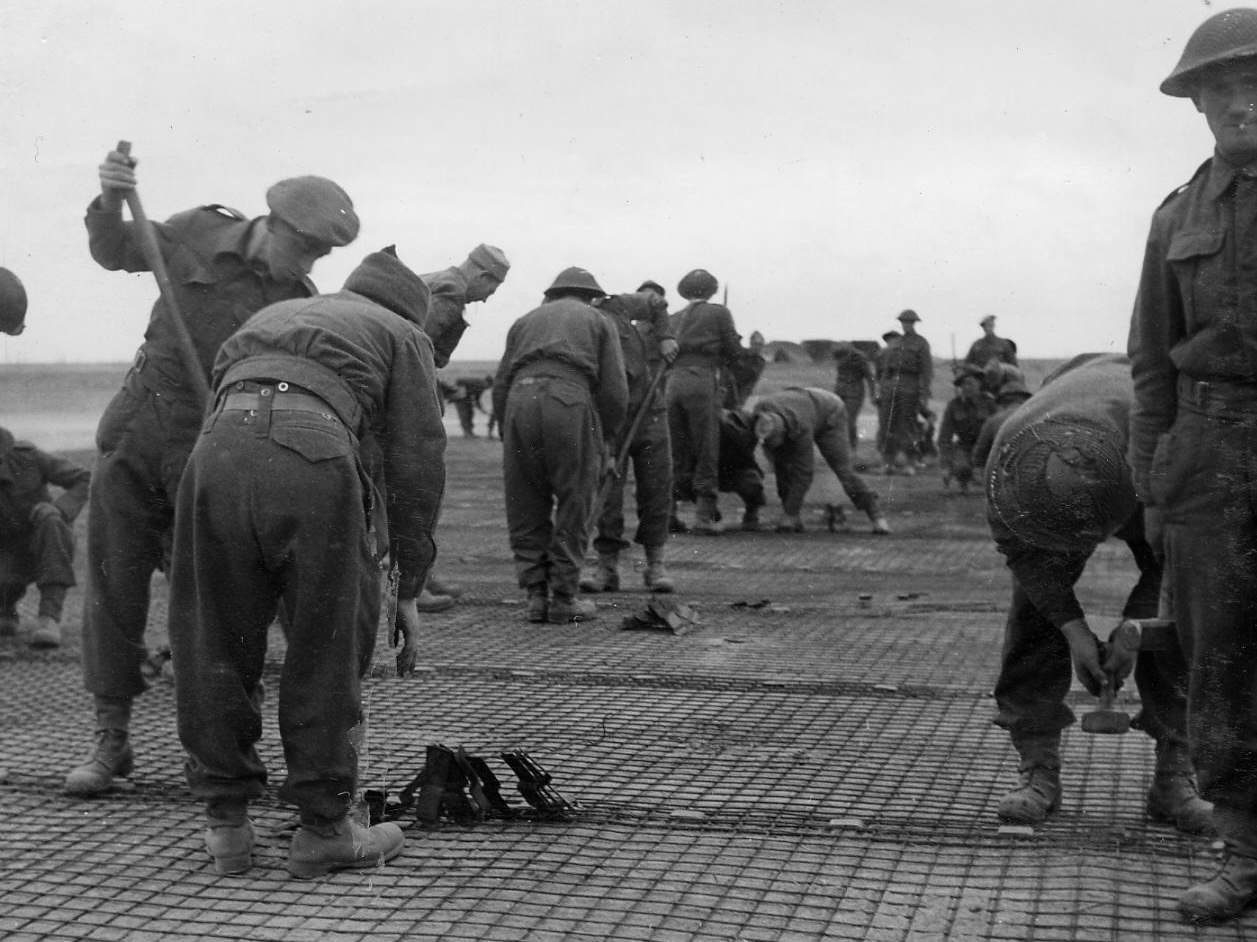
The wire mesh strip or Square-Mesh Track (SMT) which served as a runway was over 5,500 feet long and ran from north to south along the plateau. Surrounding orchards were used to give cover for maintenance hangars and as dispersal points for aircraft requiring servicing. The main HQ was situated at the southern end of the runway and the three squadrons were dispersed to the east and west of it. Anti-aircraft defences were dug in around the perimeters, and slit trenches were adjacent to all working areas.


The observant may notice that I’ve used my Airfix Club kit/decals in this diorama as the one provided with the D-Day Assault kit were for an aircraft which took part in the September’s Operation Market Garden/A Bridge Too Far and not June’s Operation Overlord/The Longest Day

The final diorama 


Sunday, 7 April 2024

Hawker Typhoon Mk.1b

I’m kicking off my D-Day 80th Anniversary builds with two of Airfix’s 1:72 scale Hawker Typhoons. One from the 2024 Airfix Club D-Day Duo set A73016 and the other from the 75th Anniversary D-Day Air Assault Set A50157A. Both use Airfix’s 2013 tooling and it’s a kit I’ve previously enjoyed building so am keen to see how my finishing skills may have improved with age! 

These come with decals for 245 Squadron’s ZY-Y MP126 and 247 Squadron’s MR-B MN265, the latter having actually joined the squadron to replace another lost on D+1, so may not have actually been present on the day itself but we won’t hold that against it.

What strikes me first on opening the boxes is the different colour plastic now used by Airfix. The feel and level of flash across both kits is however the same. The instructions are similar pictorially but the recommended painting instructions differ, probably due to the larger D-Day kit having to keep to the colours supplied in the little starter pots. 


Having built this before, I’ll not be wasting time painting the interior as I did back then as with a pilot installed none of it can be seen. Then again, may be I should this time build these without using the pilots?

I’m starting to remember there’s a lot of great detail included in this little kit.

Well I wasn’t going to but I have … I couldn’t resist in the end giving the cockpit a coat of interior green. I know it’s painted even if you can’t see it and the same for the instrument panel decal which, and I’ve said it before, it would be more useful if Airfix provided harness decals instead 🤷‍♂️

I found joining the two fuselage halves together required the arms of an octopus but they still went together beautifully even with just the two hands I had available 

These Typhoons are starting to look a bit more like aircraft as this afternoon I got to fit wings and ailerons. It's at this stage that one has to decide on payload and whether to have the cannon ammunition ports open or closed. Decisions decisions ...


For one of the kits, I've gone for all ports open and rockets as the payload. This required the careful use of a blade to cut out a section of the upper wing and the drilling of 4 holes in the lower wing to mount the rockets. For the other, having repeatedly broken off the tail wheel (note - this is very fragile) I'm now going for a wheels up Typhoon and will have it airborne flying above the D-Day Air Assault diorama, so naturally all ports will be closed, and I'm going to have to remember to install a pilot! I've also drilled just the 2 holes in the lower wing, as this Typhoon will be heading off on a bombing mission.


After a morning at the Yeovil Scale Model Show, pictures to follow, I’ve had just enough time this afternoon to run a little filler along the wing to fuselage join, nothing serious, just a bit of cosmetic touching up. 


I’ve also constructed the bombs for one and fitted the bomb and missile racks under the wings. Then, using the cutaway pieces from the gun bays and unused wheels covers to mask the painted areas, I’ve given both a covering of grey primer. 


All being well, and I see no need for more filler or sanding, I can move onto the fun bit of starting on the canopy masking and camouflage.

Typhoon MN625 MR-B of No.245 (Northern Rhodesian) Squadron, 83 Group, 121 Wing, 2nd TAF. RAF Holmsley South, Hampshire, 1944.


MN625 joined the squadron as a replacement for MN377, an earlier “B” lost south of Caen on D+1; it was flown by Fg.Off. W Smith who, a few days later, was the first Allied pilot to land at one of the Advance Landing Ground airfields in Normandy, in this case B5/Camilly which became the squadron’s operating base for the next two months before the Allied advance continued. 


BLOGGER IS DEAD LONG LIVE FACEBOOK & INSTAGRAM

It's been a blast Blogger, but not being able to upload any photos of my builds to this blog really makes you meaningless going forward....