Showing posts with label Vietnam. Show all posts

Wednesday, 25 October 2023

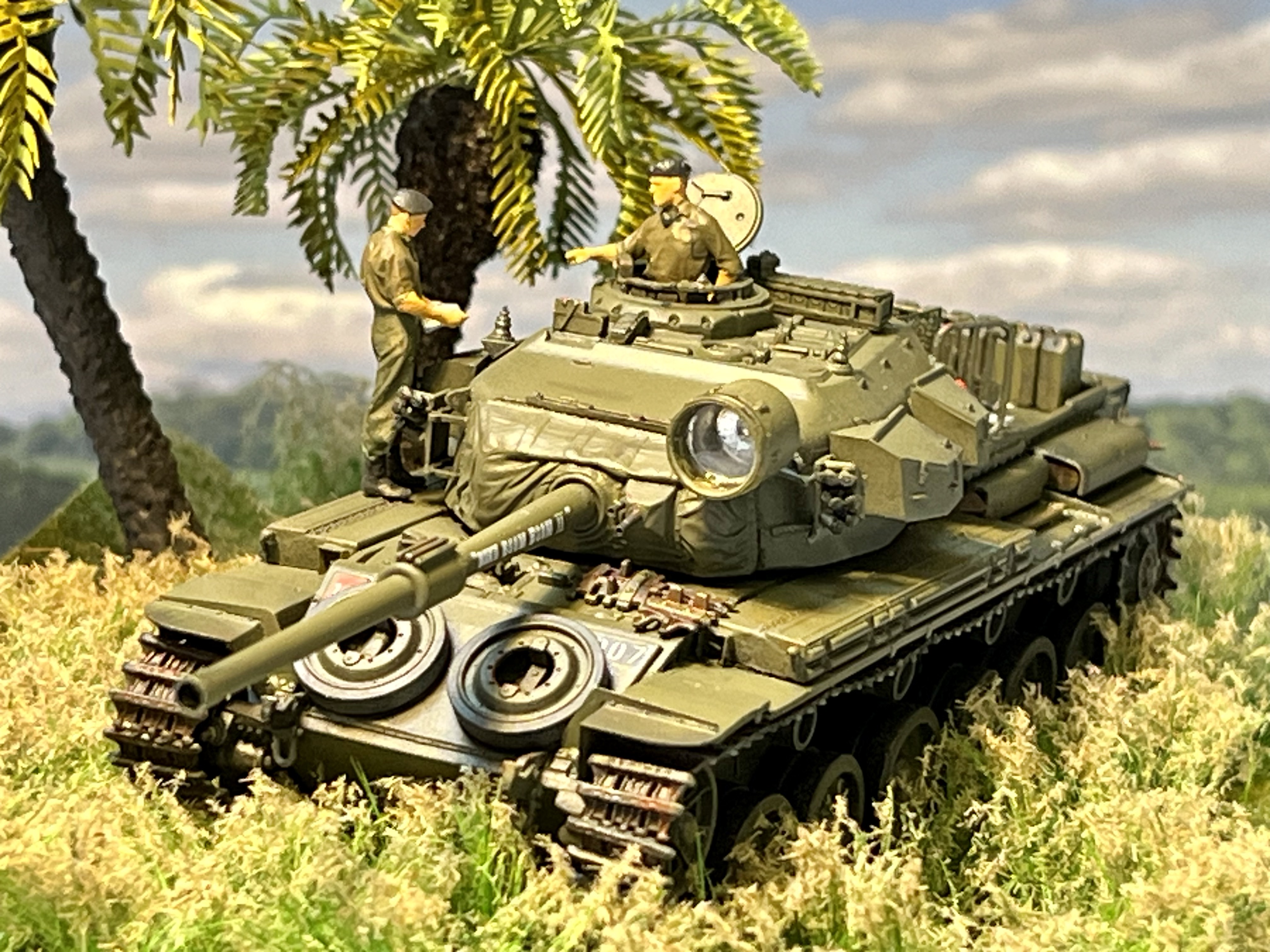
Centurion Tank Mk 5/1

Vespid Models1/72 scale Centurion Tank Mk 5/1. The scheme I’ve gone for is for that of the Australian Army’s ARN 169007, call sign 24A of B Squadron, named “Buku Boom Boom” from 1969 in Vietnam. I’ve also added a couple of excellent Modelu tank crew figures. 

In February 1968 the announcement that a squadron of Centurion tanks was to reinforce the Australian forces in South Vietnam was greeted with skepticism. Critics suggested that the mobility of the heavy tanks would be so curtailed by the rice paddies and jungle that they would eventually become static pillboxes defending the perimeter of bases. It was also argued that an enemy with modern anti-tank weapons could easily destroy the slow and cumbersome Centurions. However, such criticisms were soon to be disproved.

On the morning of 6 June 1969, two Australian Centurions of 4 Troop, B Squadron were making their way northwards along Route 2 in support of infantry when they came under fire from houses in the village of Binh Ba, north of Dui Dat in the Phuoc Tuy province. The Battle of Binh Ba, Operation Hammer, raged for two days, ending on the second mass tank and infantry assault. The battle marked the end of such large-scale clashes, and ranks as one of the major Australian victories of the war.

One of the Centurions involved in the battle was named “Buku Boom Boom”, or more formally ARN 169007, call sign 24A of B Squadron, and it is in the colours of this Centurion Mk. 5/1 that I have finished this excellent Vespas Models 1:72 scale kit. To complete theme, I’ve built a small vignette using a fantastic couple of 3D printed tank crew figures from Alan at Modelu and a super mat of sedge grass and a pair of palm trees from Steven at The Model Tree Shop. I’m liking the finish and hope you do too. 

Tuesday, 24 October 2023

M113 APC

Italeri’s 1:72 scale M113 finished as one of the Australian Army APCs involved in the battle of Long Tan, 18 August, 1966. 

These M113s were in far from the best condition and so I’ve painted a layer of rust over the standard green paintwork. I think it looks better in the metal than in these photos. 

I’ve also added 3 Modelu figures depicting a moment of reflection post battle. 


Sunday, 15 October 2023

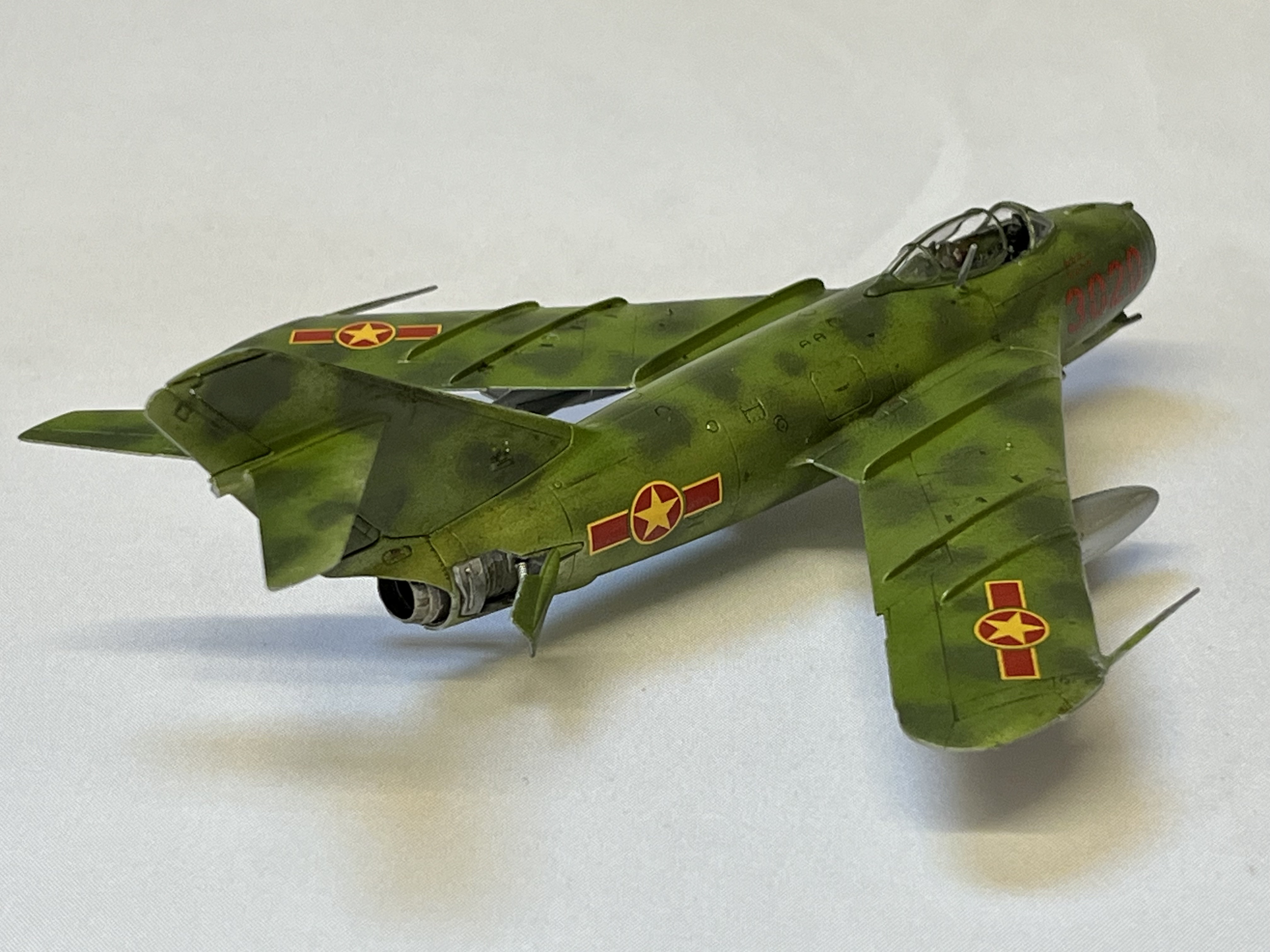
MiG-17F Fresco

This is the Airfix 1/72 scale MiG-17F ‘Fresco’ which I’ve finished in the colours of Red 3020 as flown by Lê Hải of 932 Fighter Reg Vietnam People's Air Force in August 1969. 

This was a quick and simple build of one of Airfix’s excellent new kits (2019). I’ve had it in my stash for a couple of years now and when my ISCA Exeter Scale Model Club decided on a Vietnam inspired group build, I finally had the perfect excuse to dig it out 


--------------------------
The Kit: 

Brand: Airfix
Title: Mikoyan-Gurevich MiG-17F 'Fresco' (Shenyang J-5)
Number: A03091
Scale: 1:72
Type: Full kit
Released: 2019 New tool


Tuesday, 17 August 2021

A Year's Scale Modelling Diorama

It's been a year now since I removed my old Scalextric track in the loft from its baseboard so as to showcase some of my 'lockdown' builds, and having now completed my latest diorama, the RAF Airfield from Autumn 1943, I can't believe I have finally run out of space! 🤦‍♂️


It has been suggested that there may be opportunities to display one or two of these at model shows etc, but how I not only cut them into their respective scenes, let alone bring them down from the loft, is somewhat perplexing me! 🤷‍♂️


I have, however, seen some folk building smaller dioramas, which I understand are called vignettes, using old picture frames, such that I may now have to do a tour of the house to see which pictures I can repurpose!🤭😂

Suggestions welcomed!

Thursday, 8 October 2020

Operation Silver Bayonet Diorama

Drawing to a close my scale modelling visit to Vietnam, here are a few of the diorama features which, while not specifically referenced, may have been spotted in the pictures published over the last few weeks.

Vietnam Bicycle Troops

First up the bicycle troops, who will have been seen loitering in the background of the UH-1 Huey and M113 model shots. 

1/72 Scale Viet Minh Cycle Troops

For my cyclists, I used HaT's set of four WW2 Japanese bicycle infantry. In the absence of specific Viet Minh figures, the Japanese uniforms were a closer fit to how the Vietnamese regulars were dressing than a set of stormtrooper helmeted WW2 German soldiers which would have been the alternative! They also came with a great war pedigree; it's probably not well known that the dramatic way in which the Japanese troops advanced across Malaya to capture Singapore in 1942 was given the name of the “Bicycle Blitzkrieg” ... yes, they cycled into battle!

Bicycle Blitzkrieg

Being made of quite a soft and malleable plastic, and requiring a good deal of assembly, made this set quite a challenging and frustrating build, especially when considering the small part they eventually played in my diorama! Many of the soldiers arms were separate, as were the bikes' handlebars, and putting everything together such that it all matched up correctly was not as straight forward as it should have been. The general sculpting was good and the detail reasonably sharp but the proportions of the hands to the rest of the body on a couple of the troops seemed comically oversized; a feature of being designed to wrap around the handle bars. The bikes, were also nicely detailed and, with pedals and chain, all to scale.

 HaT's set of four WW2 Japanese bicycle infantry

I felt I had to include bicycles in my diorama because they were so dominant in maintaining the Viet Minh’s supply lines which, despite the unprecedented and prolonged bombing campaign by the US, were kept open using what is now recognised to have been the largest military bicycle-transport operation in history. To put this into context, between 1964 to 1973, the US conducted 580,000 bombing missions, dropping more than two million tons of ordnance on the Ho Chi Minh trail. This equates to a single aircraft dropping it's bomb load every 8 minutes, 24-hours a day, for 9 years! Although the Vietnamese dodged the bombs running 600 Russian-made Molotova 2.5-ton trucks as well as sampans, ponies and some 200,000 porters along the Trail, the mainstay of their logistical network was composed of 60,000 resilient bicycle-pushing men and women. In their fight, first against the French and then the US, the Vietnamese favoured, not unsurprisingly considering their colonial history, the French-made Peugeot bicycle, with the Czech-built Favorit their next bike of choice. 

With their large carrying capacity, bicycles were particularly effective on Vietnam’s narrow roads and tracks in the dry season, and easily modified to carry large loads. 

Bicycles on the Ho Chi Minh trail

In addition to transporting men and supplies, the bicycle served the needs of the wounded on the battlefield. In 1968 a Peugeot subsidiary produced a model especially for the North Vietnamese Army that contained surgical and medical kits and two headlights, with detachable extension cables for lighting a small field hospital. And a rudimentary form of medevac was devised using two bikes lashed together with long bamboo poles from which one or two stretchers could be suspended!

Interesting cycling factoid, Škoda, the Czech car manufacturer, started making bicycles in 1895 and still are, and made their first Škoda Favorit in 1936. Although nothing to do with the Favorit bike manufacturer which has roots back to 1922, and yes also still makes bikes, I found it sufficiently interesting to share. 


Soviet 37mm 61-K Anti-Aircraft Gun

North Vietnam’s light anti-aircraft artillery units were widely deployed and downed more American planes and helicopters than all other North Vietnamese weapons systems combined. American airmen flying over North Vietnam faced one of the most intensive and highly developed air defence systems in history and although the North’s fighter planes and its surface-to-air missiles (SAMs) got the headlines, it was the light anti-aircraft guns that inflicted the heaviest losses. North Vietnam deployed more than 8,000 anti-aircraft guns around key targets throughout the country, inflicting more than 75 percent of aircraft  combat losses. 

North Vietnam’s light anti-aircraft artillery unit

The model I selected to engage the Huey gunship in my diorama was the Soviet 37mm anti-aircraft gun, aptly produced by the Russian scale model maker,  Zvezda! This was a very crisp and well moulded kit, uniquely having all its parts clipping together and requiring no glue! I loved it.

Introduced in 1938 the 61-K was the Soviet Union’s primary anti-aircraft gun of World War II. It was based on the Swedish Bofors which the navy had purchased back in 1933. Competitive firing trials conducted in 1940 between the 61-K and the Bofors 40 mm, then being used widely by the British and its allies, found no substantial differences between them. 61-K was also made under licence by the Chinese and subsequently the new Socialist Republic of Vietnam, and went on being produced until the 1980s. 


North Vietnam reportedly deployed more than 8,000 anti-aircraft guns for air defence during the war, the majority of which being acquired direct from the Soviet Union and the remainder from China. Those located in Cambodia and South Vietnam were committed primarily against helicopters ... so my diorama is quite accurate in its portrayal of Huey gunship versus the 61-K anti-aircraft gun. 

Huey gunship versus the 61-K anti-aircraft gun


Soviet 37mm 61-K Anti-Aircraft Gun


Other Accessories & Features

I couldn't have a Vietnam War scene without a paddy field and so a small water filled area with grass like vegetation was created at the edge of the diorama. I had originally intended for this to play a larger part of the battle scene but a 'walk-on role' was all that was left after the rushes were cleared away! 


Paddy field and sandbags

In the middle distance of the above pictures you will also be able to make out sand bag protection around a slit trench. A set of these sandbags were provide within the Operation Silver Bayonet kit together with a number modelled into a wall which I used in the M48 Patton Tank diorama of the Camp Holloway helicopter base attack ... see additional picture below. 

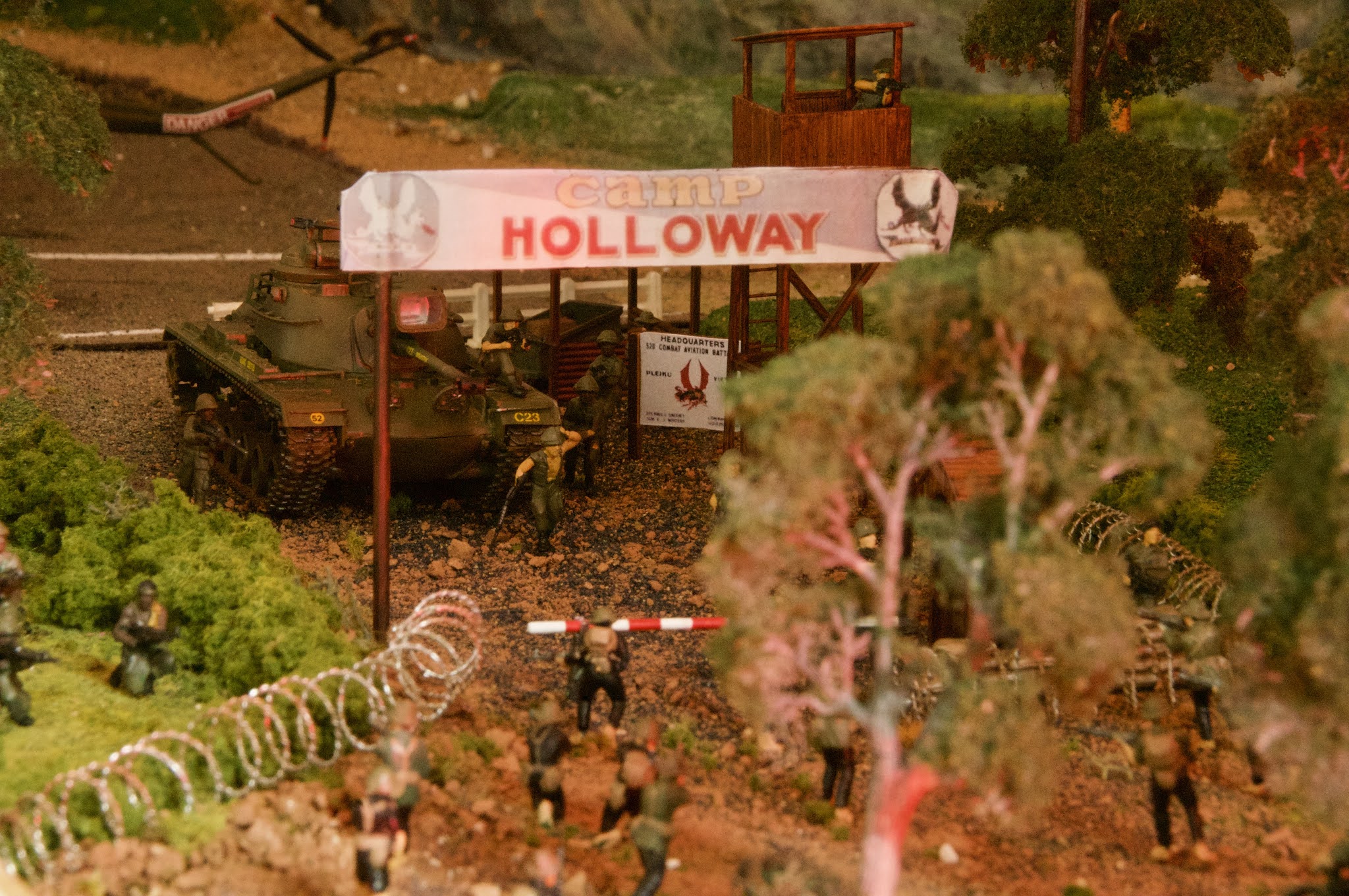
You'll also see in this picture the watchtower, guard post and stores building also included in the kit. The signs were scratch built from actual photos of the base signage and the barbed wire was a late edition to complete the scene. If you look carefully, you'll also see a shot of the Westland Whirlwind, which has dropped in on Camp Holloway from Malaya! Although you may have seen this type of helicopter in Vietnam, it would, however, have been in the guise of the original US version, the Sikorsky H-19 Chickasaw, as no British piloted aircraft took part in the Vietnam conflict.

More sandbags, barbed wire, military buildings and scratch built signage 

Returning our attention to sandbags, in the 'drone shot' below of Operation Silver Bayonet you'll see an additional horseshoe shaped set of separately acquired resin sandbags, giving shelter to the troops protecting the anti-aircraft gun. 

The drone view of Operation Silver Bayonet

For trees I used a mix of palm and deciduous, both from UK manufacturers. The palm trees needed a lot of recolouring, and I even suspect that the maker of these could very well have been working from both a black and white photo and a palette of primary colours! Thinking of my carbon footprint, I did not, however, want to further outsource my supply to China, even though their tree illustrations looked fantastic. The deciduous trees were sufficiently nondescript to fit into a jungle environment, perhaps, I like to think, looking just like the rubber trees found growing in this part of the world!

Red earth, also typical of the region, was, as in my earlier MASH diorama, sourced from a local Jurassic cliff fall. The larger lumps worked well as stone for the walls and the finer grains for the dusty paths cut through the shrub. The red glow effect, to portray fire and exploding ordinance, were supplied by a set of rear bicycle lights ... another apt addition to the diorama, considering where we came in!

Thursday, 1 October 2020

M113 A1 Armoured Personnel Carrier

My final scale model build from Italeri's Operation Silver Bayonet multi kit, and the last of my Vietnam series, is the M113 A1 ACAV armoured personnel carrier. This model, first released by Italeri in 2003, was included in this multi kit together with two other models from the early 2000s, the M48 Patton tank and UH-1 Huey helicopters.  I do wonder whether this was a lean period in Italeri's scale model production, for the quality of their earlier 1990s H-1 Souix and later 2010 UH-1 Huey are far better. The cynic in me could also assume that Italeri have lowered the quality of these re-released models just to keep the cost of their multi kits down. I guess I'm just going to have to try out a few more of these themed kits to find out! 

The nice key features of this kit were the range of alternative gun mountings, the option to have doors and hatches opened and the solid tracks, which I much prefer over the rubber band version. The decals were also the most spectacular I have seen on any but the most flamboyant military model. So much so, that when all 3 were applied to the sides, I had visions of Lydia The Tattooed Lady! As such, I removed the most garish and added one to the front, an area I have frequently seen decorated with motifs, even grimacing sharks teeth! As with all Italeri models, there were no crew or combat figures, but with around 50 US troops included as part of the multi-kit, I had plenty of options to play with! I, therefore, placed the M113 straight into the thick of the battle, with .50-caliber machine gun firing and troops spilling from its bowels into action! 

The M113 armored personnel carrier, second only to the UH-1 Huey helicopter in battlefield importance, entered production in April 1960. Developed by FMC, the fully tracked, aluminium-hulled M113 was configured for a two-man crew of a commander/gunner and driver, and could carry an additional 11 soldiers. It included a hydraulically operated rear ramp for rapid exit, as seen on my model in the down position. The ramp also had a hatch for access when it was up.

M113 engages the enemy with it's .50 machine gun while troops exit  

Enhancements included protective steel plates welded to the commander’s cupola or the .50-caliber M2 machine gun mount; which is the configuration you'll see adopted on my model. Additionally, many units mounted one or two M60 machine guns next to the roof cargo hatch, an enhancement I left off as it looked just too busy!  Over time, the improvised armour protecting the machine gunners evolved into rotating gun shields providing all-around protection; another enhancement I left off as they were a later 1970s addition  and my M113 is playing a role from 1965. 

Example of protective steel plates welded to the .50-caliber machine gun mount

The M113's combat specialism was breaking through heavy thickets in the midst of the jungle to attack and overrun enemy positions. Danger Close, the 2019 film about the Battle of Long Tan, as recommended to me by a good friend when learning of my little project, not only educated me of the Australian involvement in Vietnam but also showed some great scenes of the M113 used in just such a way. Although the M113 gets a small 'roll-on' part at the end of Platoon, in Danger Close it gets a rare staring role. 

Hydraulically operated rear ramp lowered for rapid exit

While Australia and New Zealand felt the need to support the US in this futile war, may be because this perceived Far Eastern Communist threat was seen to be too close for comfort, I’m proud to say that Britain’s special relationship with the US failed to sway the then Labour PM, Harold Wilson, to follow suit. Unlike future pretenders, Wilson fought against immense US pressure to follow them into the abyss! I read two interesting quotes in Max Hastings’ book Vietnam: An Epic History of a Divisive War 1945-1975, of McNamara, US Secretary of Defense, saying that he would pay a billion dollars for a British brigade, to which Wilson deflected the request saying that 'the Queen’s soldiers had their hands full in Asia addressing Indonesian aggression towards Borneo and Malaysia' (the subject of a couple of earlier lockdown builds); and Dean Rusk, the then US Secretary of State, is reported to have said, with considerable bitterness, ‘When the Russians invade Sussex, don’t expect us to come and help you’! There was obviously definitely no love lost within our special relationship at the time!

Next week .. The Falklands, a war that could so easily have been mine.

----
The model

Brand: Italeri
Title: M113 A1 ACAV
Number: 7011
Scale: 1:72
Released: 2005 


Thursday, 24 September 2020

M48 A2/A3 Patton

Hobart's funnies of the 1944 D-Day landings were my last tank builds and had it not been for me discovering the delights of the Operation Silver Bayonet multi kit it would not have been a tank I'd be sharing with you now but my next helicopter build .. as it is, this will now have to wait.

Italeri 1/72 scale M48 A2/A3 Patton

The tank which the US sent to fight the sandal wearing, bicycle pedalling North Vietnamese was the M48 A2/A3 Patton and Italeri included this in their multi kit. The initial M48s first landed with the US Marine 1st and 3rd Tank Battalions in 1965 and although 600 were eventually sent to Vietnam, there were few actual tank versus tank battles. Most M48s were either used for static gun support to infantry or simply as a deterrent. 

The M48 Patton was an American first generation 'main battle tank' introduced in February 1952 to replace the M26 Pershing, M4 Sherman and M46 Pattons which had been used in the Korean War. While its role in Vietnam may have been underwhelming, the M48 did see heavy action in the Indo-Pakistani Wars against India's Soviet supplied T55s, and during the Six-Day War of 1967 in the hands of the Israelis against Egypt's Soviet supplied T-54s/T-55s, T-34/85s. It was also the tank which faced off against Soviet T-55 tanks across Checkpoint Charlie in the The Berlin Crisis of 4 June to 9 November 1961. This crisis was brought about followed the USSR's ultimatum to the West, to the withdraw all armed forces from West Berlin which concluded with the the Soviet / East German construction of the Berlin Wall.

U.S. M48 tanks face Soviet T-55 tanks at Checkpoint Charlie, October 1961.

My experience in constructing the M48 scale model was probably one of my worst in recent history. I removed 10 wheels from their sprue by cutting off the lugs which attached them to the body and so had to individually glue them all back on. See the picture below of the actual tank running gear. It was these 'lugs' visible to the left of the wheels which Italeri had decided to use rather than traditional axle fixings! Then when attaching the railings around the turret, I managed to let glue flow into rotating mechanism such that it seized in the forward facing position ... fortunately a tank on sentry duty does not have to move! (see later comment). On a positive note, because the full sized turret and hull were made of huge castings rather than welded pieces - making the it immensely strong - it was harder to craft into a smooth shape, something which Italeri replicate in their scale model very well and a factoid which changed my opinion of Italeri turning out a poor quality lumpy build to a 'thumbs up' to Italeri for creating a realistic scale model! Despite all the issues, the end result is OK when viewed from a distance!

How the running gear look on the real thing

Meanwhile, I was lucky enough this week to drop in at the Bovington Tank Museum to get a close up view of their M48. This, as pictured below, is an early model - labelled as the T48, its project name before receiving its production 'M' nomenclature -  that was sent to Britain for testing and examination.

Bovingtin Tank Museum's T48 / M48

The only reference to tanks being used in the 1965 Battle of Ia Drang and thus Operation Silver Bayonet, is when a South Vietnamese relief force, which included tanks and armoured cars, was not only delayed gathering troops but was also halted almost immediately at a bridge destroyed by local Viet Cong!  I did not feel justified, therefore, even with the generous use of poetic license I've already used, to include the M48 in my diorama of the attack on the North Vietnamese supply base in the Drang Valley, instead I placed it on sentry duty, guarding the helicopter airbase of Camp Holloway, reminding me somewhat of that Chieftain tank that sits outside the MOD Defence Storage and Distribution Agency (DSDA) off the A46 in Ashchurch.

M48 provides support and cover to soldiers repelling the NVA attackers

So, in my Vietnam War diorama, picture the scene: North Vietnamese & Viet Cong soldiers launch a morning raid on 7th February, 1965, at Camp Holloway airbase 3km east of Pleiku in the Central Highlands, causing over 100 US casualties and destroying 18 helicopters. The blazing wrecks of the Hueys illuminate the dawn sky and the heat and the acrid smoke from the fires fill the air across the base. The M48 on sentry duty, using its .5 caliber machine-gun and 90mm main gun, provides support and cover for the soldiers engaging the communist attackers. It is following this attack that U.S. President Lyndon B. Johnson is so instanced that he orders the bombing of North Vietnam, plunging the county into a bitter war of attrition which will last the next 10 years.


More shots from Camp Holloway

There were actually just 3 true tank versus tank battles of note, where US or later, South Vietnamese, M48s took on Soviet built T-34, T-55 and PT-76 tanks of the NVA. The first was really a minor skirmish when US tanks fought off an NVA attack on Ben Het Camp, similar but more successfully dealt with than the Camp Holloway incident, in March 1969, destroying 2 PT-76 amphibious light tanks. The second, in February 1971, involved 62 South Vietnamese tanks in the disastrous Operation Lam Son 719 which catastrophically failed in its attempt to disrupt the Ho Chi Minh Trail along which the NVA brought resources south and across the border from Laos. The final engagement, in more ways than one, was during the 1975 Spring Offensive. With the US forces having all but pulled out of Vietnam by 1973, having agreed a 'convenient' cessation of hostilities with the North, this was effectively a final fight to the end between the North & South. The NVA drove the South Vietnamese, now lacking both US air and financial support, out of the Central Highlands, where the fighting began 10 years ago, and into the final battle in which with only 89 tanks the NVA captured Saigon and its defending 550 tanks!

---

The model


Brand: Italeri
Title: M48 A2/A3 Patton
Number: 7015
Scale: 1:72
Type: Full kit
Released: 2003 | Rebox (Updated/New parts)

Wednesday, 23 September 2020

Bell UH-1 Iroquois 'Huey'

It was my recent deviation from winged aircraft to helicopter scale models which lead me to one of the most iconic of them all, the Huey. I had already acquired one Huey model to construct before the idea even formed in my head to invest in Italeri's Operation Silver Bayonet 1965 kit which came with a second helicopter. Little then did I know how different they would be to build or the history behind them. 

 My Hueys participating in Operation Silver Bayonet 1965

The Huey first saw combat with the U.S. Army during the Vietnam War. Originally designated the HU-1 it become known by the nickname 'Huey'. Even though in 1962 it was re-designated the UH-1, the name stuck and even Bell came to adopt it by casting 'Huey' into the metal of their rudder pedals!  

Approximately 7,000 Hueys saw service in Vietnam where it was used for a variety of purposes for which they bore different names based on the role they assumed. Gunships became known as 'Frogs' or 'Hogs' if they carried rockets and Hueys that only carried guns became known as 'Cobras' or 'Guns'. Troop transport Hueys came to be known as 'Slicks' due to their lack of weapons pods.

Huey duo - UH-1D Hornet and UH-1C Easy Rider

My two Hueys are the UH-1C and UH-1D variants. On the sprue they looked very different, so much so that I found it hard to believe they were from the same scale model producer, for quality let alone being the same scale! See what you think from the two fuselage sections laid side by side in the photo. The UH-1D is on top still attached and the UH-1C below.


Being Italeri models, nether helicopter was provided with any crew, so I sourced a set of PJ Production 1/72 resin figures, hoping that I could share the 4 crew members between the 2 models.

PJ Production 721129 1/72 US Helicopter Crew
(Vietnam war) Resin Figures

The UH-1C variant, which came with the Operation Silver Bayonet kit, was specifically developed as a gunship version with an uprated engine on the earlier UH-1B to provide the increased power required to carry additional ordinance in the form of guns and rockets. While development on the UH-1C, 'Charlie', version commenced in 1960, it did not go into production until June 1966 and thus its inclusion in this 1965 kit seems to be somewhat of an error on Italeri's part. Indeed, even the markings provided for the model are that of the 174th Assault Helicopter Company which didn't arrive in Vietnam until 1966!

Bell UH-1C Huey, US Army, Easy Rider | VN 1965

As this was going to be the gunship of my Huey duo, while I had a door gunner going spare, Italeri had provided neither model with a door mounted gun, so I had to improvise. Repurposing one of 6 ski mounted guns from my earlier MASH inspired Bell H-1 helicopter build, I fashioned a bracket to the rocket launcher and attached the .50 caliber machine gun. I would not like to have been the gunner when the rockets fired but just as this gunship would not have even been around in 1965, I'm not going to overthink it; but one thing's for sure, you can't have a picture of Hueys over Vietnam without at least one of them having a door gunner!

Bell UH-1C Huey door gunner with gun repurposed from a Bell H-1 

In the Hollywood version of the Vietnam War, the gunship is synonymous with Francis Ford Coppola's 1979 film Apocalypse Now, when, to the sound of Wagner's 'Ride of the Valkyries', the 1st Squadron of the 9th Cavalry Regiment attack a VC village at the mouth of the Mekong. 

Huey gunship of 1st Squadron, 9th Cavalry Regiment as in the film Apocalypse Now

The second model, the UH-1D, was to be my troop carrier so that, as you may recall from my Westland Whirlwind post, I could finally create that diorama with soldiers deplaning into action. While earlier Hueys may have made good gunships, they lacked the cabin space that the US Army wanted so as to carry both a crew of four (two pilots and two door gunners) and also deliver an infantry section of eight to ten soldiers. Bell's solution was to stretch the UH-1B fuselage by 105 cm and use the extra space to fit two sideways-facing seats on either side of the transmission. This brought the total seating capacity to 15, including crew seats. In the picture below, the UH-1D is on the left, the UH-1C (the same size as the UH-1B is on the right) ... and yes, I should have left the roof off the D, 'Delta', version for this visual comparison! 

Extra seating capacity of the UH-1D compared to the UH-1C and earlier UH-1B

In addition to adding more space, the Delta had in place of the earlier variant's sliding side doors and single window, a set of larger doors with two windows, plus a small hinged panel with a window providing access to the cabin. A longer tail section was also designed to accommodate the longer rotor blades required to lift the larger unit. All these changes between versions now explain why my two models were so vastly different when placed side by side during the build.

US Special Forces deplaning into action from a UH-1D Huey

Interestingly, one anomaly in Italeri's scale model build of the Delta is that they have included a small rocket delivery system and set of guns beneath the crew doors which, maybe mistakingly, I affixed as instructed, somewhat thus deviating from both the US Army's and my intention for this Huey to perform a troop carrying role! But then again, I have read of units locally pimping their Hueys with additional armaments, so maybe this Huey is being flown by a gung-ho pilot who after dropping off his stick of Grunts, wants nothing more that to go shoot off some rockets!

Again, in the Hollywood version of the Vietnam War, the first ever troop deployment from Hueys is portrayed in Randall Wallace's film We Were Soldiers which was actually set in the period of my Operation Silver Bayonet diorama. If you look carefully you will see the Huey's are even of the UH-1D design.

Landing scene from the film We Were Soldiers

Development of the UH-1D began in 1960, with Army units receiving deliveries for use in Vietnam by 1965. Therefore, unlike the UH-1C, the UH-1D would have been involved in Operation Silver Bayonet; albeit my model is painted in the colours of US Army Wasp [also Hornet] Platoon, 116th Assault Helicopter Company from 1971. Although the116th did actually arrive in Vietnam in 1965, they were based near Saigon and not Pleiku around which Operation Silver Bayonet was centred. However, it does just add beautifully to the poetic licence of my Vietnam War Diorama, which, as I will continue to share in my upcoming posts, includes all the right views but not necessarily in the right order!

No Frogs, Hogs, Cobras, Guns, Slicks, VC or Grunts were harmed in the making of these models ;) 

----------

The model(s)


Brand: Italeri
Title: Operation Silver Bayonet Vietnam War 1965
Number: 6184
Scale: 1:72
Released: 2018 | Rebox (Model set)

Brand: Italeri
Title: UH-1C Gunship
Number: 050
Scale: 1:72
Released: 2007 | Rebox (Changed box only)

Brand: Italeri
Title: Bell UH-1D Iroquois
Number: 1247
Scale: 1:72
Released: 2010 | Rebox (Changed box only)


BLOGGER IS DEAD LONG LIVE FACEBOOK & INSTAGRAM

It's been a blast Blogger, but not being able to upload any photos of my builds to this blog really makes you meaningless going forward....