Showing posts with label Building. Show all posts

Tuesday, 17 August 2021

A Year's Scale Modelling Diorama

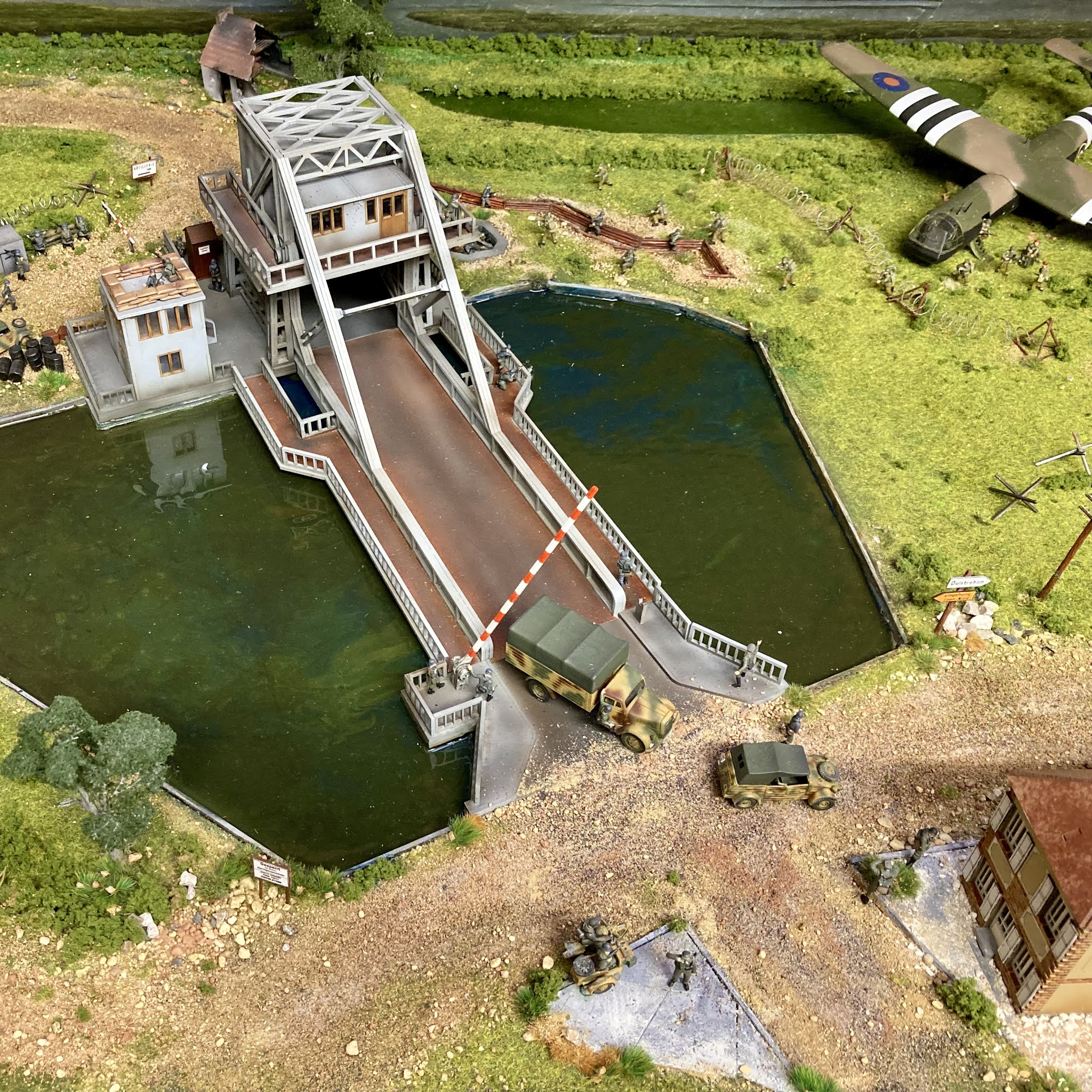
It's been a year now since I removed my old Scalextric track in the loft from its baseboard so as to showcase some of my 'lockdown' builds, and having now completed my latest diorama, the RAF Airfield from Autumn 1943, I can't believe I have finally run out of space! ðŸ¤¦‍♂️


It has been suggested that there may be opportunities to display one or two of these at model shows etc, but how I not only cut them into their respective scenes, let alone bring them down from the loft, is somewhat perplexing me! 🤷‍♂️


I have, however, seen some folk building smaller dioramas, which I understand are called vignettes, using old picture frames, such that I may now have to do a tour of the house to see which pictures I can repurpose!🤭😂

Suggestions welcomed!

Spitfire Squadron - Part 4

Spitfire Squadron … Part 4

It’s finally time to reveal the date of my diorama, a season and year which can be derived from perhaps an unusual source; the RAF vehicle paint scheme and I have to thank Mike Starmer on the Airfix Tribute Forum for this following factoid: 

1937 RAF vehicles were officially RAF Blue Grey BS.33 
1939-40 vehicles in France and Southern England were painted brown and green as used for building camouflage.  
1941 August (AMO 618/41) the RAF fell into line with army’s Khaki Green with Dark Tarmac stripe disrupter. 
1942 December (AMO 1397/42) changed to SCC2 Brown with SCC1A British Brown disrupter in a 'Mickey Mouse' design. 
1943 October changed the disrupter from SCC1A British Brown to SCC14 Black with the same 'Mickey Mouse' design.  
1944 September change to an overall SCC15 Olive Drab paint scheme.
1946 (AMO 306/46), following the end of the war, changed the scheme back to Gloss RAF Blue Grey

As the majority of the RAF vehicles are in the brown and black wavy 'Mickey Mouse' design and none are in Olive Drab it is at least October 1943 and no later than September 1944, and as I opened sating it was between 1941 and 1943 and the trees have autumn leaves, it has to be between October to November 1943!

So, what else is going on this RAF Airfield in Autumn 1943?

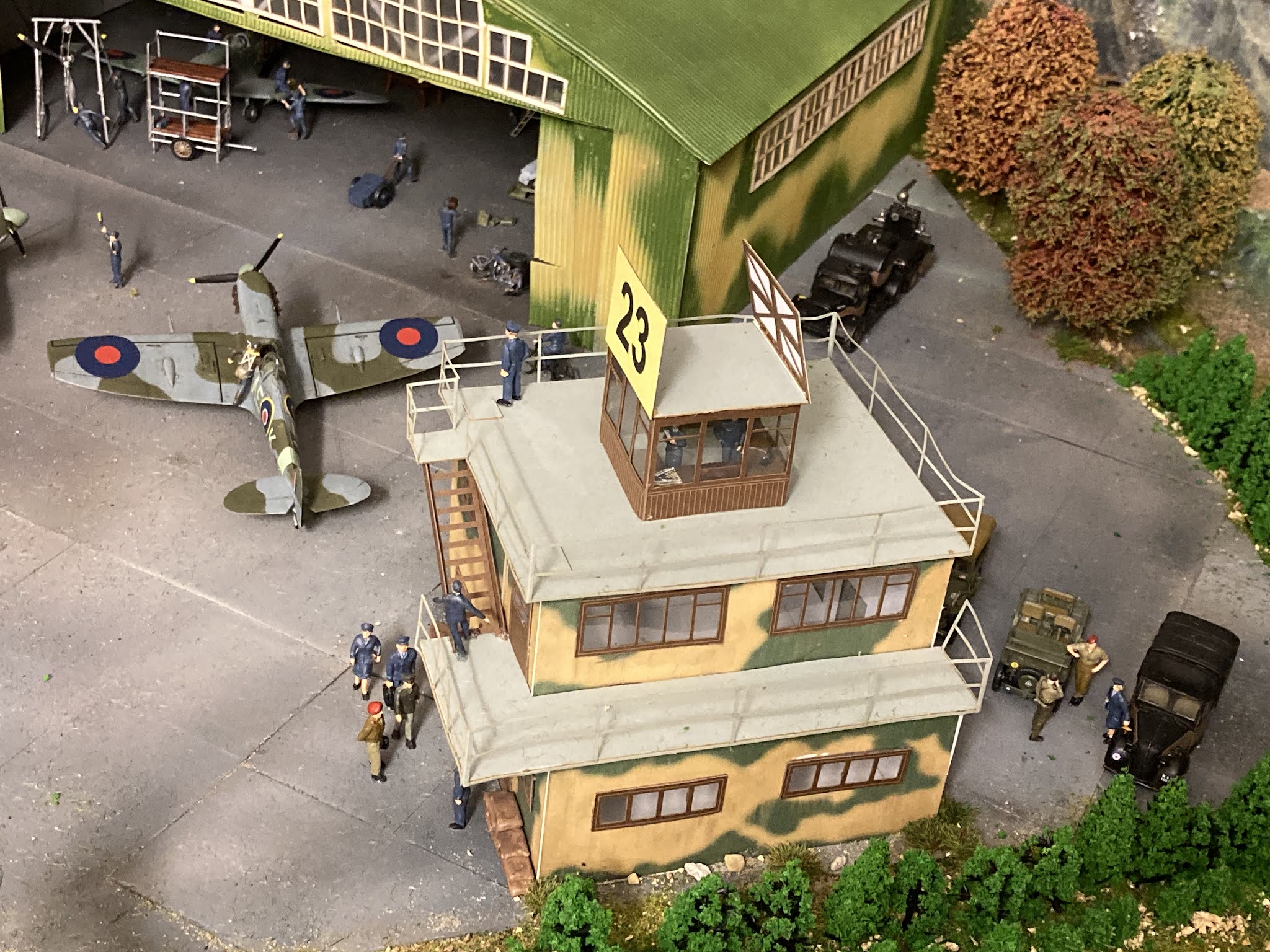
Beyond the control tower, there are parked up 3 vehicles. There is no surprise to see an RAF Standard Tilly, but the presence of the two Jeeps is intriguing. 


One is from the British Army 6th Airborne Division and the other the US Army 4th Divisional HQ. The 3 drivers, now deep in conspiratorial conversation, have just delivered their respective military leaders to the control tower, where they they are now being escorted within, to collaborate in vital D-Day planning! 


Spitfires, like the fighter‐bomber equipped Mk.Vc in front of the hanger, went on to provide essential air support for the D‐Day landings. Around 55 squadrons of Spitfire participated in the invasion of Normandy, between 5 to 7 June 1944, carrying out ground attack missions; perhaps the most famous occurring after the D-Day landings, was on 17 July 1944 when General Rommel himself was wounded in an attack by a Spitfire fighter.


There was much fear during this period of 5th Columnists and Nazi spies. While in reality, and backed up by Ben Macintyre’s excellent book ‘Agent Zigzag’, these fears were mostly unfounded, however, towards the rear of the airfield, you’ll see a spy cornered by 3 RAF Police officers, who, with the high profile visitors on the base, are taking no chances! In Ben Macintyre’s book, the British double agent Eddie Chapman is dropped into England during early 1943 to blow up the Mosquito factory on the outskirts of London; so there was certainly a desire on the part of Germany to use such spies to disrupt the British war effort.


In October 1941, with the Luftwaffe now concentrating on the Russian front and air raids on Britain lessening, so did the need for anti aircraft defences, however, the presence of senior military leaders on the base also has the Bofors 40mm Anti Aircraft gun and crew, repurposed from a my North African campaign collection, scanning the sky for a surprise Luftwaffe attack.


Finally, did you spot the set of camouflaged De Havilland Vampire wings at the back of the hanger? 


I had these left over from a previous build so thought I’d drop them in for fun, as the prototype of this single jet engined DH.100 De Havilland Vampire, Britain’s second jet fighter code named ‘Spider Crab’, conducted its maiden flight from Hatfield Aerodrome on 20 September 1943. 


Although it didn’t actually enter service until a few months after the War, it did go on to be adopted as a replacement for many of the wartime piston-engined fighter aircraft, such as the Spitfire. 


I hope you’ve enjoyed my take on this post Battle of Britain, pre D-Day airfield, and the backstories to the various scenes.


The End


Monday, 16 August 2021

Spitfire Squadron - Part 3

Spitfire Squadron … Part 3

Within the aircraft hanger, there’s a hive of activity as a Mk.Vb has  its propeller removed for repair during its 30 hour inspection. 

The fitters and riggers can be seen working through their long list of items requiring checking. For example, the engine cowlings would be removed to allow the oil filter to be removed and cleaned, and the engine checked for possible oil, fuel or coolant leaks; the propeller spinner would be removed to allow checking for possible damage, as has been found here, or leakage from the hydraulic pitch-change mechanism. 

In this scene, one of the port guns is being replaced and a sticking canopy is getting some attention. 


Meanwhile a dispatch rider delivers an important package for the second Spitfire which is sat at the back of the hanger awaiting for work to commence. 


Most of the bits and bobs of equipment here were sourced via the Airfix’s WWII RAF Bomber Re-Supply Set, and the fitters and riggers are from a box of Airfix’s RAF Personnel. The makeshift frame with pulley I scratch built from old bits of spares and stretched sprue, so pleased I no longer throw stuff away! 

To be continued …


Sunday, 15 August 2021

Spitfire Squadron - Part 2

Spitfire Squadron … Part 2

On the apron to the hanger there are two Spitfire L.F. Mk.Vb (L.F version of Merlin engine optimised for low level flight and Type B wing with 4 .303" Browning machine guns and 2 20mm Hispano Cannon). The L.F. Version engine was typically also combined with clipped wings, where their wing-tips were replaced by short fairings to improve the aircraft’s rate of roll. These latter changes were implemented in 1942, in an attempt to counter the then superior low level performance of the Fw 190. 


The development of the Spitfire was, however, relentless and a further look at these Mk.Vb would point to them actually being the new Mk.Vc (C or Universal Wing, which in addition to the Type B configuration were strengthened to make them capable of supporting a single 250 lb bomb under each wing and a 500 lb bomb beneath the fuselage). The first Spitfire to be modified to carry underwing bombs was a Malta-based Mk Vc, EP201 X-V of 229 Squadron in late summer of 1942. 

This gave me opportunity to incorporate into my diorama, not only the bombs and trailers which came with my airfield vehicles, as part of Airfix’s WWII RAF Bomber Re-Supply Set, but also to add a munitions Nissen hut, which for additional safety I positioned away from the hanger and sunk into the hillside. These Spitfires are, therefore, configured for low level fighter bomber missions against enemy airfields, communications and installations. 


Continuing the challenge to time box this diorama into a specific season of a specific year … the presence of these two cropped wing Spitfire Mk.Vc in fighter bomber mode, means that we’ve now moved on a year from my last post and are looking at a scene from at least the end of 1942.


To be continued …. 

Monday, 21 September 2020

Operation Silver Bayonet - Vietnam War 1965

I think 'boys' of a certain generation have a morbid fascination with the Vietnam War. Fought during a period of major political, social and economic change, by a superpower with seemingly unlimited military hardware, against a fanatical foe dressed in black pyjamas and sandals, over a distant exotic land of jungle, swamp and palm trees, which when coupled with free love and a great musical soundtrack provides the perfect intoxicating mix for a great action film ... and this is where such 'boys of a certain generation' have probably formed this morbid fascination with the Vietnam War!

From this introduction, you'll gather that the Vietnam War is the focus of my latest lockdown scale modelling project. The year is 1965 and the US launch Operation Silver Bayonet. This was a defining moment; it was the first major engagement of US ground forces in a 10 year conflict the Vietnamese would call Kháng chiến chống Mỹ, 'the Resistance War Against America'.  Operation Silver Bayonet was fought during what was to be known as the Battle of Ia Drang during November 1965; the objective being to destroy North Vietnamese positions in the Pleku Province in the Central Highlands of Vietnam.


Scale model company Italeri have, in recent years, produced a number of themed multi kits with all the parts required to recreate one's own historical battle scene. It was a 'no brainer', therefore, that I should lay my hands on their Operation Silver Bayonet kit for this Vietnam War phase of my scale modelling project! 

This Italeri 'Operation Silver Bayonet' multi kit included:
While the most famous event of the Battle of Ia Drang, as depicted in the 2002 movie We Were Soldiers, is the one fought over a helicopter landing zone overrun by the North Vietnamese, I at least needed a location with a village backdrop so as to make full use of Italeri's excellent wooden buildings. My build, therefore, was to depict one of Operation Silver Bayonet's other engagements where US Special Forces,  delivered by air and over land by APC, launch an attack with helicopter gunship support, on one of the heavily defended North Vietnamese supply bases in the Drang Valley. 

US attack a heavily defended North Vietnamese supply base in the Drang Valley

Battle of Ia Drang 1965 - US Department of Defense

This still left me with a few unused bits; namely a checkpoint, watch tower, a storage building and an M48 Patton tank! With these, I recreated the location of another key event of the war, the airbase of Camp Holloway, home of the UH-1 helicopters of the 119th Assault Helicopter Company, located just 3km east of Pleiku also in the Central Highlands. Here, on 7th February, 9 months before Operation Bayonet, the Viet Cong launched an early morning attack killing 8, wounding 108 and destroying 18 helicopters, prompting U.S. President Lyndon B. Johnson to begin bombing North Vietnam!


Viet Cong attack. on Camp Holloway


Camp Holloway 1965

In the next few posts, I'll deep dive into each of these models, displaying the finer details of the models which can only be seen in close up shots, explaining how they were constructed and of course sharing those additional factoids and backstories which will hopefully bring them to life!

-------

The model(s)


Brand: Italeri
Title: Operation Silver Bayonet Vietnam War 1965
Number: 6184
Scale: 1:72
Type: Multi-kit
Released: 2018 | Rebox (Model set)


BLOGGER IS DEAD LONG LIVE FACEBOOK & INSTAGRAM

It's been a blast Blogger, but not being able to upload any photos of my builds to this blog really makes you meaningless going forward....