Monday, 22 May 2023

Beaufighter VIF

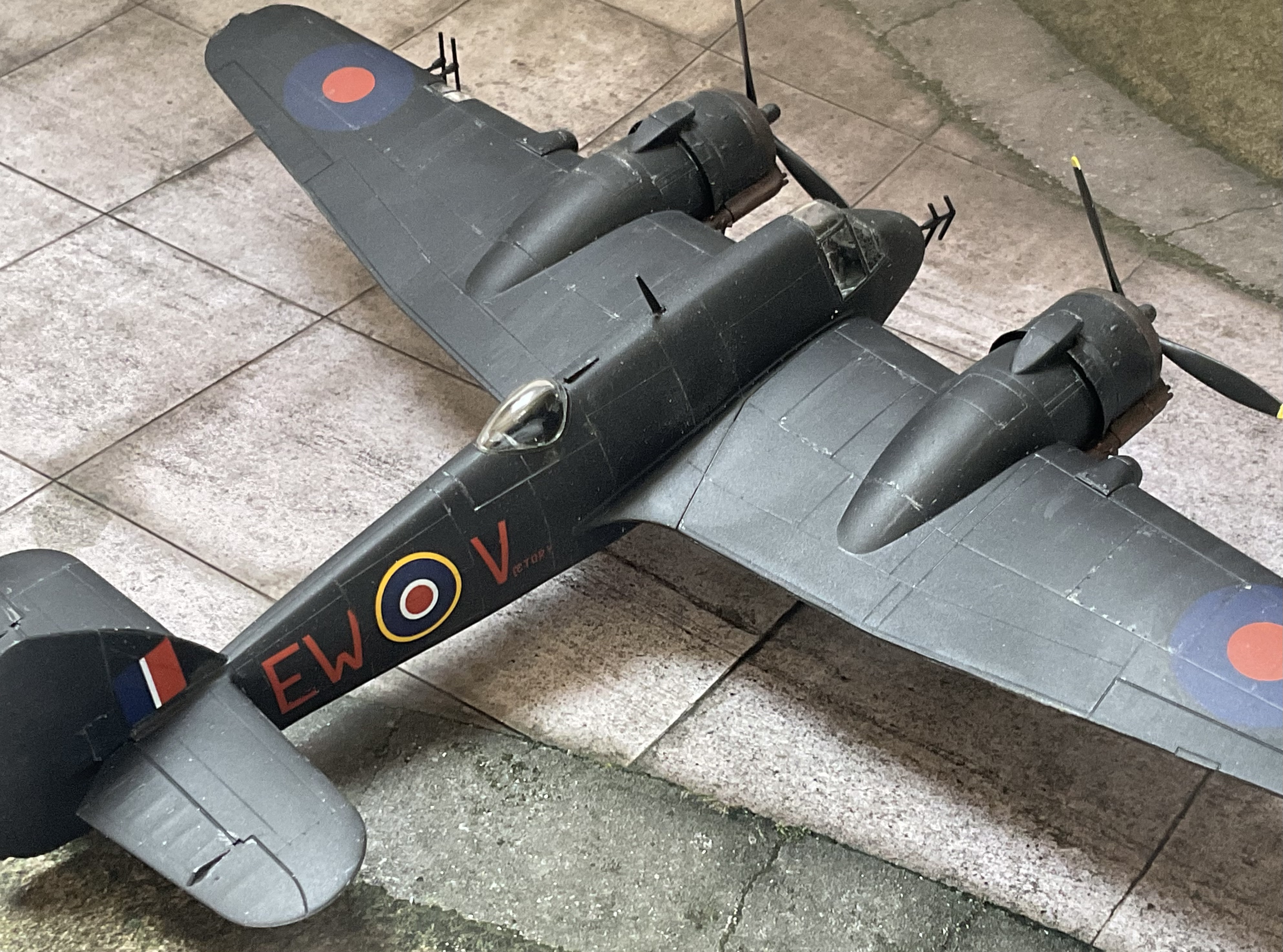
Built side by side with my Airfix Coastal Command Beaufighter that I shared yesterday, this is the Hobby 2000 (Hasegawa) kit of the Beaufighter VIF finished in the colours of 307 Squadron, Polish nightfigher unit in 1942. Between April 1941 - 1943 the squadron was based at RAF Clyst Honiton, now Exeter Airport, defending the SW England from enemy night bombers. 

From a model building view, this was one of the best quality 1:72 kits I’ve built and that’s saying something! 

I struck on building this aircraft after pausing at a memorial to two nightfighter pilots overlooking Beer beach. This remembers the night of 12th April 1942, when Beer Coastguards saw an aircraft crash into the sea one mile south of Beer Head. The aircraft was a Bristol Beaufighter IIF from 307 Squadron, based at RAF Exeter, operating in the nightfighter role, patrolling Lyme Bay to intercept German bombers which passed through this area en route to targets such as Bristol, Cardiff and Liverpool.

In response to the crash 2 Beer fishermen took their boat to look for survivors, but found only small pieces of wreckage. Both members of the crew were killed in the crash. The body of the observer, Flying Officer Mieczyslaw Swierz, was recovered from the sea by an RAF rescue launch from Lyme Regis. The body of the pilot, Squadron Leader Roman Smok, was never found.

The Beaufighter being flown on 12 April was the rarer and less reliable Merlin engined Mk.IIF introduced late in 1941 when the Short Stirling bomber programme was given a higher priority for the Hercules engine. The squadron re-equipped with the improved Beaufighter Mk VIF in May 1942 and it is this aircraft I have recreated in my model. 

In total, Beaufighter crews shot down 15 enemy bombers with three probables and 6 damaged; the last victory was the shooting down of a Do 217 on 24/25 September 1942.


On 15 November 2019, the Polish 307 nightfighter squadron was honoured for defending the British city of Exeter from a German blitz campaign during the second World War. A Polish flag fluttered over the city honouring the pilots who prevented the destruction of Exeter in the 1942 Luftwaffe attack.

Sunday, 21 May 2023

Bristol Beaufighter TF.X

I’ve finished this very nice 1:72 scale Airfix Bristol Beaufighter TF.X in the colours of 404 Squadron aircraft EE-H / NE355 apparently set in June 1944 when stationed at Davidstow, Cornwall. 


Having recently built a later Beaufighter with rockets, I thought this time I’d go with the torpedo. Airfix suggest these are interchangeable on this model, though I decided, however, to forgo the D-Day stripes, preferring its all grey appearance. I completed the look with a set of Vallejo’s Coastal Command paints and AK’s weathering pencils. 


Now for a bit of interesting background: 

In 1942, Coastal Command began to take delivery of the torpedo-carrying Beaufighter. The TF Mk.X (Torpedo Fighter), commonly known as the 'Torbeau', was the Beaufighter for precision attacks on shipping at wave-top height with torpedoes or '60lb' RP-3 rockets. 

In April 1943, after a spell in Cornwall flying missions over the Bay of Biscay, 404 moved to Scotland in support of 144 (RAF) Squadron’s torpedo-carrying Beaufighters in what was to be their new anti-flak role. Using machine-gun, cannon and rockets, their mission was to engage and neutralise defending flak ships and fighters, while 114’s torpedo bombers closed in on the high value merchant vessels.

In May 1944, 404 and 144 moved back to Cornwall, to Davidstow Moor. According to 404 Squadron’s website, this Airfix kit is based on one of the most famous photos of a Canadian Beaufighter taken during the War; that of the Commanding Officer’s (W/C Gatward) aircraft.  The ‘EE-H’ unit code and D-Day invasion stripes are interesting. I understand this picture was probably taken in August, long after D-day and that on D-Day, aircraft no. NE355 actually wore the unit code ‘2-H’, the ‘2’ signifying Davidstow Moor. 

So, this model is a bit of an oddity. For one, I have built it with a torpedo which although correct for the Beaufighters of 114 Squadron, not necessarily for 404 which were fitted with rockets; and while the unit code “EE” may have been correct as early as August, not so June. Discuss … 🧐

Either way, I always enjoy a ‘what-if’ build!

Thursday, 11 May 2023

Mustang IV

I’ve finished this Airfix starter kit of the Mustang IV ‘out of the box in the colours of aircraft KH774 GA S, 112 Sqn. 239 Wing, RAF Cervia, Italy, flown by Ft Lt Ellis F Blanchford between Feb 1945 - Dec 1946


I decided on 2 changes to the Airfix scheme: firstly I omitted the yellow leading edge on the wings as other resources shed doubt that S.GA had this applied. Secondly, I painted the spinner red and white as it should have had rather than black, assuming that Airfix did not want to provide two extra colours in their starter set! 

Overall, this was a lovely build but I did miss the extra decals you get with the full version of the kit. I also got too blasé at the beginning -  putting the decal on the wrong side of the control panel and messing up the undercarriage fittings! Fortunately you can’t even see the control panel and a scalpel and superglue fixed the undercarriage in no time 😊

The Mustang IV (P-51K) was the last version of the Mustang to see service with the RAF. This incorporated a number of improvements, including a bubble hood and an increased armament of 6 x .50" machine guns.  

112 Squadron’s use of shark teeth dates back to July 1941, when inspired by the unusually large air inlet on their P-40 Curtiss Tomahawk, the squadron copied the shark's mouth logo painted on some German Messerschmitt 110s seen earlier in the war. 


After supporting the 8th Army during the campaign in the Western Desert and victory at El Alamein, the squadron moved to Tunisia, Sicily and then in September 1943 to Italy. Receiving Mustangs in June 1944 the squadron provided air support to the Allied armies in Italy for the rest of the War, during which, 112 Squadron had brought down 206 enemy aircraft and destroyed a further 62 on the ground. After a period of occupation duties in northern Italy, the Squadron was disbanded on 30 December 1946.


Tuesday, 2 May 2023

Seafire Mk.1b

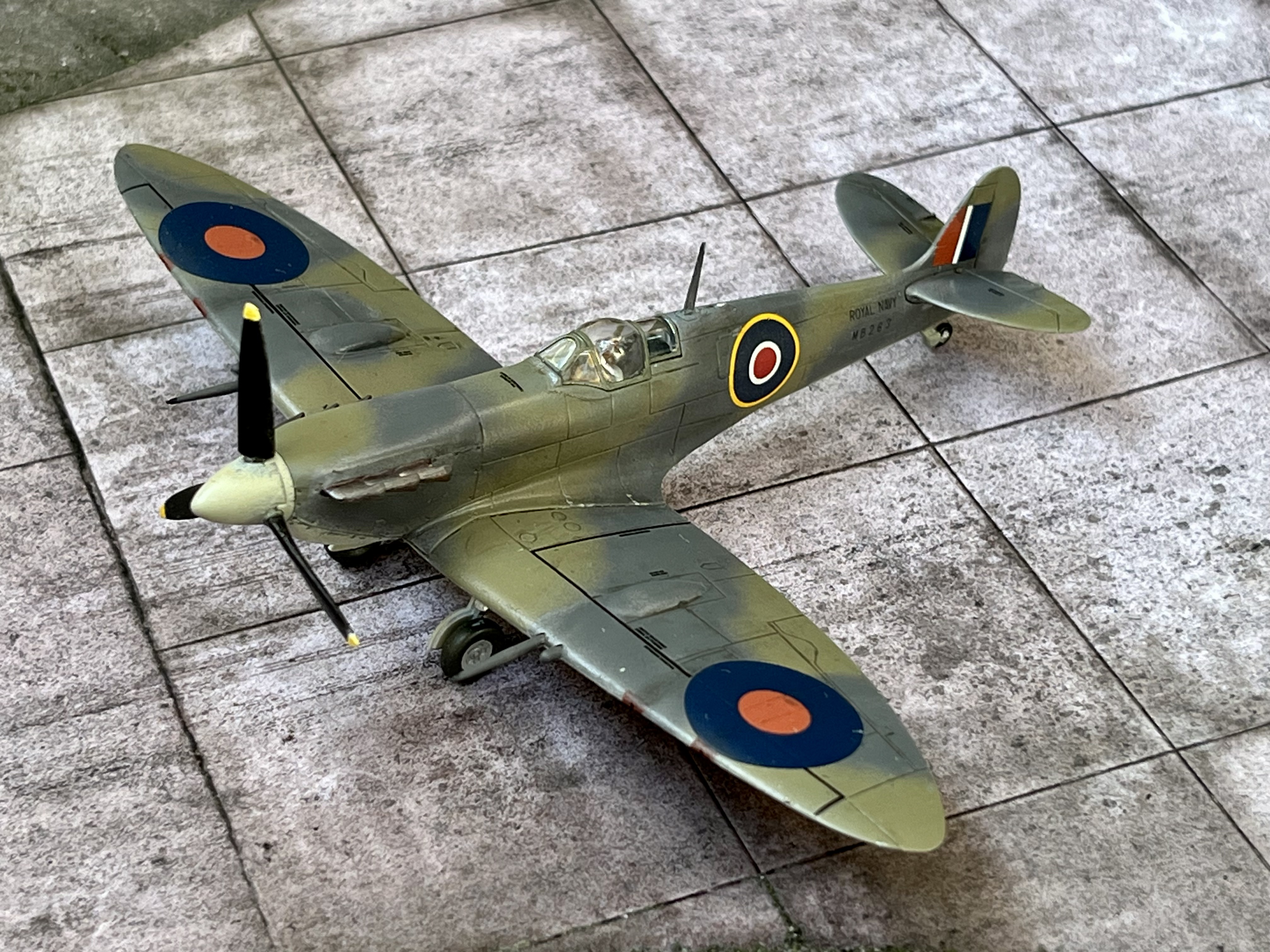
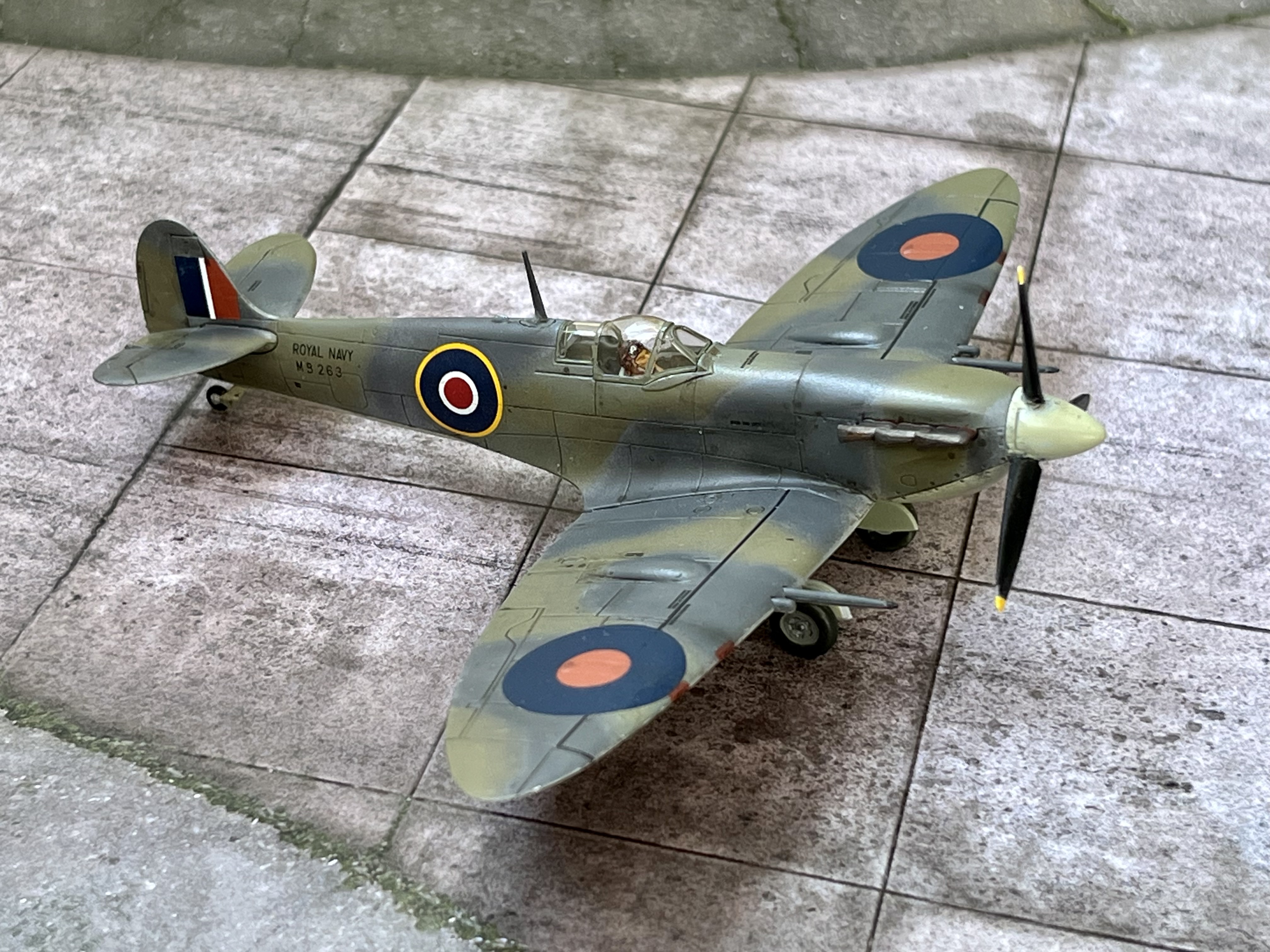
Here is my take on a pair of Dunkeswell Seafires. 

Between 1943-45 Dunkeswell was home to the US Navy. Flying PB4Y Liberators against U-Boats in the North Atlantic, their main threat was from the patrolling Ju-88 fighters. To prepare the pilots and gunners in fending off fighters, six Seafires were assigned to Dunkeswell to provide what was called “fighter affiliation” training. 


Seafires MA996 and MB263 were two of the fighter affiliation aircraft at Dunkeswell in 1944. Both arrived after serving on aircraft carriers in support of ‘Operation Avalanche’, the 1943 Allied amphibious landings at Salerno, Italy. 

I started these builds with the objective of providing a Seafire to the Dunkeswell Airfield WW2 Museum. I’ve ended up with 2 models as I first thought I’d use Airfix’s Spitfire - the Mk.Vc being the original source aircraft - for the Seafire, but then, on a visit to Hannants in Lowestoft, I chanced upon a rare Czech Kovozávody (KP) Seafire kit which I felt would be an even better match.


Although both went together well, I felt I could have built the Airfix one blindfolded while Kovozávody’s reminded me of kits I’ve built from another Czech provider, AZ Models; unnumbered sprue, no locating pins and poor decals. While I won’t be rushing back to KP any time soon, it is great that such companies exist providing such unusual kits. 

The build was the easy bit, the challenge was what camouflage to finish them in. The photos I had of the aircraft only helped confirm they were finished in a pattern similar to RAF fighters of the period. Uncovering a copy of the book “British Aviation Colours of WWII - Official Camouflage, colours and Markings of RAF Aircraft, 1939-45” made up my mind, TSS (temperate sea scheme) it would be. 


So, following an unsuccessful attempt to mix my own colours, I sought out a set of Vallejo’s FAA colours which included the all important dark slate grey and extra dark sea grey that TSS demanded. That dark slate grey is the most unusual colour I’ve ever encountered, no wonder I had issues coming up with my own version! For the decals I used a combination of the Airfix roundels, Kovozavody’s lines and markings and more roundels and lettering from my spares box. 

Seafire MA996, the Kovozávody kit, will head to join the aircraft models on display at Dunkeswell, while the Airfix kit, Seafire MB263, will fit in nicely with my existing Spitfire and Seafire collection.


Tuesday, 11 April 2023

Airfix AFV Starter Kits

Last Thursday morning I set off back to Devon on a 350 mile drive from Cumbria. 10 miles into the journey, my car’s water pump died and I was stranded. My motoring recovery service failed in their contractural obligation to bring me home, such that my car has been languishing in a Carlise garage over Easter and is only now receiving attention … but that’s another story. 


The scale modelling tale is one of me returning to where my hobby started, some 50 years ago, with what tools I could find around the house and a hairy stick to colour my creations! 

Feeling the need to build, I begged a lift over to a local garden centre close to my temporary location where I knew they had a large stock of Airfix kits. Without any of my usual tools nor paints with me, I decided on a couple of AFV starter kits which I felt I could better get away with a rough and ready finish. 


Using a set of snips and Pollyfiller, nail clippers and file, I set about the build. This certainty made me value the work that goes behind the scenes to craft tools specific for scale modelling! The builds went well, with the only fly in the ointment being that 4 of the 6 pots of acrylic paint were dried up and unusable. A return to the garden centre and the raiding of another couple of new kits resolved this, but why Airfix continue to rollout Starter Kits with this issue is beyond me. 

I was going to wait until I got home to apply the decals over a nice smooth layer of varnish but having completed the builds all too quickly and with still no sign of my wheels, I pressed on with the ‘in the field’ build, just as my younger self would have all those years ago. What innocent fun I had 

Friday, 24 March 2023

Junkers Ju-52

Heller’s Junkers Ju-52/3M in its “Where Eagle’s Dare” or as Heller would have it, Blindflugschule 3’s 1941 camouflage. 


Interestingly, Blindflugschule means ‘Blind Flying School’ which, as far as I can make out, is where Luftwaffe night fighter pilots learned their craft. So, whether they actually used the Ju-52 to train in or it was just the ‘bus’ to transport them to and from the school, I’ve not yet managed to find out.

Anyway, this Heller kit has been a challenging one but, I hope you’ll concur, I managed to get the better of it in the end. 

The base white was airbrushed using AMMO by Mig Jimenez primer and the green was hand painted with Hataka’s WW2 Luftwaffe range. 

Heller would not rate as one of my favourite kit providers but when you want to build an unusual model, like that other interesting kit producer AZ, they rarely disappoint

Tuesday, 21 March 2023

Spitfire TR.8

In July last year, I picked up a couple of AZ Spitfires at the North Somerset Scale Model Show. I quickly learned, after building the first, that AZ models are an acquired taste, so at least I knew what I was letting myself in for when I picked this rare Spitfire TR.8/9 out of my stash last week.

Rather than go for the 3 options in the box, I decided to finish this kit in the colours of IAC-163, one of 6 two seater Spitfires flown by the Irish Air Corps in the 1950s. 


Interestingly, when this Spitfire was ‘demobbed’ in 1968, it went on to appear in the film “The Battle of Britain”. Then after a spell in the US, it returned to the UK in 2019 to join three other 2 seater IAC Spitfires at ‘Fly a Spitfire’ based at Biggin Hill. 

I love a model’s backstory probably as much as building them

BLOGGER IS DEAD LONG LIVE FACEBOOK & INSTAGRAM

It's been a blast Blogger, but not being able to upload any photos of my builds to this blog really makes you meaningless going forward....