Sunday, 5 February 2023

Fw190A-4

Probably one most detailed but certainly one of the worst Airfix 1:72 scale kits I’ve ever had to construct is unbelievably complete.

The inspiration for this build came to me when I picked up Captain Eric ‘Winkle’ Brown’s fascinating book “Wings of the Luftwaffe - Flying the captured German aircraft of World War II” in my local second hand bookshop some months ago. I already had an Airfix Fw 190 in my stash and so thought it could be the perfect donor kit for a ‘Winkle Brown’ project. 


From the book, I selected Fw190A-4, serial PE882, which had landed in error at RAF West Malling during the early hours of 17 April 1943 as my target aircraft. Winkle Brown flew this Fw 190 at Farnborough on 4 February 1944 while working as a test pilot for the Royal Aircraft Establishment (RAE). At this time it had both outside cannon and its external stores carriers removed which at least saved me gluing back on two of the four guns which I found impossible not to break off during the build! 

This aircraft was to fly until 13 October 1944 when after catching fire in the air, it was to crash on the road between Kettering and Stamford, demolishing three walls before coming to rest in the garden of a house. During its build, I had many a thought to use this model in such a diorama! Not my finest, just glad to get it finished; my first attempt ended in the bin!

Tuesday, 17 January 2023

Sepcat Jaguar GR.1

I’m on a roll! After just 3 half days at the workbench, my 3rd build of 2023, Italeri’s Sepcat Jaguar GR.1, is done. 

I’ve finished it in the colours of XX733 “Pink Spitfire” of RAF 6th Squadron, flying from Thurrait Air Base in Oman in 1991 during Operation Desert Storm, when it took part in 39 missions against Iraqi forces. 


For a kit based on 30 year old tooling it is amazing quality and was great fun to build. It also comes with decals, paint instructions and ordinance for 4 different squadrons/aircraft. I was inspired to go for the Desert Storm variant after both coming across a No.6 squadron pin from my air cadet days and having both a Tornado and Buccaneer lined up for the same operational colour’s, the former having been built a while back. 

I was hoping this would have lasted me a little bit longer but it was just so much fun

Saturday, 14 January 2023

C-47 Skytrain

My latest scale model build and second of 2023 is Italeri’s C-47 Skytrain. I’ve had it in my stash since doing a Pegasus Bridge D-Day diorama some years back when I had a plan to have it flying overhead with paratroopers leaping out in support of the glider troops below. This never happened due to my short attention span and me having moved on to my next build! 

Having just read over Christmas the interesting book “The Lost Paratroopers of Normandy” I was inspired to dust off the C-47 and build it as D8 of 94th TCS commanded by Major Joseph A Beck II and then discovered was based at Station 462 Upottery, of Band of Brothers fame, here in Devon! 


This was a really nice kit to build. Very simple but lots of nice detailing. I’ve since seen that Airfix have recently re-released their 2014 moulding and this comes with decals for another of Upottery’s aircraft … how can I resist! 

Hope you like it.

Friday, 6 January 2023

SS-100 Gigant Transporter & V2

Revell’s SS-100 Gigant Transporter & V2 and 1/72 Special Armour’s A-StoManhänger "Liquid Oxygen Tank for V2 Rocket" mounted with a few British and German figures for effect. I acquired this unusual selection of kits from fellow modelling club member, Roy last year and it’s been really rewarding to complete something a little different. 


I’ve built and finished these complementary kits to reflect a moment during October 1945 when a total of 3 V-2 rockets were launched from a test site at Cuxhaven, Germany, by German POWs under the British supervision, into the North Sea as part of ‘Operation Backfire’. The explosive material in the warheads was steamed out and replaced with sand and for tracking purposes, these rebuilt missiles were painted in a black-and-white checkered pattern, similar to the early Peenemünde rocket schemes that were first tested 3 years earlier. 


In June 1945, General Eisenhower approved Operation Backfire, the British initiated Operation put forward by J. C. C. Bernard, A.T.S., Personal Assistant to Major-General Cameron, head of the British Air Defense Division. The objective of the Operation was to provide the knowledge and skills of guided ballistic missiles, to ascertain the German technique of launching long-range rockets and to prove it by performing an actual launch. Following the successful conclusion of the tests, the War Office in London issued a 5-volume report detailing these operations. Operation Backfire resulted in one of the most comprehensive evaluations and documentation of the total V-2 weapons architecture, not only by the Allies, but also the Germans!

If you’re interested in reading more, then check out this amazing article with photos and links to the 5-volume report. http://www.v2rocket.com

Wednesday, 14 December 2022

Avro Lancaster B.III (Special) Dambuster

On the night of 16 to 17 May 1943, Lancaster AJ-T (T-Tommy) was 617 Squadron’s reserve aircraft, prepared with Barnes Wallace’s bouncing ‘Upkeep’ bomb, for Operation Chastise, the Dambuster raids. 

I decided to finish my Airfix 1:72 scale Avro Lancaster B.III (Special) Dambuster in the markings of T-Tommy, rather than the more famous G-George flown by 617’s Squadron Leader, Guy Gibson, in recognition of the recently departed “last surviving Dambuster”,  Geroge ‘Johnny’ Johnson, the aircraft’s bomb aimer.


Having been detailed to attack the Sorpe Dam and flying the longer, northern route, Flt Lt Joseph Charles "Big Joe" McCarthy (an American serving in the RCAF) and crew, with four other aircraft of Formation No. 2, were to be the first of the 3 waves and 19 Dambusters to take off. After McCarthy's bomber developed a coolant leak, the crew had to take T-Tommy, the reserve aircraft, and followed on half an hour later.

Being an embankment dam , with concrete core covered in soil, the Sorpe dam was the one least likely to be breached, unlike the Eder and Möhne concrete-and-steel gravity dams that were so successfully breached. The attack on the Sorpe also differed from the previous ones in that the topography of the valley required the approach to be made along the length of the dam and not at right angles over the reservoir. The 'Upkeep' bomb, therefore, had to be dropped on top of the dam rather than being spun and then bounced on the water. The specialist bombsight developed especially for the raid would also be of no use. It is also amazing that the five crews detailed to attack the Sorpe Dam received their briefing on the afternoon prior to the raid.

None of the other 4 Lancasters of Formation No. 2 made it to the dam, and so McCarthy at the controls of T-Tommy was the first to arrive. McCarthy made nine attempted bombing runs before bomb aimer George “Johnny” Johnson, was sufficiently satisfied to drop the 'Upkeep' bomb on the tenth run. The bomb exploded but only a section of the crest of the dam was blown off; the main body of the dam remained. The planners of the Operation had estimated that it would take 5 of the ‘Upkeep’ bombs placed correctly to weaken the dam sufficiently for water pressure to complete the break. Only McCarthy and one other aircraft, from the Formation No.3, made it to the Sorpe with their bomb. Even a second British Operation on 15 October 1944 with five-ton Tallboy bombs failed, leaving behind only several huge craters and causing minor spillage.

Saturday, 10 December 2022

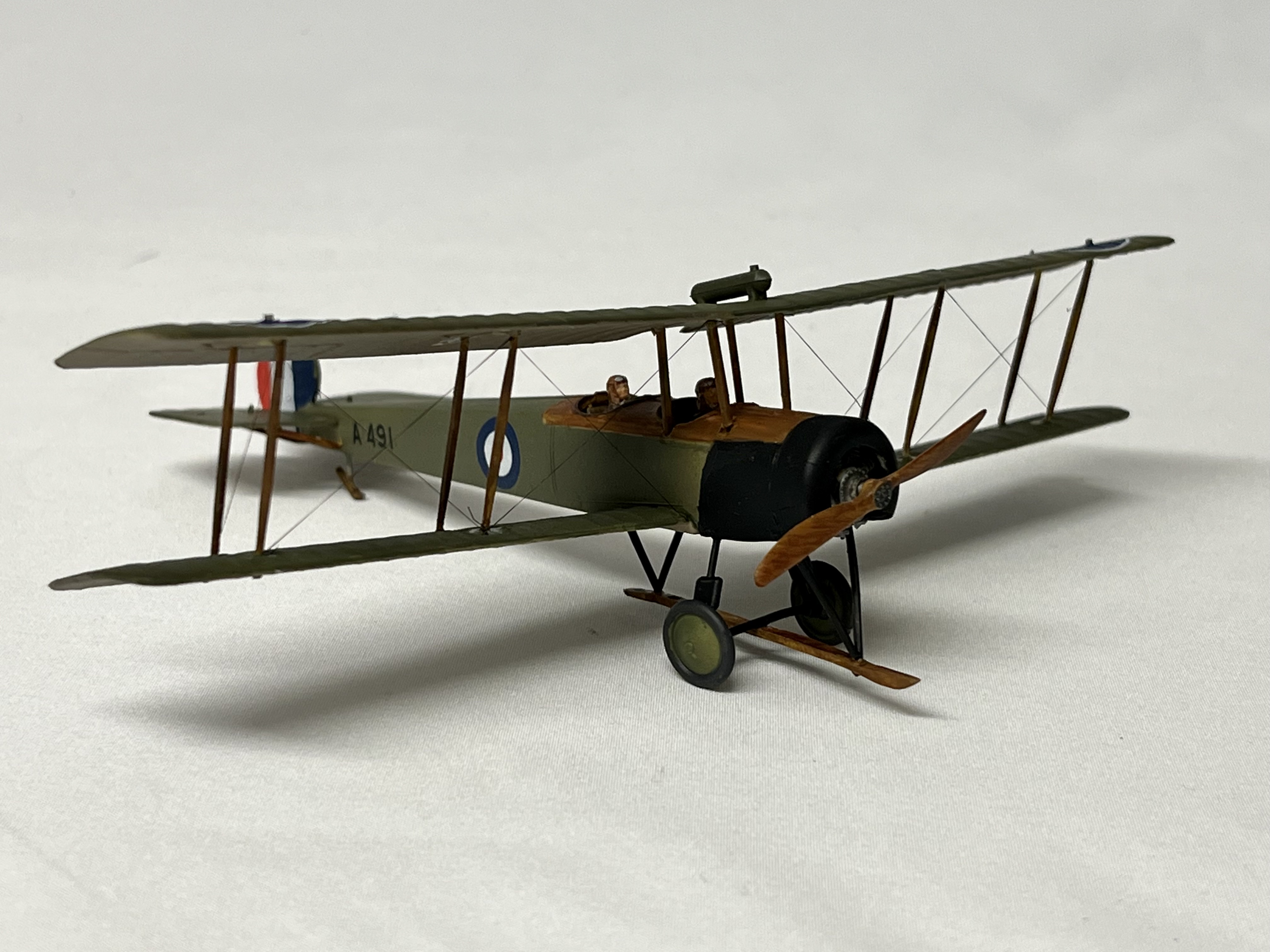
Avro 504


Well that was good fun! 


It came as a surprise to me that AV Roe’s Avro 504 was the most numerous aircraft flown by the RFC during WWI, a fact I learned after recently being gifted  book on the history of Avro by a good cycling friend of mine. As it then goes, I just had to build one of these famed aircraft and this opportunity only arose when a good scale modelling pal of mine gifted me a 1973 Airfix kit of the same!


I had to go for some new decals from Hannants and although overpriced, PRINT SCALE LTD - scale model store UK were the only offering available. What a mistake.. they were truly awful, no historical reference to the options, totally the wrong scale and fractured on application. A note to never buy this make again. 

I also had a go at rigging. Having previously dismissed AMMO of MIG Jimenez NL’s useless product, I’ve since just used stretched sprue but not that long ago acquired a reel of AK-Interactive rigging which turned out to be sublime. No snagging and it pulls off the reel time after time, no problem. It was only my own lack of time that prevented me from doing a complete job, but feel the little I’ve added gives an impression of there being rigging there 😆

So, this is finished as an unknown WWI Avro 504K in honour of all those RFC flyers of the time and of AV Roe’s amazing aircraft. 

Monday, 7 November 2022

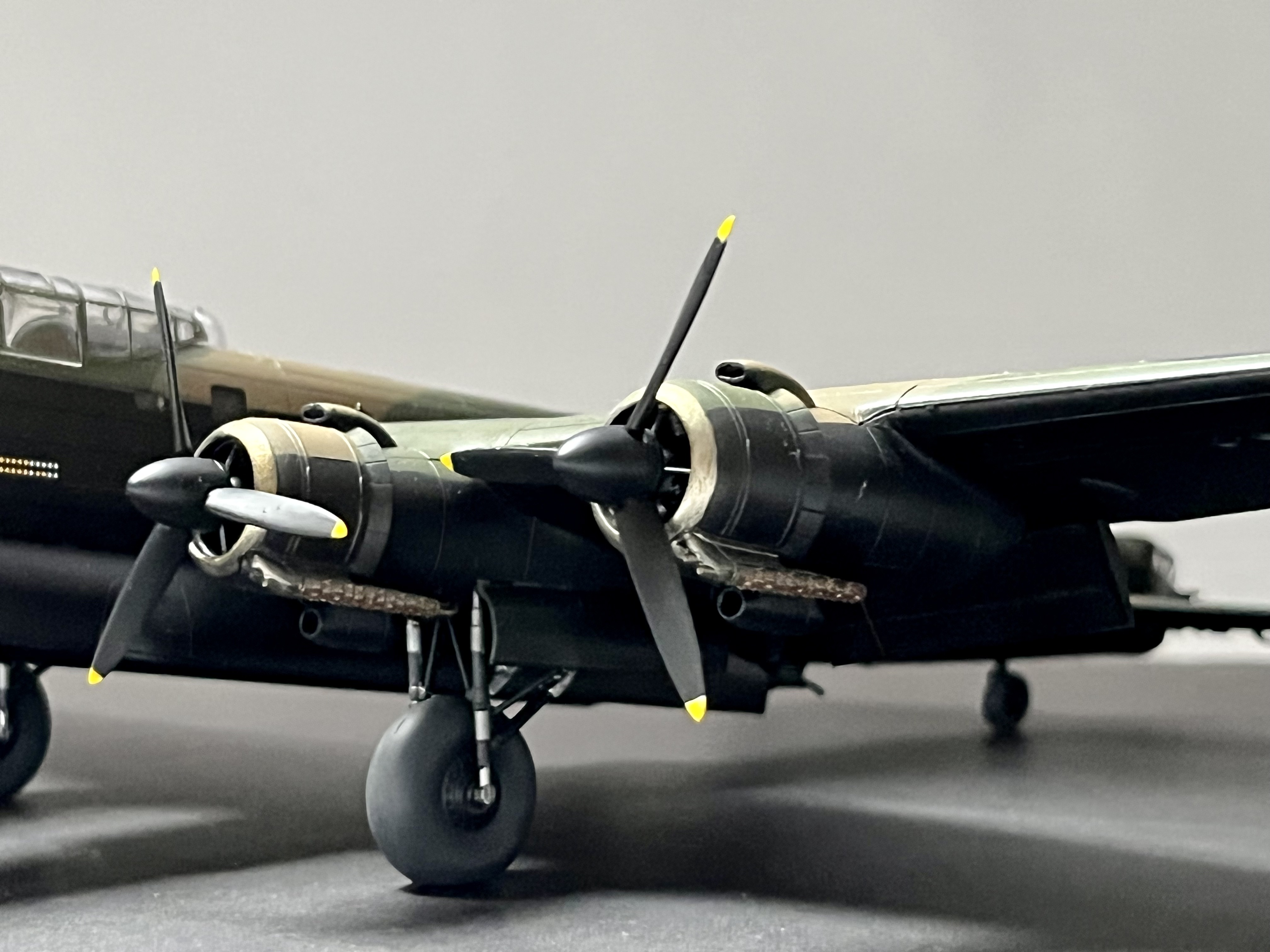
Avro Lancaster Mk II

While not the classic Lancaster we’re used to seeing, I just had to build this rare incarnation of probably the most iconic bomber of the War. It is indeed a rarity, in that it made up just 4% of the total number of Lancasters produced, it remained in frontline service for no more than a year and none survived beyond 1950.


The uniqueness of this aircraft is that rather than having the standard Rolls-Royce Merlin engines, the Lancaster Mk II. due to concerns over the supply of the Merlins, were fitted with Bristol Hercules radial engines. As it happened, by the time the Mk II entered service in October 1942, the threat to the Merlin supply was already receding and as such only 300 Mk IIs were produced. 


The Hercules engine’s performance was found to be not as good as the Merlin. The maximum operational altitude the Mk II could achieve was between 14,000 - 18,000 feet as opposed to the greater and considerably safer altitude of 22,000 feet of the Mk I. Fortuitously, in not requiring the merlin’s liquid cooling systems, the Mk II could take a little more punishment. 


The Mk II also received an additional protection in the installation of a FN64 ventral turret situated behind the bomb bay; though many crews removed these to save weight. A second problem with the Mk II was that it could only carry 14,000 lbs of bombs, compared to the 18,000 of the Mk I. Thus, by the end of 1943, it was no surprise to find the Lancaster Mk II being phased out.

A couple of additions I made to the completed build were the set of bombs sourced from the RAF Resupply Set as Airfix no longer provide these with the kit, and I drilled out and filled with liquid glazing the windows in the escape hatches. It seems odd to me that in their 1960s kit these were included while in the 2020s moulding, the many side windows are added, but the escape hatch windows are omitted!


In it being Halloween, it seemed only right to finish my Airfix Mk II in the markings of “Z-Zombie”, LL725, of No. 408 (Goose) Squadron, 6 Group, Royal Canadian Air Force, based at RAF Linton-on-Ouse, Yorkshire, in July 1944. 


And in researching the back story as to why this aircraft carries the Zombie Nose Art, I dredged up the following account by the aircraft’s rear-gunner and nose artist, George Oliver:

… for some reason the call sign at Linton-on-Ouse, Yorkshire, was changed from Z-Zebra, to Z-Zombie. On their 8th operation to Essen, Germany on 24 March 1944, they lost an engine and had the option to dump their bomb load and return to base or to carry on. The crew agreed to press on but arrived over the target late and all alone. After the release of their bomb load they were met with intense ack-ack and were lucky to escape. On return to base they discovered that they had been posted as lost in action. It was following this experience they all agreed “Zombie” [return of the living dead] should become the nose art, and so it was. 


BLOGGER IS DEAD LONG LIVE FACEBOOK & INSTAGRAM

It's been a blast Blogger, but not being able to upload any photos of my builds to this blog really makes you meaningless going forward....