Sunday, 11 April 2021

Space Shuttle

Today is the 40th anniversary of the launch of the world's first spaceplane and coincidentally 60 years to the day that Yuri Gagarin became the first human to orbit the earth. 

NASA Space Shuttle

On Sunday 12th April 1982, astronauts, John Young and Robert Crippen, aboard the Columbia Space Shuttle, heralded a new era of commuting into space. I was just 17 years old at the time and had been following the development of the Space Shuttle for many years. I still have my copy of Hamlin's The Space Shuttle Handbook in which I wrote my name and date of purchase, January 1980, as was my habit back then, together with an inked summary of the first Shuttle 3 launches: April '81, November '81 and March '82

Revell's 1:144 scale Model of Space Shuttle Atlantis

The winged spacecraft we tend to refer to as the Shuttle is actually just called the Orbiter. The Space Shuttle is comprised three parts, the Orbiter, a solid fuel rocket to initiate the launch and two reusable boosters.

Entering into the spirit of exploration, NASA named the five Orbiters after famous ships that have charted the oceans of the world. Orbiter-102 was Columbia after the sloop which explored the mouth of the Columbia River in 1792. Orbiter-103, Discovery, is named after the vessel in which Henry Hudson searched for the north-west passage between the Atlantic and the Pacific Oceans in 1610. Orbiter-104 was Atlantis, Orbiter-099 Challenger and Orbiter-105 Endevour all names of ships that logged millions of miles conducting research and exploring the oceans. Orbiter-101 Enterprise, named at the request of many fans of the Star Trek television series, was, however, the first to actually fly. Enterprise was used for Air-Launch Flight Tests released from the back of a Boing 747 airliner in1977, and although was planned to be made ready for space flight, this never happened.


That first space flight of Columbia which I documented in my Space Shuttle Handbook reads:

Shuttlenauts: Capt. John Young 50; Capt. Robert Crippen, 43 
Launched: Sunday 12 April 1981 (13:00) - OK - But 15 of 27,000 heat resistant tiles lost
Orbiting: Monday 13 April 1981 - Cargo doors open / operate OK; Tuesday 14 April 1981 - Cargo doors close OK; 36 Orbits completed
Landing: Tuesday 14 April 1981 (19:14) - OK - after 54 hour flight, 57 seconds ahead of schedule at Edwards Airforce Base in California's Mojave Desert
  
Columbia went on to deploy the Space Lab, the reusable laboratory developed by European Space Agency (ESA) during the early 1990s and then was tragically lost on 1st February 2003 at the end of its 28th mission over Texas approximately 16 minutes before landing. The cause of the disaster was a piece of polyurethane foam insulation which broke off from the Space Shuttle external tank and struck the reinforced carbon–carbon leading edge of the orbiter's left wing. When Columbia reentered the Earth's atmosphere, the damage allowed hot atmospheric gases to penetrate the heat shield and destroy the internal wing structure, which caused the spacecraft to become unstable and break apart.


Space Shuttle Atlantis was first launched on 3 October 1985 to deploy a Department of Defense communications satellite but is most famous for performing the first Shuttle docking with the Russian Mir Space Station on 27 June 1985 and playing a instrumental role in the construction of the International Space Station (ISS) between 19 May 2000 and 8 July 2011, the Space Shuttle's last ever mission.  It is a fact that without the Space Shuttle the ISS would never have been built. Indeed, following the grounding of all Shuttles after the loss of the Shuttle Columbia in 2003, assembly was held up for almost four years, while the Russians ferried crews back and forth to ISS

Shuttle loading bay opened showing the radiators and the ESA Space Lab

The Shuttle was born as a steppingstone to routine space transportation ferrying people, cargo, satellites and space station modules to low earth orbit, from where nuclear-powered rocket stages would send the next generation of astronauts to colonise the moon and deeper into space. It was believed that the Shuttle would be capable of making up to 60 flights a year but as the 1970s wore on it became apparent that such extravagant expectations could not be met. The hope that the Shuttle could be turned around within two weeks was impossible to fulfil and keeping the thermal insulation tiles in place and undamaged during launch and re-entry was to be a significant challenge to the programme.

My interpretation of Atlantis in Earth's orbit

The Shuttle lasted 30 years and spanned 3 distinct and separate phases:

Phase 1 1981 - 1986 :  the first 25 missions, in which an attempt was made to increase flight rates and carry all manner of government and commercial satellites; 

Phase 2 1988 - 1998 : the next 67 flights during which the shuttle was restricted to non-commercial payloads, flying military missions and docking with the Russian Mir space station; 

Phase 3 1998 - 2011 : the last 43 missions building the International Space Station, at last carrying out the role for which the Space Shuttle was designed. 

Atlantis ends the Space Shuttle era


My Model

For my model of the Space Shuttle, I used Revell's reboxed 2005 kit which was showing its age! The flash and moulding across the whole model was poor, making for a very frustrating and one of my most unenjoyable builds and unfortunately this reflects much of the final finish that I achieved.


I finally finished the model in the 2011 colours of Orbiter-104 Atlantis, as it would have been seen on its last visit to the ISS and the last ever flight of any Space Shuttle. I painted but did not bother to include the astronaut provided, it looked daft moulded in a 'standing to attention' position. The clear stand was equally unusable so I found another in my stash which, having decided to have the wheels up,  would do as a stopgap, and I could not be bothered to paint the nose in the suggested mid grey, perhaps I'll return to that at a later time. 

-----------

The kit:


Brand: Revell
Title: Space Shuttle Atlantis
Number: 04544 (Also listed as 80-4544)
Scale: 1:144
Type: Full kit
Released: 2013 | Rebox (Changed box only)


Friday, 9 April 2021

Douglas Bader's Bristol Bulldog

Douglas Bader joined the RAF as an officer cadet in 1928 as one of six annual prize cadetships offered by the Royal Air Force College Cranwell. On 26 July 1930, Bader was commissioned as a pilot officer into No. 23 Squadron RAF based at Kenley, Surrey, flying Gloster Gamecocks.

In 1931, a couple of months after his twenty-first birthday, Bader was selected to fly in 23 Squadron’s aerobatic display team. At the same time, the Squadron began to replace its Gamecocks with a new fighter, the Bristol Bulldog IIA. Powered by a 490-hp Bristol Jupiter VII engine, the Bulldog was much faster than the Gamecock — it could do nearly 180 mph flat out — but it was also a good deal heavier, which gave it a tendency to lose height during certain aerobatic manoeuvres such as slow rolls.

After a poor game in front of the England Rugby selectors at the weekend, Bader was feeling mildly depressed on the morning of Monday, 14 December, when he went down to ‘C’ Flight to see what his orders would be for the day. 23 Squadron had been picked to appear at Hendon Air Display three years running and it would be a tremendous achievement appear a fourth time, so Douglas threw the Bulldog around the sky for an hour and a half, ridding himself of some of the weekend’s anxiety, but not all. He had hoped then that lunch with two fellow pilots at Woodley Aero Club, near Reading, would have improved this but when some of the keen young members of the Club asked the three RAF pilots if they would put on a show for them, Douglas was goaded into agreeing and the three Bulldogs took to the air. 

While the other two continued their climb, Douglas pulled up in a steep turn to head back towards the aerodrome, dropping the aircraft lower and lower until it was only feet above the grass. The Bulldog’s entry speed for a roll was 120 mph — safe enough at altitude, but leaving very, very little margin for error low down. Bader aimed for a spot just in front of the clubhouse and began his manoeuvre, pushing the stick smoothly over to the right to start his roll; once well past the vertical, his port wingtip coming down to point towards the ground, he applied rudder to maintain the height, vital now, for his speed was slipping. Unable to create the required lift, the heavy Bulldog sideslipped the last few feet into the ground. 

Bader’s right leg was damaged beyond repair; requiring it to be amputated just above the knee. The surgeon hoped to save his left leg but that too, having been badly crushed, had to be removed from below the knee. Such horrific injuries one would not have gleaned from his logbook, where, after the crash Bader made the following entry :

Crashed slow-rolling near ground. Bad show

After a lengthy period of recovery and being fitted with prosthetic legs, Bader underwent tests at the Central Flying School, believing it a formality to retuning to active service. The RAF hierarchy, however, decreed that,  although he passed the flying and medical checks, an officer could not fly without legs, there being nothing in King’s Regulations to cover such a case. In April 1933 Bader was invalided out of the service prematurely ending his RAF career .. or did it?

The Model

For Badar's Bulldog, I used both Airfix's original 1960s kit and their Vintage Classics rerelease. My first attempt at the original ended in disaster when I glued the upper wing together totally wrong. I had intended to buy the new kit to just use its upper wing, but after breaking the old wing into 3 and rejoining the pieces in the correct sequence it didn't look too bad. So I built both!

For Bader's aircraft decals I used a set from Model Alliance, which despite the cover art did not include the roundels nor the full tail stripes! The 1960s decals were well past their use by dates so I made use of the rereleased set's national markings and decided on painting the now extra kit in the colours of the RAF College which, in the Model Alliance drawings, did not have tail markings.


I also has a go at rigging Bader's aircraft, but the Ammo Mig rigging kit was so awful to use and difficult to see I'd even done anything, that I only managed 2 wires.

Overall, I'm very happy with the end result(s), they were great fun little kits to build.


Friday, 2 April 2021

International Space Station (Phase 2007)

Just to recap, for Christmas, I received the gift of Tim Peake's autobiography 'Limitless'. As the subjects of my scale models are inspired by events and observations, it should be no surprise that this inspiring book has steered me to kick off a mini project focussing on 3 of vehicles which feature in the 3 phases of Tim's flying career. The Army Air Corps helicopter pilot, test pilot and astronaut. 

Tim Peake the Astronaut

In 2010, following his initial 4 years with the Army Air Corps as a Gazelle helicopter pilot and 12 years as  instructor and test pilot on the AH-64 Apache helicopter, Tim graduated as an Astronaut with the European Space Agency. 

On 11th December 2015 Tim became the first Britain in space when he was assigned to Expedition 46 to the International Space Station (ISS). Tim launched on the Russian Soyuz TMA-16M rocket from the Baikonur Cosmodrome, Kazakhstan with fellow astronauts, Sergey Volkov, Mikhail Kornienko, Yuri Malenchenko and Timothy Kopra, for the 4 hour flight to join Commander Scott Kelly who would be remaining on ISS while the earlier Expeditions' crews, whom Tim and team were replacing, departed for earth.

ISS Expedition 46 patch, 2015

The 46 icon in the foreground of the patch represents the forty-sixth expedition mission to the International Space Station. Earth is depicted at the top with the flags of the countries of origin of the crew members: the United States, Russia and the United Kingdom. The Union flag of the UK is displayed in a position of prominence in recognition of the significance of the first British ESA astronaut to fly in space. The outer border is in the shape of a triangle with an unbroken border, symbolising the infinite journey of discovery for past, present and future space explorers. The names of the six Expedition 46 astronauts and cosmonauts are shown in the border.

Tim's mission of gravity free experiments and even a space walk, concluded on 1 March 2016 when he bounced down to earth landing on the Kazakh Steppe, a vast region of open grassland in northern Kazakhstan. His was possibly a harder landing than this counterparts on Apollo missions I remember from my youth landing in the Ocean! or better still that experience by the Shuttle crews of the 1980s. 

The International Space Station (ISS)

NASA's idea of the space station was first publicly shared in 1963 at the most unlikely venue, the Ideal Home Exhibition! The space station would be the springboard to the planets but it took until 1984 for President Reagan to actually authorise NASA to begin work on a space station and to 'do it within a decade'. 

The Soviet space program, having lost the race to the moon, meanwhile, had been launching space stations for 20 years. Their Salyut series of space stations first launched in 1971were followed up with the Mir (peace) space station in 1986. Mir presaged a new capability for keeping people in space, using the building block approach to expand the facility into a fully equipped laboratory.

After the collapse of the Soviet Union on 25 December 1991, Russia lost territory, natural resources, manpower, factories and government facilities now located in what, almost overnight, became foreign countries. There was just enough money to maintain the Mir programme but their shuttle Buran was abandoned. In June 1992, President George Bush of USA and President Boris Yeltsin of Russia signed an agreement pledging cooperation through Shuttle missions to Mir. This resulted in the setting up of frequent ferrying flights of Russian cosmonauts aboard the Shuttle and Americans aboard a Soyuz between Earth and the Mir Space Station.

International Space Station ISS (Phase 2007)

This relaxation in political tension led in 1993 to Bill Clinton's presidential decision requesting NASA bring in Russian expertise and forge a new working relationship within a five-team partnership comprising the USA, Russia, Europe, Japan and Canada to create a truly International Space Station - the ISS.

ISS Phase One - missions to Mir. Following agreement to merge their efforts, NASA and its Russian counterpart set to work planning a series of missions that would prepare the way for assembly of an international laboratory in space - one hosing astronauts from several countries. 

ISS Phase Two - the assembly. By 1995 the scale of the ISS had grown to 75 assembly flights in a complex schedule of launches planned to start in November 1997 and finish in June 2002. By 1997 this had been paired back to 45 and the final configuration settled. The agreement was for a 'T' configuration for the ISS modules with 8 solar panels, 4 extending from each end of the top of the "T' called the truss assembly. Nodes would be sighted down the length of the 'T' connecting the European Colombus and Japanese JEM modules to the US and Russian modules which were the first to assembled. 

The first module launched was planned to be built by Boeing in the US, but as costs spiralled NASA pushed for Boeing to cancel their build and pay Russia for a replacement. In November 1998 the Russian built Zarya (Sunrise) model was launched. Visually similar to the Mir core module and designed primarily for living and working in, it would initially serve as a powerhouse and tug. 

The second ISS element lifted into space in December 1998, was the first of 3 nodes called Unity, it was the first piece of US hardware. The nodes are places where engineering and systems equipment are located while doubling as connectors between modules and other structures. 

The third element was the Russian-owned Service Module Zvezda (Star), launched in July 2000, delayed 2 years by holdups in manufacturing and postponed launch dates.

Annotated with ISS Phases Two to Three

ISS Phase Three - permanent habitation. The arrival of the Solar Arrays in December 2000 would enable the station to provide a permanent home and work environment for its occupants. February 2001 saw the Space Shuttle Atlantis attach the 13 tonne US Destiny science laboratory to the Unity Node delivered 3 years earlier. Additional trusses and solar arrays followed.

ISS Phase Four - final assembly. With the anticipation high for an early completion of the giant station, hopes were dashed when the only vehicle capable of transporting large loads into space was grounded. The loss of the Shuttle Columbia in 2003 held up assembly for almost four years, while the Russians ferried crews back and forth to ISS. 

In August 2007 Endeavour was the first Space Shuttle since 2003 to resume flights to the space station and enable the final assembly to be completed. Between 2007 and 2011 the final elements comprising, 4 further solar arrays, the final 2 nodes, the European Lab - Columbus Orbital Facility, Japan's Jem modules, Canada's remote arm, and the Science Power Platform were all delivered, completing - for now at least - the ISS assembly.

The Model

I was amazed to learn that anyone had created a scale model of ISS, so was thrilled to lay my hands on this Dragon 1:400 scale kit, even if it was based on its assembly as at 2007, prior to the Shuttle flights resuming after the 2003 Columbia tragedy. 

Dragon's 1:400 Scale Kit and my Haynes Owner's Workshop Manual to assist in construction!

This kit, therefore, shows ISS as it would have looked after completion of Phase Three rather than how Tim would have seen it when he arrived in 2015.

Just need to put it together now 


The finished model before adding the CGI background


The Model

Brand: Dragon
Title: International Space Station (Phase 2007)
Number: 1102
Scale: 1:400
Type: Full kit
Released: 2020 | Initial release - new tool


Sunday, 28 March 2021

MINI Countryman for Mum

Since they were released, my Mum has always wanted a Mini Countryman. So, while I'll probably never have the funds required to buy her a real one, I thought I'd build her a mini-me 1:32 scale version.

Using Airfix's Mini Countryman WRC gift set kit as the base, I set about constructing as close to a road going version as possible, in a metallic colour that she would appreciate more than the bright yellow of the Mini Countryman WRC I built a few weeks ago, or the John Cooper Rally Team red with rally decals that the box art suggested.


I had thought that I would have been able to swap a few bits from the Airfix Mini Cooper S, I was building at the same time, as a copy of my old Mini 850, however, the rally seats wound not fit in the lower roofed Cooper S and its more traditional road wheels were really too small for the Countryman. So, more by accident than design, it was just the Cooper's rear view mirror and speedo decals which I transferred over, having been too hasty in joining the Cooper's body to chassis before spotting these still lying on the bench!

One additional and planned modification that I did make, was to covet the Countryman from left to right hand drive. Why are rally cars left hand drive these day's? This conversion was achieved by drilling a second hole for the steering column in the righthand footwell, a much simpler conversion than on the real mini! One thing I neglected to spot in doing this, however, was that I could not move the rev counter, but you can't have everything!

My Mum's current car is painted a pale metallic green, which having checked with her prior to the build, is a colour she would have again - I just hope my prior questioning does not make her think I'm buying her a full sized new car! I probably should have gone to the dealer to get a colour pot of this actual colour but having found a Vallejo green metallic, for probably a fraction of the cost, I thought how different can metallic greens be? With hindsight, very different! Then again, a sporty mini needs to have a bold, bright colour, doesn't it.

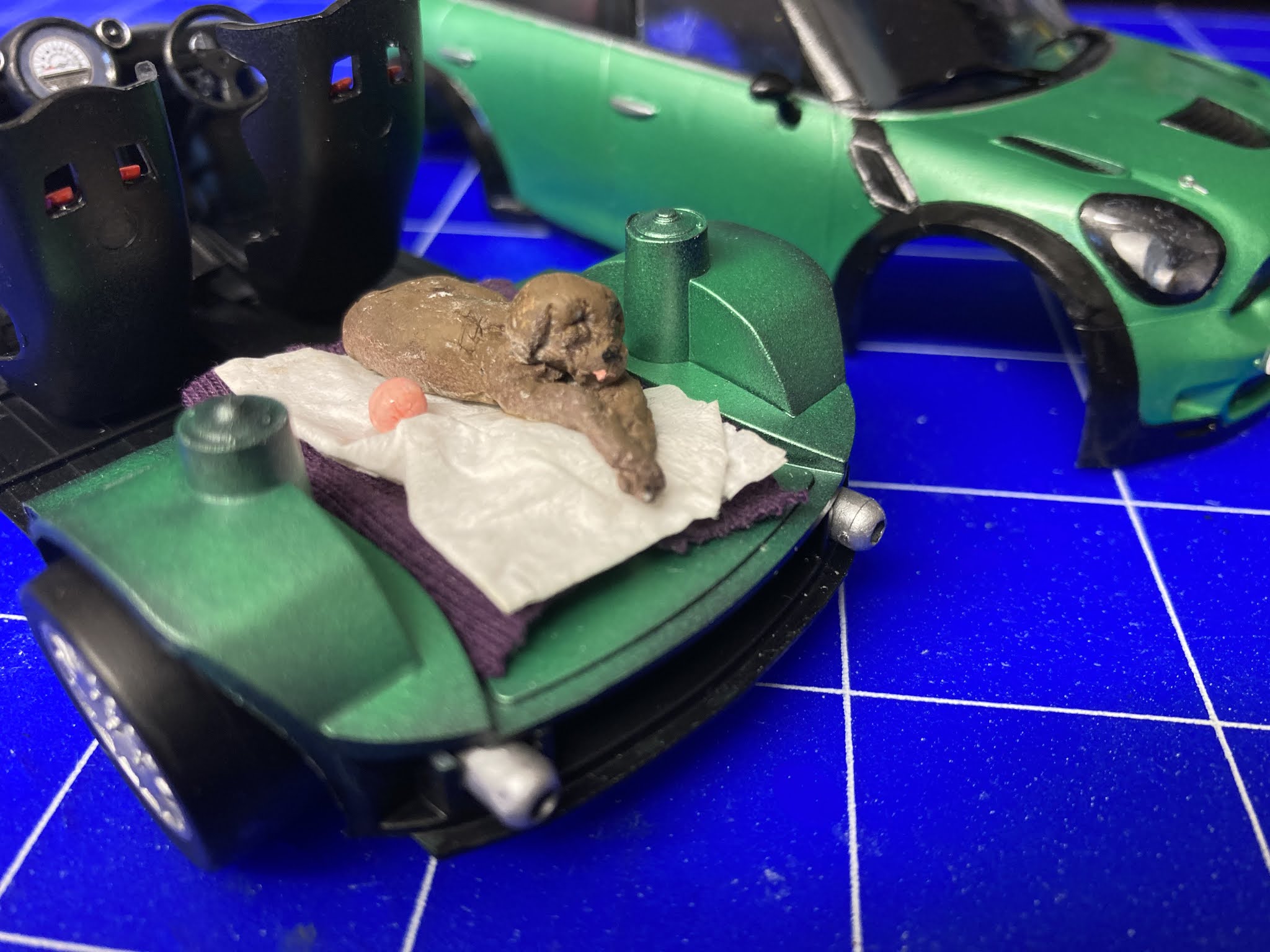
One reason why my Mum likes the idea of the Countryman, is because there is a better chance of her dog getting in the back than in, for example, the Cooper S. Bearing in mind that her current vehicle is a large estate car, it is fortunate that the Countryman WRC Mini comes with its rear seats removed, to both save weight and accommodate a large spare wheel! By not using the spare wheel nor fitting the roll cage, I found just enough room for a blu tac crafted dog!

This then just left a final coat of varnish and a set of personalised number-plates to finish the build. My only hope now is that it survives being parcelled up and Royal Mail handling to the other end of the country, as unfortunately lockdown restrictions will not be lifted in time for me to deliver it in person!


....


The Model

Brand: Airfix
Title: MINI Countryman WRC Starter Set
Number: A55304
Scale: 1:32
Type: Full kit
Released: 2013 | Rebox (Model set)


Thursday, 25 March 2021

Boeing AH-64 Apache

For Christmas, I received the gift of Tim Peake's autobiography 'Limitless'. As the subjects of my scale models are inspired by events and observations, it should be no surprise that this inspiring book has steered me to kick off a mini project focussing on 3 of vehicles which feature in the 3 phases of Tim's flying career. The Army Air Corps helicopter pilot, test pilot and astronaut. 

Tim Peake's Apache

In 1998, following his 4 year tour with the Army Air Corps flying the Gazelle helicopter, Tim was accepted on the Qualified Helicopter Instructors course at RAF Shawsbury in Shropshire. Here he converted to the Squirrel, the Eurocopter AS350 - not readily available in the 1:72 scale kit format - which had replaced the Gazelle as the military's basic training helicopter.

After a year teaching students the art of military flying, Tim was selected for a 3 year exchange posting to Fort Hoot, Texas, the home of the 1st US Cavalry Division, flying the fearsome Apache attack helicopter. While flying with the US Army, in 2001, Tim came close to being called in to action under Operation Enduring Freedom in Afghanistan, but at the last minute his squadron was stood down.

Highly sophisticated and technically demanding, the Apache appealed hugely to Tim’s thirst for new challenges. On his return to the UK, Tim was ideally placed to be part of a small team responsible for training the first British aircrews on how to fly and fight in this unique machine; transitioning the selected Army Air Corps pilots from a traditionally passive support role to an aggressor offensive role.

​Promoted to Major and with well over 2000 hours of flying experience, Tim was accepted onto the Empire Test Pilot’s School at Boscombe Down. He enrolled in evening classes to study mathematics and attained a Bachelor of Science degree in flight dynamics whilst also studying for his test pilot qualification. As a test pilot he undertook several high-risk trials on the Apache helicopter, taking the aircraft beyond limits previously flown and introducing over twenty urgently required modifications to support operations in Afghanistan. His role as a test pilot also saw him deploy to Afghanistan in support of Special Forces operations!

​After nearly 18 years of military service, Tim left the Army in 2009 to work as a senior test pilot for AgustaWestland (now Leonardo Helicopters). At the same time, having been surprised to see an online recruiting advertisement from the European Space Agency (ESA), he underwent a rigorous year-long astronaut selection with over 8000 other hopeful candidates. Previously, UK citizens had been unable to apply to become ESA astronauts and so Tim leapt at this once in a lifetime opportunity. 

The History of the Apache

The Boeing AH-64 Apache is an American twin-turboshaft attack helicopter with a tailwheel-type landing gear arrangement and a tandem cockpit for a crew of two. It features a nose-mounted sensor suite for target acquisition and night vision systems. It is armed with a 30 mm M230 chain gun carried between the main landing gear, under the aircraft's forward fuselage, and four hardpoints mounted on stub-wing pylons for carrying armament and stores, typically a mixture of AGM-114 Hellfire missiles and Hydra 70 rocket pods. 

The Apache was developed by Hughes Helicopters for the United States Army's Advanced Attack Helicopter program to replace the AH-1 Cobra and put onto full production in 1982. The AH-64 Apache was selected for British Army use, in favour of the French Eurocopter Tiger, in July 1995, and a contract for 67 helicopters was signed in 1996. Assembled by Westland at Yeovil, Somerset from Boeing-supplied kits, the AgustaWestland Apache AH-1 was fitted with a more powerful Rolls Royce engine and folding rota blades for ship launched operations. It entered service in January 2001 with Tim being one of the small team responsible for training the first British aircrews. 

The AH-1 played close air support roles with the British forces in both Afghanistan and Libya, where operations launched from the flight deck of HMS Ocean proved the value of the British modifications. 

The Italeri 1:72 Apache Model

​For my Tim Peake scale model, I chose Italeri's AH-64A Apache, the original version in service when Tim was flying with the 1st US Cavalry Division, and prior to the delivery of its replacement, the Apache Longbow, later to be used by the British Army and may be a kit for a future project! 

This was a simple, no frills build to which I added a couple of after market pilots. 

The final finish was also very straight forward; every millimetre of the helicopter is matt olive drab and the few decals more or less all black! 


Brand: Italeri
Title: AH-64 A Apache
Number: 159
Scale: 1:72
Type: Full kit
Released: 2005 | Rebox (Changed box only)


Monday, 15 March 2021

Westland Gazelle SA.341 / AH.1

For Christmas, I received the gift of Tim Peake's autobiography 'Limitless'. As the subjects of my scale models are inspired by events and observations, it should be no surprise that this inspiring book has steered me to kick off a mini project focussing on 3 of vehicles which feature in the 3 phases of Tim's flying career. The Army Air Corps helicopter pilot, test pilot and astronaut. 

Tim Peake's Gazelle

In 1993, at the age of 21, Tim's Army Pilot's Course began. Once he'd mastered the Chipmunk fixed wing training aircraft, it was onto the Gazelle helicopter, nicknamed the 'screaming chicken leg' on account of its shape and high-pitched, whining engine. 

After earning his wings, Tim signed up for 4 years of operational service. His first posting as a rotary wing pilot was at Gutersloh in Germany, with 1 Regimental Army Air Corps (AAC) 652 'Chosen Few' Squadron. Here, he learned to ski, parachute and witnessed the failing of the Gazelle's rota blade fixings causing them to be grounded for some time. Apart from routine flying, in the absence of a plane, he would also assist the ACC parachute team with their Friday practice, taking the doors off his Gazelle, removing one of the front seats and fly up to 10,000 feet and let them jump out!

With flying in Germany being a little too tame, in May 1995, Tim opted for a short flying tour in Northern Ireland. Working closely with the RUC and intelligence services, he flew the City Flight, providing overwatch for Belfast city. Having his Gazelle loaded with sights and sensors, attached to a stores boom, and additional armour protection, it was heavier than any he'd previously flown. There were also a couple of new flying manoeuvres to master. Being based at Palace Barracks in the city, necessitated the 'rapid descent landing', to avoid any chance of being shot down as he came in to land. This manoeuvre required him dropping the Gazelle from 3000 feet to the ground, reaching a downward speed of up to 130 mph! 


In the spring of 1996, now freshly promoted to captain, Tim was sent on a six-week detachment to Laikipia County, Kenya as flight commander of 652 Squadron's Gazelle flight. Here, his first duty of the day was to take off from his base at Nanyuki, shortly before dawn, to run Exercise Grand Prix. This involved herding elephants off the live firing range at Maple Farm, something which some of the elephants took unkindly to, with the large bull elephants coming close to swatting his helicopter from the sky! As well as flying casualty evacuation and VIP transportation, he also assisted a wildlife conservation team in darting rhinos for tagging purposes; very different flying action to the usual AAC operations. Following this, Tim deployed to Bosnia for Operation Resolute where he dodged AK47 small arms fire and finished his tour by flying the Gazelle the 2,000 km home to Wattisham, Suffolk!

In 1997, with his 4 year tour coming to an end, Tim took his Gazelle to Canada to take part in the BATUS (British Army Training Unit Suffield) military exercises, providing reconnaissance support and casualty evacuations. Following the exercise, he returned to his unit in Germany to complete his operational service, and then moved back to the UK to train as a Qualified Helicopter Instructor, a step closer to becoming a test pilot.

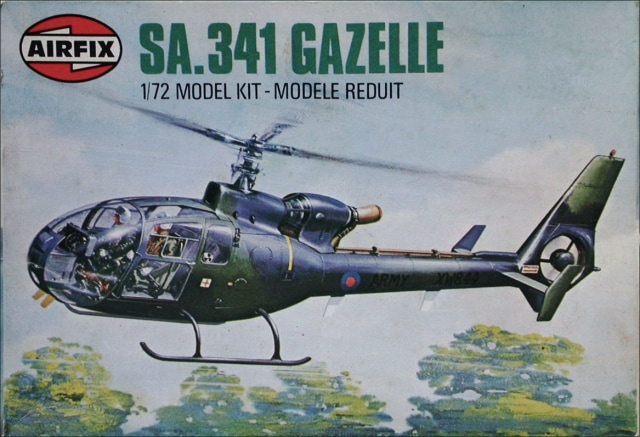
I have painted my Airfix 1:72 scale model of the SA.341 Gazelle in the grey / green camouflage of that Tim's helicopter would have been painted in during his 1995 City Flight and 1996 Kenya assignments. Prior to this, from the 1970s through to the 1982 Falklands War, it would have been seen in its earlier black / green scheme, as depicted on the kit's box and in the instructions. 

The 1980s decals were well past their best and the 1970s red, white & blue roundels unsuitable for this variant. I, therefore, had to dig into my extensive spares box for an unused set of XT131 Bell Sioux AH Mk1 'Army' label and 'XT131' serial number and a Sea Harrier's set of small roundels, all of which were just the right size.

The History of the Gazelle

The Westland Gazelle entered service with all branches of the British Armed Forces from 1973/4, with the SA.341B being especially equipped to a specification for the Army Air Corps as the Gazelle AH.1 (from Army Helicopter Mark 1).  It was designed by Sud Aviation, later Aérospatiale, and manufactured in France and the United Kingdom through a joint production agreement with Westland Aircraft. Originally based on a French Army requirement for a lightweight observation helicopter, it was enlarged to carry 2 crew and 3 passengers to enable greater versatility and make it more attractive for the export market. 

The type was also frequently used to perform airborne patrols in Northern Ireland. On 17 February 1978, a British Army Gazelle crashed near Jonesborough, County Armagh, after coming under fire from the Provisional IRA during a ground skirmish.

During the Falklands War, the RNAS Gazelles operated from the flight decks of Royal Navy ships where they were fitted with 68mm SNEB rocket pods and various other optional equipment such as armour plating, flotation gear and folding blade mechanisms. Two Royal Marines Gazelles were shot down on the first day of the landings at San Carlos Water. In a high-profile incident of friendly fire on 6 June 1982, an Army Air Corps Gazelle was also mistaken for a low-flying Argentine C-130 Hercules and was shot down by HMS Cardiff', a British Type 42 destroyer.

The Gazelle was operated in reconnaissance and liaison roles during the 2007 War in Afghanistan where it was reported that, while many British helicopters had struggled with the conditions of the Afghan and Iraqi theatres, the Gazelle was the "best performing model" with roughly 80% being available for planned operations. Gazelles have also served in other theatres, such as the 1991 Gulf War against Iraq and in the 1999 intervention in Kosovo. 

In 2009, the Army Air Corps was the sole operator of the Gazelle with approximately 40 in service with the expectation they be decommissioned in 2012. However, in July 2016, the Ministry of Defence announced that the Gazelle would remain in service until 2025 taking the Gazelle past its 50th anniversary in UK military service and making it the oldest helicopter in active UK inventory.

----


The Model

Brand: Airfix
Title: SA.341 Gazelle
Number: 9-61059
Scale: 1:72
Released: 1981 | Rebox (Changed box only)


Thursday, 4 March 2021

Mini Cooper S

My second Airfix Mini model build is another look back to a car I used to own in my youth!

This time it’s a modern Mini Cooper S dressed up as my 1983 Mini 850. You can see how it came to be that in 1989 I finally went rallying!

This Mini was an EU import, with a kmph speedometer which gave unbeknown passengers a feel of what it would have been like to ride in a real Cooper S!

My 1983 Mini 850 and the young pretender

In 1983, as an avid follower of the World Rally Championship, it was not long before I added a bit of rally art to the car. Following in the footsteps of Herbie (the VW Beetle) I first looked our a set numbers for the doors; but what numbers? For some reason, which now escapes me, I chose the year of its elevation to rally car, or to be exact, the number '83'. I also remember taking my mim's Fiat Panda on a 300 mile round trip to Mini Sport Ltd in Padiham, Lancashire, to buy, of all things, a roll cage! Fitting that was no easy task, but it did set me up for when I repeated the operation, some six years later, to rally prepare my Mini 1275 GT!

Modern Airfix recreations of my Minis

After building the Airfix Mini Countryman WRC model kit last week, I was inspired to attempt building the smaller Mini Cooper S as my little Mini 850. Ironically, while the Countryman was moulded in white plastic, which I had to make yellow, the Cooper S was moulded in yellow and needed it to be white! I must say that turning white to yellow is much easier than the reverse!

I didn't quite stick to the painting instructions!

I raised my stash of RAF decals for the numbers. They are not really a perfect match for the ones I fitted to the full size mini in 1983, but close enough. I cut individual miniature letters and numbers out for the number plate and hand painted two black lines over the bonnet and roof. Any imperfections are intended, as on the full sized car, these were applied from a roll of insulation tape, so very home made!

I'm happy with memories rekindled but think I'll stick to military vehicles from now on

While I was happy building these cars and with the memories they rekindled, I was disappointed not to be able to get close to the show room finish I wanted. So, I think I'll stick to military vehicles from now on, where a matt finish and the addition of a bit of grime and weathering can hide a multitude of sins!


BLOGGER IS DEAD LONG LIVE FACEBOOK & INSTAGRAM

It's been a blast Blogger, but not being able to upload any photos of my builds to this blog really makes you meaningless going forward....