Tuesday, 15 December 2020

FV101 Scorpion CVR(T)

The FV101 Scorpion CVR(T), Combat Vehicle Reconnaissance (Tracked), manufactured by Alvis in Coventry, was introduced into service in 1972 and served with the British Army and RAF Regiment until 1994. It saw combat during both the 1982 Falklands War, the Gulf War of 1991, and the Battle for the Fireplace, under the command of my flock headed Action Man when Palitoy released their Action Man Scorpion Tank into the hands of this very excited schoolboy in 1972!

Although weighing in at 8-tonnes, the Scorpion was designed to be amphibious, with flotation screen deployed, to operate in boggy conditions, and to be easily shipped by air, with two Scorpions being able to be carried in a C-130 Hercules transport aircraft. As a light tank, the Scorpion entered service modestly armed, with a 76mm main gun, 7.62mm machine gun and six smoke grenade dischargers in the turret. Fitted with a Jaguar 4.2-litre petrol engine, it had a maximum speed of 50 miles per hour on land and close to 4 mph on water!

Driver in the front, recruited from a set of NATO troops

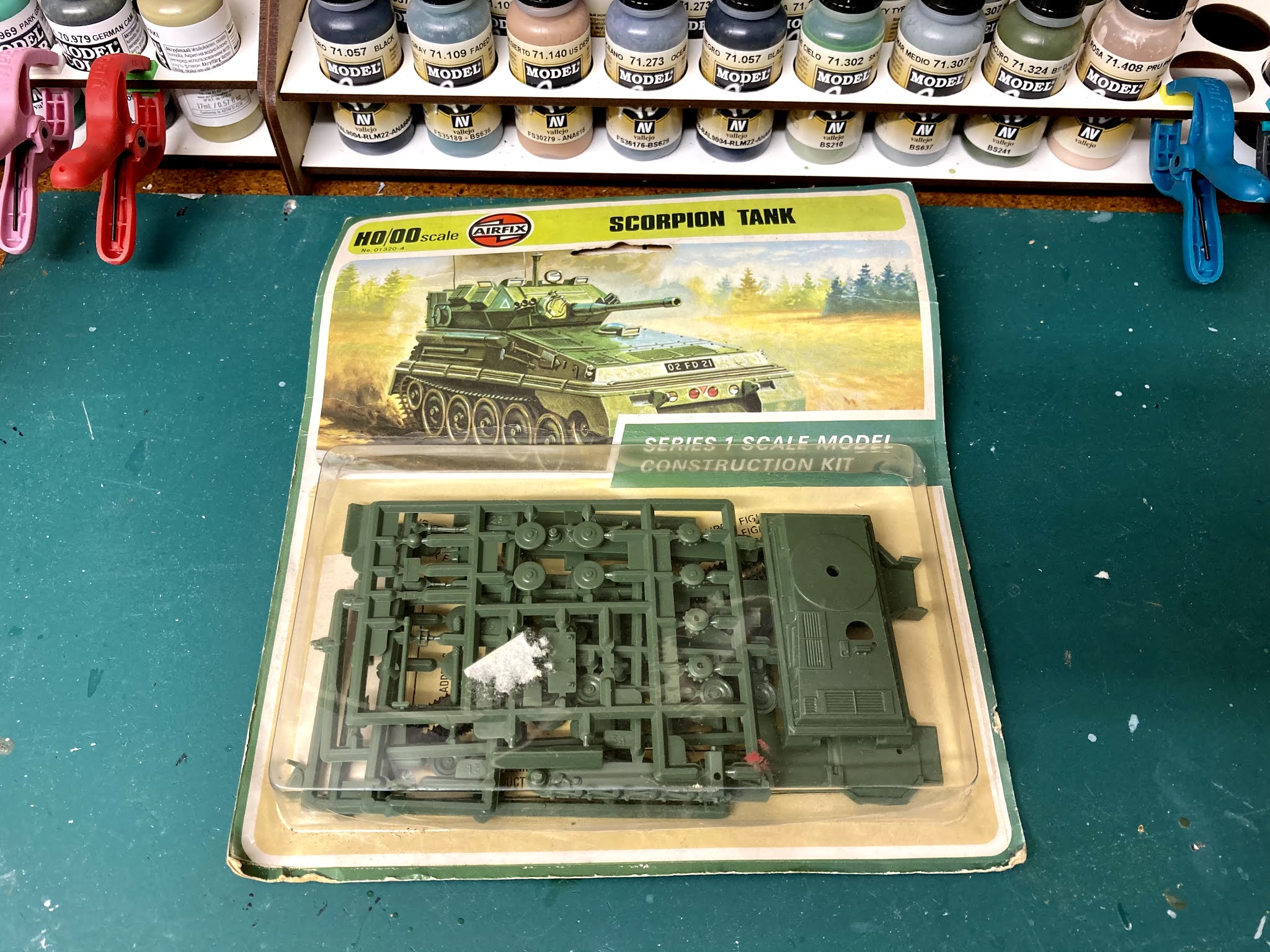
The kit I managed to procure for this build was actually the original 1975 Airfix kit and thus the very one I could have made as a mini-me to my Action Man's Palitoy version! In spite of its age, small scale and minimal number of parts, it is surprisingly well detailed and of a better fit to many of a much younger age. I fitted a driver in the front, recruited from a set of NATO troops and left the gunner's hatch in the turret open and vacant to fit with a Port Stanley diorama I have planned to share towards the end of this project ... so watch this space.

The source model is the original Airfix kit from in 1975

Two troops (3 and 4) from B Squadron, The Blues and Royals, travelled with 9 CVR(T) vehicles 4 Scorpions, 4 Scimitars (basically a Scorpion with a 30mm gun) and a single Samson (a Scorpion with a vehicle recovery hook in place of its turret) aboard the requisitioned Truck Ferry, M/V Elk, while crews embarked on the SS Canberra. After engaging in range practice on Ascension Island, the Scorpions and accompanying CVR(T)s were loaded aboard HMS Fearless in readiness for the amphibious landing at San Carlos Bay on 21-May.

After the initial landing had taken place the beachhead was first enlarged in preparation for the move on Stanley. During this time the Scorpions and Scimitars provided perimeter security from dug-in positions and with the loss of the Atlantic Conveyor, even assisted the then limited helicopter force as logistics carriers, shuttling stores from one place to another. 

Argentine Panhard and British Scorpion side by side on the modelling mat 

In a terrain which prevented the the 90mm, much larger gunned, Argentine Panhard AML-90 armoured cars from even leaving Port Stanley, the Scorpion was to ably support British ground forces in a number of operations, including 

* 5 Commando in their move along the northern route to attack Two Sisters 11-12 June
* 3 Para in their move to Teal Inlet and the taking of Mount Longdon 11-12 June
* 2 Para in the Battle of Wireless Ridge 13-14 June
* Scots Guards during the Battle of Mount Tumbledown 13–14 June 


Two techniques used by the British employing the CVRs proved very successful. The first involved a diversionary attack on the night of 12 June. In the attack, the Scots Guards employed 4 Troop in a reconnaissance role and then a direct fire role in support of the diversionary assault. The impact of the use of the CVRs was instrumental deceiving the enemy. The other technique employed by the CVRs was known as “zapping”: …the CVR crew would engage the Argentine position with a brief burst of 7.62mm machine gun fire provoking a response, which was promptly silenced by either the Scorpion’s 76mm or Simitar’s 30mm main gun, firing HESH (High-explosive squash head rounds). It is said that few Argentines felt able to reply after being zapped!

--------

The model


Brand: Airfix
Title: Scorpion Tank
Number: 01320-4 (Also listed as 02312-6)
Scale: 1:76
Released: 1975 | Initial release - new tool


Wednesday, 9 December 2020

IAI Nesher FAA Dagger

I had intended to build the Mirage III at this point in my Falklands War scale modelling project but coming across the seemingly interchangeable name of Dagger used in write-ups of this time, I had to investigate further. The Dagger, I discovered, was actually the much more numerous (30:17) Israeli Nesher. The IAI (Israel Aircraft Industries) Nesher was the IAF (Israeli Air Force) version of the French Dassault Mirage 5 multirole fighter. Build from plans acquired from Dassault, before a French arms embargo severed the partnership with IAI to design the Mirage 5, it was fitted with Israeli avionics, a Martin-Baker ejection seat and the Israeli Shafrir heat-seeking missile. Between 1978 and 1980, following the retirement of the Nesher from IAF service, 39 remaining Israeli aircraft were refurbished and exported to the FAA (Argentine Air Force) who then operated it under the new name, Dagger. 

PM Model IAI Nesher in the colours of FAA Dagger based at Rio Grande, June 1982

During the 1982 Falklands War, supported on the ground by IAI technicians, Daggers were deployed to the southern naval airbase of Río Grande, Tierra del Fuego, and an airfield in Puerto San Julián. Despite the lack of an aerial refuelling capability and the considerable distance to their targets, which gave them only 5 minutes combat time over the Falklands, the Dagger conducted 153 sorties against both ground and naval targets over the 45 days of combat operations. The primary role of the Dagger and Mirage III was to protect the Douglas A-4 Skyhawk strike force from the patrolling SHAR (British Sea Harriers). This was achieved by deploying at high altitude, drawing the SHAR away from the strike force and then, using their superior speed, out run the pursuers to return to the safety of their base on the Argentine mainland.

Dagger C-432 stationed at San Julián, now on display at the Museo Nacional de Aeronáutica, Argentina

Armed with 2 French 30mm DEFA cannon and British built 500 and 1000 lb bombs, the Dagger was also free, in the absence of any covering SHAR, to engage the British Task Force. Between 1st and 21st May, HMS Arrow, Antrim, Brilliant and Broadsword were all attacked and damaged with cannon fire. On 21 May and 8th June two British ships, HMS Ardent and then HMS Plymouth, received direct hits with bombs, and although damage was sustained, outright destruction was avoided as the bombs failed to explode. This was due to them being dropped too low for their arming mechanisms to have sufficient time in the air to trigger. 

This was not, however, totally risk free for the Daggers. During the 45 days of combat operations and 153 sorties, eleven, a third of the Dagger complement, were to be lost in combat; nine to the SHAR AIM-9L Sidewinder, one to HMS Broadsword's Sea Wolf missile and the other to a Rapier surface to air missile over San Carlos Water. 

PM Model's 1:72 Scale Model Kit of the IAI Nesher in the colours of the FAA Dagger 

My IAI Nesher 1:72 scale model kit, from the lesser known Turkish company PM Model, was probably one of the simplest and least detailed builds I've encountered. Rather than completing it in the IAF colours provided, I used a set of Xtradecal Falklands War decals for the Argentine FAA Dagger C-401 as flown by Lt Jorge Ratti. Using my new found Blu Tack skills in applying camouflage, I had a couple of attempts in producing the various shades of green and brown as used at this time, trying also not to over paint the unusual yellow markings on wing and tail.

Capt Carlos ‘Castor’ Rohde in C-415

The combat 'highlight' for FAA Dagger C-401, was the part it played in the last major air battle of the conflict: the attack on the Royal Navy's Rothesay-class frigate HMS Plymouth, in Falkland Sound and the strike by A4 Skyhawks on the landing ships at Fitzroy Cove, during 8 June 1982. HMS Plymouth had not been the intended target, the original mission being a combined Dagger/ Skyhawk strike to neutralise the British amphibious landings on East Falkland. 

Five Grupo 6 Daggers, lead by Capt Carlos ‘Castor’ Rohde (C-415) with his wingmen, Lt José Gabari Zocco (C-417) and Lt Jorge Ratti (C-401), and Capt Amílcar ‘Mastin’ Cimatti (C-435) and Maj Carlos ‘Napo’ Martínez (C-418) tucked in behind, flew in a five pointed star formation up the western edge of Falkland Sound, in support of 5 Skyhawks. Their target were the LSLs (Landing Ship Logistics) offloading troops and supplies in Fitzroy Cove. 

FAA Dagger C-401 flown by Lt Jorge Ratti against HMS Plymouth

Out of his canopy to the left, Rohde spotted HMS Plymouth alone and exposed in the middle of the waterway. Leaving the LSLs to the Skyhawks, Rohde turned his 5 aircraft formation towards HMS Plymouth and, spreading out to attack in line-astern, the first three Daggers dived in to attack at wave-top height, with the second pair close behind. 

 HMS Plymouth and HMS Avenger in San Carlos Water

Responding to anti-aircraft fire from HMS Plymouth the Daggers opened up with their 30mm cannon as they commenced their bombing run. Releasing their ordinance as they flew fast and low, HMS Plymouth was hit, but there was no explosion. Holed in the hull and smokestack, a helicopter depth-charge was detonated causing fire. Internal flooding from the breaches made by the unexploded bombs forced a six-degree list to the ship as it manoeuvred in search of safety in to San Carlos Water. HMS Avenger, a Type 21 frigate, quickly came to its aid and assisted in extinguishing the fire. 

In response to HMS Plymouth’s initial air raid warning, HMS Exeter vectored 801 NAS’s SHAR cover over the LSLs in Fitzroy towards San Carlos Strait. While the SHARs were in a futile hot pursuit of the five fleeing Daggers, the Skyhawks launched their attack on the two now undefended LSLs, Sir Galahad and Sir Tristram, in Fitzroy Cove. Sir Galahad was hit by two or three bombs and set alight. Sir Tristram was hit by a 500 lb bomb which penetrated the deck, but failed to explode immediately. The crew were able to be evacuated before the bomb later exploded and Sir Tristram was left abandoned.

HMS Plymouth, meanwhile, was patched up and returned to shore bombardment duties on 14 June, in time to see the Argentine forces in the Falklands finally surrender.

------

The model 

Brand:       PM Model
Title:          IAI Nesher
Number:    PM-222
Scale:        1:72
Released:  2019 | Rebox (Changed decals)

Thursday, 3 December 2020

FMA IA 58 Pucará

This week’s Falklands War build is the Airfix 1:76 scale model of the FMA IA 58 Pucará (or the Fortress). 

The Pucará was the Argentine’s ground-attack and counter-insurgency (COIN) aircraft manufactured by the Fábrica Militar de Aviones. It entered service in May 1975 with the Argentine Air Force (Fuerza Aérea Argentina, FAA) and had its operational debut late in 1975 when a number of Pucará carried out counter-insurgency strikes as part of Operativo Independencia, the first large-scale military operation of the Dirty War against the People's Revolutionary Army (ERP), a guerrilla group which tried to create a Vietnam-style war in the northwestern province. 

With its twin-turboprops, the Pucará was designed to operate from short, rough airstrips, making ione of the few Argentine aircraft capable of flying from the small airfields in the Falklands, the runway at Port Stanley Airport being too short for the navy's Super Étendard and FAA Skyhawks and Mirages to be deployed, especially after being bombed by Vulcan 607! 

During April 1982, 12 Pucará were shipped to the Falklands for use in a reconnaissance and light-attack role, operating from Port Stanley airport and the two small grass improvised airfields at Goose Green and Pebble Island. 

FMA IA 58 Pucará A-522

The Pucará's fixed armament was comparable with aircraft of the WWII era, and directly comparable with the cannon and machine gun arrangement on the Messerschmitt Bf 110. It consisted of two Hispano 804 20 mm cannons mounted under the cockpit with 270 rounds each and four 7.62 mm Browning FN machine guns mounted on the sides of the fuselage with 900 rounds each. 

Although these aircraft had little success against British ground forces, it was a real threat to the British helicopters. In Harry Benson's excellent book Scram!, about life as a helicopter pilot during Falklands War, one gets a first hand account of what it was like to have to 'scram!' at the first sign of a Pucará attack aircraft.  This threat was to be realised when, on 28th May, a Pucará shot down and killed the pilot of the Scout helicopter, Lieutenant Richard James Nunn, en route to recover the wounded Commanding Officer 2 PARA, Lieutenant-Colonel Herbert 'H' Jones VC,  during the battle for Goose Green. This was to be the only British air to air combat loss to the Argentines during the conflict.

My scale model is of Pucará A-522 which was delivered to the Argentinean Air Force Grupo 3 de Ataque (3GA) at Port Stanley airfield on or around 15th May 1982, as a replacement for aircraft lost earlier in the conflict. On the surrender of the Argentine forces, A-522 was found at Port Stanley airport in a relatively undamaged state. It was airlifted by Chinook onto the Contender Bezant in Port William and brought to the Fleet Air Arm Museum, Yeovilton, Somerset. It can now be seen on display at the North East Land, Sea & Air Museums (NELSAM), Sunderland, Tyne & Wear. 

Update: I've not managed to get to Tyne & Wear to see A-522, however, in April 2023 I did get across to the Norfolk and Suffolk Aviation Museum where they have Pucará A-528 on display and looking rather good in its unusual camouflage some 40 years later!

Pucará A-528 on display at the Norfolk & Suffolk Aviation Museum April 2023

Pucará A-528, also with 3GA, was flown to Stanley Airport in the first week of April 1982, then to Goose Green on 29 April and then for some reason back to Stanley a week or so later, where it was found on the Argentine surrender in June. Although, post 14 June, it was found to be still standing on its undercarriage it had broken propeller blades, nose damage and shrapnel cuts below the cockpit area.

It was airlifted on 6 September 1982 by Chinook to the ship Contender Bezant and arrived back in Southampton on 23 September. From here it was to be displayed at several exhibitions including the Boat Show and the Cosford RAF Museum before being transferred to the Army Museum at Middle Wallop in 1985. When it arrived at the Norfolk & Suffolk Aviation Museum I do not know, but it is certainly there in 2023. Interestingly there is now visible damage to the port engine as it sags forward. The volunteer on duty suggested the aircraft had been dropped either in its loading or unloading from the Contender Bezant back in 1982, though I can fond no further reference to this.


Unnumbered sprue & unintelligible plans made for an interesting build!

With unnumbered sprue, unintelligible plans, poor moulding and misprinted decals, this kit it was so far from what one expects from Airfix that it's hard to believe they would put their name to it. Looking further into its history, I believe Airfix may have acquired it from Special Hobby Models, as their 2003 kit and instructions look identical, albeit it Special Hobby Models' decals look better! 

The colour scheme of the Pucará is noticeably different to the camouflage we are more familiar seeing on European aircraft, and I had to dig through the sea greys, earth browns and dark greens, to the bottom of my paint box, to find something which would come close to the pale green and yellow sand used on the original aircraft. I also attempted, for the first time, to use Blu Tack (the white kind as it contains, apparently, less oil) to mask out the required camouflage pattern. I first applied the sky blue to the underside, masked this with tape and then covered the upper surface with the pale green. In my excitement, I forgot to add the pre shading of darker primer, so will have to make a note to self not to get so carried away next time! 

My first attempt at using Blu Tack masking 

Once the green had been given a chance to dry, I moulded the Blu Tack over the areas which were to remain green and then sprayed over the gaps with the sand colour. After another drying period, and feeling like a plastic surgeon about to remove the bandages from his patient, it was time to remove the Blu Tack. I was quite happy with the final result, although disappointed to have lost the shading through my omission to even apply it before the green!

Blu Tack removed

Ignoring past experience and my better judgement, I did attempt a bit of weathering using some Humbrol weathering oils with mixed results and found, in my spares box, a set of Argentine FAA decals to replace the awful Airfix versions. The varnish layers were applied using Johnsons Floor Shine which has, amazingly, become my goto source of gloss varnish.

Weathering and after market decals added

My final comment on the kit, is that one of the key building instructions was to place an 8g weight in the nose to ensure it sat correctly on its front wheel when completed. This is not an unusual requirement but having weighed out the ballast it became very clear that there was absolutely no space to place any weights in the nose! I had to, therefore, reluctantly ignore this instruction, knowing full well that this would mean I’d never be able to easily display it. Indeed, to take the picture of the aircraft outside the hanger, above, I had to superglue its front wheel to the runway! 

------


The Model

Brand: Airfix
Title: F.M.A. IA 58A Pucara
Number: A03068
Scale: 1:72
Released: 2008 | Rebox (Updated/New parts)

Thursday, 26 November 2020

Dassault-Breguet Super Étendard

My Falklands War scale modelling project , which, be warned, is likely to last as long as the 1982 campaign itself, now focuses on the military inventory of the Argentines. 

This week’s build, is of the aircraft which carried the infamous anti-ship Exocet missile, the Dassault-Breguet Super Étendard.

In 1979, the Argentine Navy placed an order to buy fourteen of France's new carrier-borne strike fighter aircraft, the Dassault-Breguet Super Étendard (French for battle flag). Between August and November 1981, Argentina took delivery of the first five aircraft, each supplied with a single anti-ship sea-skimming Exocet missile. 

In December, General Leopoldo Galtieri, with the support of Admiral Jorge Anaya, head of the Argentine Navy, seized the Presidency of Argentina. Just four months later, on 2 April, the now President Galtieri ordered the invasion the Falkland Islands. Galtieri's seemingly hasty action was driven, both by an urgent need to improve his downward spiralling popularity at home and in 'payment' to Admiral Anaya, for his earlier support in his presidential coup; the invasion proposal being one put forward by Anaya. Galtieri's expectation was that the anti colonial opinion of the international community would be behind him, and as an ally in their El Salvador operations, the United States would be firmly on his side. He also believed that the British would be powerless to intervene particularly in the face of the upcoming winter. On 5 April, however, the British government dispatched its largest naval task force since the Second World War with the order to retake the islands.

The Falklands had only three airfields. The longest and only paved runway was at the capital, Stanley, and even that was too short to support fast jets (although an arrestor gear was fitted in April to support Skyhawks). The Argentines had no option therefore, but to launch their Super Étendard from the mainland, severely hampering their efforts at forward staging, combat air patrols, and close air support over the islands.

Lt Mayora and Cpt Bedacarratz exchange notes after sinking HMS Sheffield

Four Super Étendards of the Second naval fighters strike squadron (2da Escuadrilla Aeronaval de Caza y Ataque EA32), armed with their Exocet anti-ship missiles, were stationed at the Río Grande, Tierra del Fuego naval air base. The threat posed to the British Task Force as it lay off the shores of The Falkland Islands led to the planning of the Mikado and Black Buck Operations. Operation Mikado was the proposed covert mission, led by a Sea King helicopter carrying SAS troops, to destroy the Super Étendards, and Operation Black Buck, was the long range Vulcan bombing mission against Port Stanley's paved runway; the objective being to make it unsafe, even if extended, for fast jets to land there.


Badge of the Second naval fighters strike squadron, 
nicknamed La Lora (female parrot)

The Super Étendards' first attempt to attack the British Task Force with was made on 2 May 1982, but this had to be abandoned due to in-flight-refuelling problems. A couple of day's later, on 4th May, the second attempt resulted in two Super Étendards, flown by Lt Mayora in 3-A-203 and Cpt Bedacarratz in 3-A-202. Mayora and Bedacarratz both released their missiles from about 12 miles out, then banked sharply for home. One missile fell harmlessly into the sea but the other hit the British destroyer, HMS Sheffield, amidships. Although the warhead failed to explode, the impact and resulting fire inflicted mortal damage on the ship and twenty of her crew. 

The infamous anti-ship sea-skimming Exocet missile 

On 25 May, the Argentines launched another attack. 3-A-203 was again one of the aircraft, this time flown by Cpt Curilovic, and Lt Barraza was flying 3-A-204. The primary targets for this mission were the two British aircraft carriers, HMS Hermes and HMS Invincible. Forty miles northwest of the lead carrier, HMS Hermes, the Super Étendards popped up and swept the ships with their radar. Picking the first target they saw, 20 miles from the ships, Curilovic and Barraza launched their missiles, then veered away, outrunning the Sea Harrier which was providing combat air patrol (CAP). The ships launched chaff and turned to bring their anti missile weaponry to bear on the Exocets. One of the missiles fell into the sea, the chaff having confused its targeting systems. The other flew past the carriers until its small internal radar found the Atlantic Conveyor. The missile drove well into its hull before exploding, igniting tons of fuel. Abandoned and left to burn, the transport ship sank several days later, taking with her the helicopters and other supplies that had been intended for the ground war just beginning.

Cpt Curilovic and Lt Barraza prepare for their mission against the British aircraft carriers

On May 30, two Super Étendards, flown by Cpt Francisco and Lt Collavino (3-A-202 & 3-A-205), Collavino carrying Argentina's last remaining Exocet, were joined by four Air Force A-4C Skyhawks of Grupo IV for an attack on carrier HMS Invincible. Two of the Skyhawks were shot down by Sea Dart missiles from HMS Exeter during their final approach, and while they were following the wake of the Exocet missile. 

With the European Economic Community, and thus France, having placed an embargo on fulfilling the Argentine order for their remaining nine Exocet missiles, Argentina looked to other markets to acquire the weapon, but it was fortunate for the British, that their search was in vein and the Super Étendards were to take no further part in the war, fortunate for the British, that only five AM.39 Excites had been delivered to Argentina.

Once the conflict was over, the rest of the Super Étendards shipment was delivered, however, Super Etendard 3-A-203 was lost in a fatal crash on 29 May 1996 while attempting to land on Punta Indio airstrip, in Northern Argentina.

This model of the Super Étendards is the 1984 Heller kit reboxed and distributed by Airfix in 1990. Now being a somewhat rare kit to acquire, I ironically purchased it second hand in September 2021 from Oxfam's online store for £20.00! Hannants after market Argentinian decals were then used to complete the build as aircraft 0753 which in March 1982 was with 2 Escadrille as '3-A-203'. Deployed to Rio Grande from Espora between 19-20 April 1982, it was used on the missions of 4 May and 25 May 1982 and subsequently marked with silhouettes to show the losses of HMS Sheffield and Atlantic Conveyor.

----------

The model

Brand: Airfix
Title: Super Etendard
Number: 03060
Scale: 1:72
Released: 1990 | Rebox (Changed box only)

Thursday, 19 November 2020

Westland Wessex HU.5 & HAS.3 - Operation Paraquet

I'm ending my current helicopter builds with a flurry of Westland Wessex Junglie and Pinger whirly birds. Last month, I posted how the rarity of the Wessex, in scale modelling form, had resulted in a very unsatisfactory build. Then, just a few weeks later, like busses, two turn up together in exactly the configuration I was originally looking for; such better quality ones too! My approach to constructing this pair was exactly the same as with my earlier Junglie and Pinger Sea King duo, but with so many lessons learned from that experience, I think enjoyed these more and must say that the Pledge Floor Gloss worked so much better than Vallejo's gloss varnish!

As it's been a good few weeks since my first Wessex build, here's a reminder of the helicopter's pedigree. It was the Westland Wessex that replaced the Westland Whirlwind, first being used by the Royal Navy, in the form of the anti-submarine Wessex HAS.1, in 1961. The HAS.3 was brought onto service in 1961, with improved avionics and radar equipment; the sound of which gave the anti-submarine force the nickname of Pingers. 

1964, saw the Wessex HAS.1, operating from bases in Sarawak and Sabah, assisting Army and Marine detachments fighting guerrilla forces in Malaysia. Having removed much of the anti-submarine equipment to lighten the aircraft, during the subsequent campaign in Borneo, the Wessex was typically operated as a transport helicopter, capable of ferrying up to 16 troops or a 4,000-pound payload of supplies directly to the front lines. It is from these operations the Commando Helicopter Force gets its nickname of the Junglies and the commando assault variant, the Wessex HU5, was developed.


Italeri, Wessex HAS.3, as Humphrey

Matchbox, Wessex HU.5, as Yankee Alpha

In 1982, around 55 Westland Wessex HU.5 and 2 HAS.3 participated in the Falklands War, and it is 3 Wessex helicopters from this conflict that my scale models have been based on. 

The models and their intended Falklands War identities are:

  • Ark Models' Wessex HAS.1 as the HU.5 Yankee Foxtrot flown by Lt Mike Tidd
  • Matchbox's Wessex HU.5, as Yankee Alpha flown by Lt Ian Georgeson
  • Italeri's Wessex HAS.3, as Humphrey flown by Lt Cdr Ian Stanley
These 3 helicopters were key players in the opening days of Operation Paraquet, the code name for the attempt to recover South Georgia from Argentine military control using SAS elite troops, one of the first British acts of the War.

I recount below, much of their story discovered in the pages of Harry Benson's excellent book Scram! This is thrilling first-hand account of what it was like to be a helicopter pilot during Falklands War; from dodging Pucara attack aircraft, to landing special forces behind enemy lines, as told from the seat of his Westland Wessex. 


Operation Paraquet was an SAS planned mission to take control of South Georgia by the most unlikely and unexpected route. Inserted by two Royal Navy commando Wessex helicopters, of 845 Squadron, onto the Fortuna Glacier, the largest tidewater glacier on South Georgia, the plan was for these troops to march across the mountains and take the unknown Argentine force at the Leith whaling station by surprise.

Against the strong advice of a scientist, from the British Antarctic Survey team, who had only recently been extracted from the island himself, 22 mountain troops of D Squadron SAS were landed on the glacier. Overnight, on 21/22 April 1982, and as the Antarctic expert warned, the weather was to "defy human reason". A violent storm, the wind gusting to 100 knots and producing squalls of driving snow, stopped the SAS in their tracks. With frostbite and exposure a real concern, the SAS troop commander, Captain John Hamilton, radioed for the helicopters to return and rescue them.

Lieutenant Commander Ian Stanley in Humphrey, the single engined Wessex 3, but the only Wessex equipped with radar, acted as pathfinder for the 2, radar-less twin-engine, troop-carrying, Wessex 5s. Stanley guided Lieutenant Mike Tidd in Yankee Foxtrot and Lieutenant Ian Georgeson, flying the second Wessex 5, Yankee Alpha, in a close formation up to the top of the glacier.

Although dressed in white Arctic clothing, after exposure to a night of sub-zero temperatures, gale force winds and driving snow, the SAS troops were already in varying stages of hypothermia. Yankee Foxtrot, with Tidd at the controls and with half the frozen soldiers safely loaded, was the first to pull up into the icy but clear sky, when, without warning, it was enveloped in a tidal wave of a snow shower. In an attempt to return to the landing zone, the tail and left wheel of the Wessex hit the snow at about thirty knots, bringing the aircraft crashing down on its left side and sliding it onwards for fifty yards. The left side of the cockpit filled up with debris and snow as the windows imploded. Tidd slid open the cockpit window and clambered up onto the side of the aircraft to help open the rear cabin door.

Tidd slid open the flimsy cockpit window and clambered up onto the side of the aircraft

The snow shower passed as suddenly as it had appeared and visibility improved once more. Out on the snow, the soldiers were divided between the two remaining helicopters. With ten people now crammed into the Wessex 3 and fourteen in the Wessex 5, the depleted formation rose to the hover once again. As Stanley navigated over the ridge of the glacier with the use of Humphrey's Wessex 3 radar, Georgeson in Yankee Alpha followed a few rotor lengths behind. Then, another ferocious snowstorm hit the formation just at the wrong moment, barely ten seconds after launch. As Humphrey dropped down over the ridge-line of the steeply descending glacier, Georgeson lost sight of it in the now near blizzard conditions. Yankee Alpha's starboard wheel caught in a hidden and small ice crevasse and the aircraft toppled over onto its side. While it was amazing that no one was severely injured, Yankee Alpha was not so lucky, the second and last troop carrying Wessex was out of action.

Out on the snow, the soldiers were divided between the two remaining helicopters

With no radio contact, an overloaded helicopter and appalling weather conditions, there was nothing Stanley could do but to return to HMS Antrim, the County-class destroyer from which they had launched two hours earlier. After Humphrey received a thorough safety check by the engineers, Stanley decided to have another go at rescuing the survivors. As if taking to the air in arctic conditions which would ground any peace time flight, with only one engine to support them, was not bad enough, Stanley also had the added problem of how to fit fourteen large passengers into Humphrey's tiny cabin, already full of radar equipment! During the earlier rescue flight, Humphrey's rear cabin had been cramped with just two crew and six passengers and would now have to find room for an additional eight! Even if they could somehow cram everyone in, the Wessex would be dangerously overloaded way beyond the design limits of the rotor gearbox and the capacity of the single engine. 

Stanley and Humphrey have another go at rescuing the survivors

Stanley radioed ahead for the ship to get onto a heading that gave maximum wind, and thus maximum lift, over the deck. His final approach was judged to perfection. The helicopter descended straight towards the deck unable to maintain the usual careful hover due to its excessive weight. The air speed indicator showed around sixty knots at the moment they touched down. A controlled crash would have been good enough. Instead it was as close to as smooth a landing as you could get! Against the odds, Humphrey had brought all helicopter crews and SAS troops safely home.

Ending the day with one failed mission by the SAS and two crashed helicopters, this near disaster on Fortuna Glacier was a worrying start to Britain’s campaign to reclaim South Georgia and the Falkland Islands. But for the astonishing skill of Lt Cdr Ian Stanley and his Wessex 3 crew, it could have been so much worse. 

Julian Thompson, Commander 3rd Commando Brigade in 1982, has an insightful and somewhat amusing thought in his forward to Scram! ... What the SAS thought they were doing up there is another matter, and my opinions on the matter are best left unsaid! 

Imperial War Museum’s copy of an original photo taken from Humphrey

On 25th April, with a sense of reality restored, a more traditional helicopter assault by Special Forces and Royal Marines, with two Royal Navy vessels (Antrim and Plymouth) conducting a naval bombardment, brought a successful conclusion to Operation Paraquet with the surrender of the island's two Argentine garrisons. And this was just the start .... !

--------------

The Models

 Brand:      Italeri
 Title:        Wessex HAS.3
 Number:  1258
 Scale:       1:72
 Released: 2007 | Rebox (Updated/New parts)

 Brand:      Matchbox
 Title:        Westland Wessex HU.5/HAS.31
 Number:   PK-133
 Scale:       1:72
 Released: 1987 | Initial release - new tool


  Brand: Ark Models
 Title: Westland Wessex HAS Mk.1/31 Anti-submarine helicopter
 Number: 72032
 Scale:      1:72
 Released:2009 (Originally 1963 Frog)


Thursday, 12 November 2020

Westland Sea King HC.4

When the Westland Sea King entered service with the Royal Navy in 1969, it was probably never envisaged they would be needing the HC.4, more commonly known as the Commando. Ten years later, following a request from the Egyptian Air Force for a Sea King without its amphibious configuration, there being little need of this in the desert, Westland came up with the Sea King Commando. In fulfilling the Egyptian Air Force's requirement, the Sea King’s side floats were removed and replaced with stub sponsons to carry the main undercarriage. With an operational range of up to 600 nautical miles, without refuelling, and seating for up to 28 fully equipped troops, the Commando was soon to be adopted by Royal Navy, in particular, by the Naval Air Squadrons (NAS) for troop transport and commando assault operations. The Royal Navy designated the Commando the HC.4 and used it in all major operations around the world; the Falklands, the Balkans, both Gulf Wars, Sierra Leone, Lebanon and Afghanistan. 

ZA314 / WT Giving a lift to some troops; note Paras not Marines in this instance 

I was inspired to build this HC.4, and the earlier HAS.2, to recognise the role they both played in Falklands War, and yet, when it came to adding the final decals, I followed the Airfix plans to the letter, depicting it as helicopter ZA314 / WT from 848 (Training) NAS, based at Yeovilton, Somerset in 2011. I've visited the Fleet Air Arm Museum on the Yeovilton base many times, and may even have been buzzed by ZA314 as I've walked the East Devon coast, where their helicopters are frequently seen and heard on their training flights. 

ZA314 was assigned to 848 (Training) NAS in 2007, from 845 squadron, having themselves received it from 846 NAS in 2000. ZA314 came into service in September 1982, and while too late to be used in the Falklands War, a number of personnel from 848 (Training) NAS, did get to serve in the Falklands; not, however, with the Sea King HC.4, but the Wessex HAS.3, and not with 848 NAS but with 847 NAS! 847 NAS was one of the squadrons urgently reformed to provide the additional anti-submarine capability required to protect the Taskforce from Argentine submarines. Coincidentally, I have a scale model of the Wessex HAS.3, all lined up for one of my next builds. 

Junglie door gunner in training

Factoid: since their operations in Borneo during the 1960s, the Commando Helicopter Force are affectionately known as the Junglies, while their siblings in the Anti-submarine Force, are known as the Pingers, this being the sound made by their submarine searching sonar

A must read book from the view of Junglie

During my research into the Falklands back story of Westland Commando, and before I went with the Airfix 2011 scheme for my HC.4 build, I came across a fascinating book, Special Forces Pilot: A Flying Memoir of the Falkland War by Richard Hutchings, published in 2009. 

Richard (Dick) Hutchings was a Commando helicopter pilot, awarded the DSC with 846 NAS during the Falklands War. In a very story telling style, he pulls back the covers on some very covert missions. These include the raid on Pebble Island, to destroy Pucara aircraft - the nemesis of the helicopter force - a mission which resinates with the iconic Special Air Service (SAS) desert raids on Axis bases during the Second World War, some 40 years earlier. He also describes the role the Junglies played in pioneering night flying, when a small number of the Commando pilots took delivery of the first ever night vision goggles, only released from development for Special Forces to use in covert operations against the Argentines. 

A few key Falklands War locations and dates

The most enlightening and final story of the book, was the reveal of hitherto undisclosed material relating to Operation Mikado. This was the ill-fated, Special Forces mission to destroy the Exocet carrying Super Étendard aircraft and their supply of missiles at Rio Grande airbase in Argentina. Dick shares his first hand experience of this incredulous and audacious mission, which, had it been successful, would have saved the British ships and crew of both HMS Sheffield and the Atlantic Conveyor from the devastating effects of this weapon. As it was, the story remained a secret for many years after the War. Indeed, it does not even get a mention in my usual goto Falklands War tome, Max Hasting's Battle for the Falklands. I assume, even though Max was an embedded reporter within the Taskforce, by publishing in his book in 1983, it was far too soon after the War for such secrets to be released. 

------------------------

The model:


Brand:       Airfix
Title:         Westland Sea King HC.4
Number:    A04056
Scale:        1:72
Type:         Full kit
Released:  2015 | Initial release - new tool

Tuesday, 3 November 2020

Westland Sea King HAS.2

The Westland Sea King entered service with the Royal Navy in 1969 to replace the Westland Wessex anti-submarine (HAS) helicopter. Over the past 40 years, the Sea King has operated in all the major military conflicts including: the Falklands War, the Gulf War, the Balkans conflict, the Iraq War and the Afghanistan War. 

My interest in building a scale model of the HAS.2 Sea King was inspired by a very good friend of mine, Mark, who was a technician with 824 NAS, working to keep the 2 helicopters of 'A' Flight in the air during the 1982 Falklands War. These helicopters were '50' (XV660) and '55' (XV649) and it is '55' that I selected for my build. I just hope I have done it justice.

Formed in April 1933, 824 squadron received their first helicopters in 1958 in the form of the Westland Whirlwind. In February 1970, 824 squadron became the first operational Sea King unit at Culdrose and in April 1982 they were called on to participate in Operation Corporate, the code name given to the British operations to retake the Falkland Islands and its territories, following the invasion by Argentine military forces. 

Sea King 55 HAS.2 XV649 of 'A' Flight 824 Squadron RNAS - "Where's Mark?!"

It was on 5 April 1982, that Mark, with fellow maintainers, aircrew, support personnel and the two Sea Kings of 'A' Flight, '50' & '55', sailed from Devonport to join up with the the Carrier Battle Group en route to Ascension Island, aboard RFA Olmeda, an Ol-class fast fleet tanker of the Royal Fleet Auxiliary. Three further Sea Kings accompanied 'C' Flight on RFA Fort Grange just over a month later. In all, around 35 HAS Sea Kings from 4 NAS Squadrons (820, 824, 825 and 826) served during the Falklands War. While some performed their intended role on anti-submarine patrols, others were stripped of their anti-submarine equipment and fitted with seats for the moving of troops and supplies between ships and out to the Islands. This latter role became even more critical to the success of the campaign after the loss of the MS Atlantic Conveyor, together with three of the four Chinooks it was carrying, rendered British forces with only one serviceable heavy lift helicopter.

In its anti-submarine role, 'A' Flight's Sea Kings were armed with torpedos, depth charges and machine guns. Once, like so many others, it was stripped of all non essential anti-submarine fixtures and fittings, it moved into load lifting, troop carrying and a multitude of other missions. During the landing of British Troops on East Falkland, the two helicopters, aircrew and maintainers were detached to San Carlos in support of ground operations. Following the surrender of all Argentine forces on the 15th June 1982, RFA Olmeda and 'A' Flight sailed to South Georgia with one helicopter '55', to embark 'M' Company of 42 Commando Royal Marines for transit to Thule Island, which was still under Argentine occupation. Operation Keyhole consisted of a small task group of RFA Olmeda, 824 'A' Flight', HMS Yarmouth, HMS Endurance, and MS Salvageman. After arriving off the shore of Thule Island on Sunday 20th June, Sea King '55' landed the Commandos and returned to RFA Olmeda with Argentine prisoners following their surrender without a shot being fired.

Squadron artwork hidden on the reverse of the crew's open door - "Where's Mark?!"

As for the scale model, in Part 1 of my Sea King story, you'll have learned that I selected the Airfix 1:72 scale Westland Sea King HAR.3 kit. I had read somewhere that a couple of Air Sea Rescue (HAR) helicopters had been converted to the Anti Submarine version at the time of the Falklands and so felt they would be a close enough match. They certainly had the wheel floats/sponsons and radar dome, but I had missed the erroneous inclusion of rear observation windows which, had I realised earlier, I'd have blanked out. Having decided to leave them in place, then required me to dip into my extensive spare decals collection to make up a smaller set of numbers for the '55', which would fit between the observation windows and the door! On a more positive note, and talking decals, I was very pleased to lay my hands on a very rare set of Modeldecal's 1979 produced 824 Squadron emblems. These were key for the build as they were the ones applied to the helicopter's nose during Operation Corporate. Ironically, I then went and hid the decals on the port side behind the crew's open door, but trust me, they are there!

Tail and main rotor blades folded back. Headphone cable makes for a good rope!

All the helicopters I've built so far have been completed in the 'ready for flight' mode, wheel down and rotor blades extended. So when I saw that this kit allowed me to build the Sea King in the 'ready for maintenance' or similar state, I don't know the official term, I just had to give it a go. This was of particular interest to me as I had it in mind to present the finished model in the same state that Mark may have seen when he worked on it, i.e.with tail and main rotor blades folded back. In photos, I've seen the rotor blades secured individually with cables to the body. On this occasion, I just had a go at securing the outside blades, with the others yet to be secured. I may return to these later.

Another use for iPhone headphones

Other modifications I made were to add a hand rail to the steps using wire from those ties you find supplied with plastic freezer bags, and, for the yellow exhaust covers, I cut up an old set of iPhone headphones. I found that a section from below the earbuds fitted the exhaust openings perfectly and the cable made for a good length of rope to secure the rotor blades! I also needed to change the box dust filter which came with the kit with the cover you see sitting above the cockpit, in front of the engines. Having no squadron transfers for this, I painted this on freehand, with the 'A' Flight letter added from my spare decals box.

A few modifications include: hand rail, rotor blade ties, plus exhaust and engine covers.

The figures added to the model were mostly taken from Italeri's NATO Pilots & Ground-crew and PJ Production's Air Sea Rescue sets. There is a pilot sitting in the right hand seat, and behind the left rear window there's a crew member sitting at a desk; although the effort in preparing and fixing them here now seems to have been somewhat wasted, as they are hardly visible. Some I had to alter slightly to fit the scenes, e.g. the pilot on the steps was originally resting his foot on a box and the shirtless figure, modelled on Mark, had his wrench swapped for an instrument panel. This panel was a not insignificant piece of the model's interior which I should have fixed to the cockpit ceiling, but only came across it, still sitting on my desk, after I had glued everything else together! I suppose, however, it makes for an amusing final photo caption!

"Ah! Mark ... I think you'll find that instrument panel is still needed!"


Images of the real Sea Kings

To assist me in my build, Mark shared some great photos of 'A' Flight's helicopters, which I have tried here to recreate. I hope you at least see some likeness. 

824 Squadron


RGA Olmeda onboard which 'A' Flight's Sea Kings sailed


Sea Kings '50' & '55' en route to the Falklands, notice the squadron emblems

'55's' sister Sea King, '50' coming into land, notice the emblem on the engine cover

Another of Sea King '50' .. I didn't realise I did not have a good shot of '55'

'A' Flight in action


'A' Flight detached to San Carlos in support of ground operations


Interesting observation in this last picture, is that for action on the Islands, the Sea Kings have changed the colour of their numbers from white to black and the squadron markings have also been painted out ... I feel the need for another build!  


A brief history of the real Sea King XV649

Sea King XV649, which I have attempted to recreate here as Sea King '55' 824 Squadron, was built in 1969 as an HAS.1 and was upgraded to an HAS.2 in 1978. This added a 6th rear rotor blade, a more powerful engine and improved navigation and communications equipment. It was in this configuration that it embarked on Operation Corporate. 

On its return from the Falkland Islands it underwent a further conversion to an Airborne Early Warning helicopter, the AEW.2A. A painful lesson learned during the conflict was Britain's lack of Airborne Early Warning aircraft and the Sea King took on the challenge to fill that gap. 

Finally, in 2002 XV649 underwent its final upgraded to an Airborne Surveillance and Control ASaC7 helicopter. In this new role of interception/attack control in the detection of low-flying attack aircraft, it went on to complete its military service in Afghanistan. Today, it has reportedly been demobbed and is stored at RNAS Gosport, Hampshire.

BLOGGER IS DEAD LONG LIVE FACEBOOK & INSTAGRAM

It's been a blast Blogger, but not being able to upload any photos of my builds to this blog really makes you meaningless going forward....